







Question: answer the two classroom discussion questions Article 1: OM in the News: Labor Shortages and the Automated Warehouse SEPTEMBER 25, 2021 by Barry Render The
answer the two classroom discussion questions 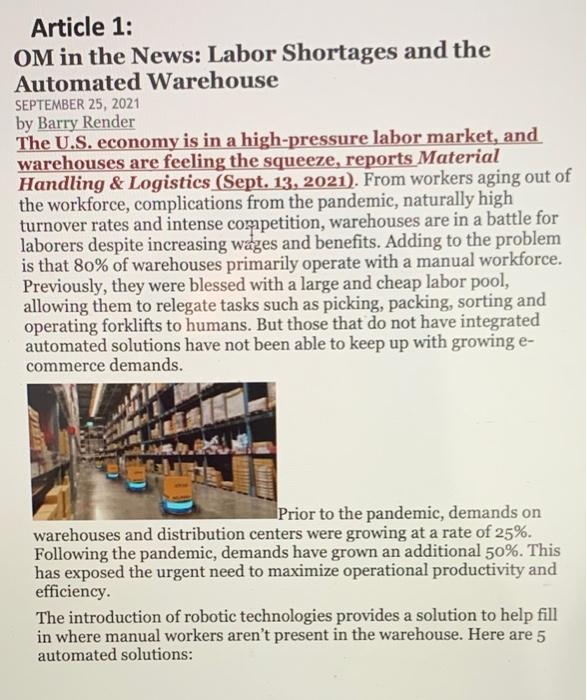
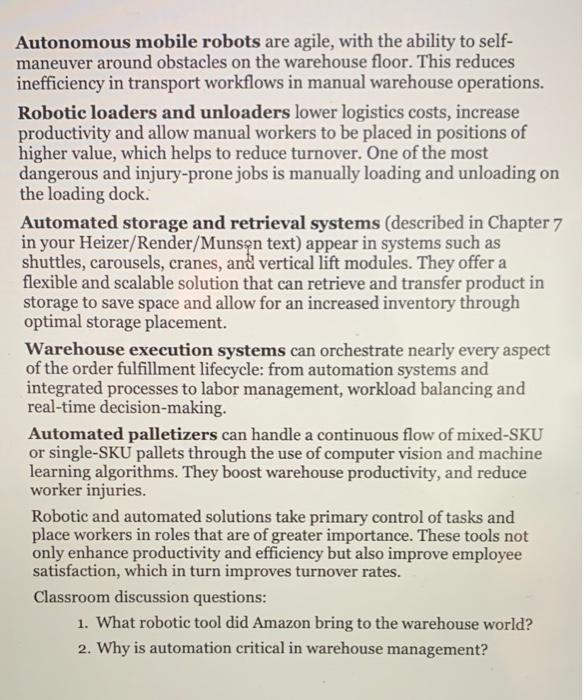
Article 1: OM in the News: Labor Shortages and the Automated Warehouse SEPTEMBER 25, 2021 by Barry Render The U.S. economy is in a high-pressure labor market, and warehouses are feeling the squeeze, reports Material Handling & Logistics (Sept. 13, 2021). From workers aging out of the workforce, complications from the pandemic, naturally high turnover rates and intense competition, warehouses are in a battle for laborers despite increasing wages and benefits. Adding to the problem is that 80% of warehouses primarily operate with a manual workforce. Previously, they were blessed with a large and cheap labor pool, allowing them to relegate tasks such as picking, packing, sorting and operating forklifts to humans. But those that do not have integrated automated solutions have not been able to keep up with growing e- commerce demands. Prior to the pandemic, demands on warehouses and distribution centers were growing at a rate of 25%. Following the pandemic, demands have grown an additional 50%. This has exposed the urgent need to maximize operational productivity and efficiency. The introduction of robotic technologies provides a solution to help fill in where manual workers aren't present in the warehouse. Here are 5 automated solutions: Autonomous mobile robots are agile, with the ability to self- maneuver around obstacles on the warehouse floor. This reduces inefficiency in transport workflows in manual warehouse operations. Robotic loaders and unloaders lower logistics costs, increase productivity and allow manual workers to be placed in positions of higher value, which helps to reduce turnover. One of the most dangerous and injury-prone jobs is manually loading and unloading on the loading dock Automated storage and retrieval systems (described in Chapter 7 in your Heizer/Render/Munson text) appear in systems such as shuttles, carousels, cranes, and vertical lift modules. They offer a flexible and scalable solution that can retrieve and transfer product in storage to save space and allow for an increased inventory through optimal storage placement. Warehouse execution systems can orchestrate nearly every aspect of the order fulfillment lifecycle: from automation systems and integrated processes to labor management, workload balancing and real-time decision-making. Automated palletizers can handle a continuous flow of mixed-SKU or single-SKU pallets through the use of computer vision and machine learning algorithms. They boost warehouse productivity, and reduce worker injuries. Robotic and automated solutions take primary control of tasks and place workers in roles that are of greater importance. These tools not only enhance productivity and efficiency but also improve employee satisfaction, which in turn improves turnover rates. Classroom discussion questions: 1. What robotic tool did Amazon bring to the warehouse world? 2. Why is automation critical in warehouse management
Step by Step Solution
There are 3 Steps involved in it
1 Expert Approved Answer
Step: 1 Unlock

Question Has Been Solved by an Expert!
Get step-by-step solutions from verified subject matter experts
Step: 2 Unlock
Step: 3 Unlock
 Study Help