Question: answer the two classroom discussions Article 1 OM in the News: Intel Speeds Up Its Chip Revival MARCH 29, 2021 tags: chip production, Intel, semiconduxtors
answer the two classroom discussions
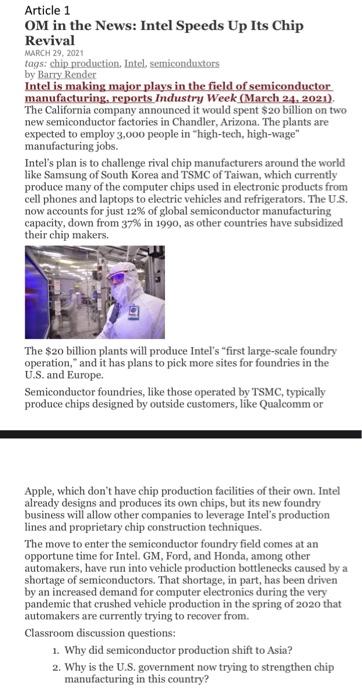
Article 1 OM in the News: Intel Speeds Up Its Chip Revival MARCH 29, 2021 tags: chip production, Intel, semiconduxtors by Barry Render Intel is making major plays in the field of semiconductor manufacturing, reports Industry Week (March 24, 2021) The California company announced it would spent $20 billion on two new semiconductor factories in Chandler, Arizona. The plants are expected to employ 3,000 people in "high-tech, high-wage" manufacturing jobs. Intel's plan is to challenge rival chip manufacturers around the world like Samsung of South Korea and TSMC of Taiwan, which currently produce many of the computer chips used in electronic products from cell phones and laptops to electric vehicles and refrigerators. The U.S. now accounts for just 12% of global semiconductor manufacturing capacity, down from 37% in 1990, as other countries have subsidized their chip makers. The $20 billion plants will produce Intel's "first large-scale foundry operation, and it has plans to pick more sites for foundries in the U.S. and Europe Semiconductor foundries, like those operated by TSMC, typically produce chips designed by outside customers, like Qualcomm or Apple, which don't have chip production facilities of their own. Intel already designs and produces its own chips, but its new foundry business will allow other companies to leverage Intel's production lines and proprietary chip construction techniques. The move to enter the semiconductor foundry field comes at an opportune time for Intel. GM, Ford, and Honda, among other automakers, have run into vehicle production bottlenecks caused by a shortage of semiconductors. That shortage, in part, has been driven by an increased demand for computer electronics during the very pandemic that crushed vehicle production in the spring of 2020 that automakers are currently trying to recover from. Classroom discussion questions: 1. Why did semiconductor production shift to Asia? 2. Why is the U.S. government now trying to strengthen chip manufacturing in this country









 Study Help