







Question: b) ( 6 pts) Experiments 4 through 9 contain sufficient information to determine the rate law of the catalyzed reaction. Note that when Cl atoms
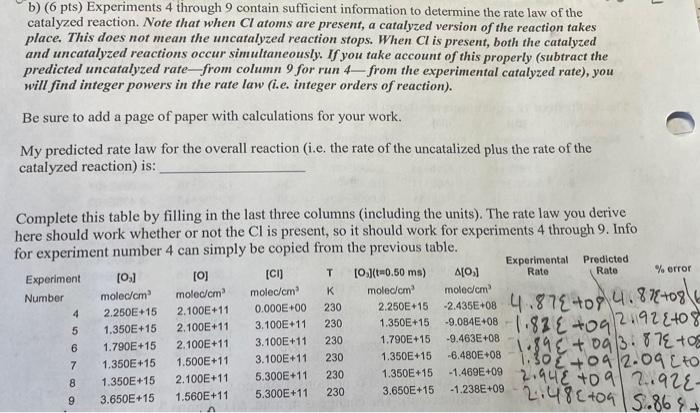
b) ( 6 pts) Experiments 4 through 9 contain sufficient information to determine the rate law of the catalyzed reaction. Note that when Cl atoms are present, a catalyzed version of the reaction takes place. This does not mean the uncatalyzed reaction stops. When Cl is present, both the catalyzed and uncatalyzed reactions occur simultaneously. If you take account of this properly (subtract the predicted uncatalyzed rate - from column 9 for run 4 - from the experimental catalyzed rate), you will find integer powers in the rate law (i.e. integer orders of reaction). Be sure to add a page of paper with calculations for your work. My predicted rate law for the overall reaction (i.e. the rate of the uncatalized plus the rate of the catalyzed reaction) is: Complete this table by filling in the last three columns (including the units). The rate law you derive here should work whether or not the Cl is present, so it should work for experiments 4 through 9 . Info for exneriment number 4 can simply be copied from the previous table. b) ( 6 pts) Experiments 4 through 9 contain sufficient information to determine the rate law of the catalyzed reaction. Note that when Cl atoms are present, a catalyzed version of the reaction takes place. This does not mean the uncatalyzed reaction stops. When Cl is present, both the catalyzed and uncatalyzed reactions occur simultaneously. If you take account of this properly (subtract the predicted uncatalyzed rate - from column 9 for run 4 - from the experimental catalyzed rate), you will find integer powers in the rate law (i.e. integer orders of reaction). Be sure to add a page of paper with calculations for your work. My predicted rate law for the overall reaction (i.e. the rate of the uncatalized plus the rate of the catalyzed reaction) is: Complete this table by filling in the last three columns (including the units). The rate law you derive here should work whether or not the Cl is present, so it should work for experiments 4 through 9 . Info for exneriment number 4 can simply be copied from the previous table
Step by Step Solution
There are 3 Steps involved in it

Get step-by-step solutions from verified subject matter experts
 Study Help