


Question: based added. Every equivalent of base will deprotonate one acidic proton. In a titration, a strong base would now be added and the pH measured
 based added. Every equivalent of base will deprotonate one acidic proton.

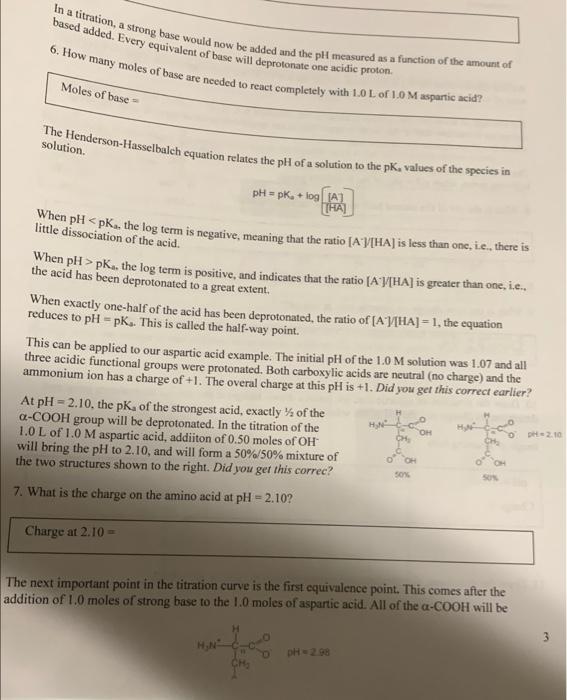
based added. Every equivalent of base will deprotonate one acidic proton. In a titration, a strong base would now be added and the pH measured as a function of the amount of 6. How many moles of base are needed to react completely with 1.0 L of 1.0 Maspartic acid? Moles of base solution. The Henderson-Hasselbalch equation relates the pH of a solution to the pk, values of the species in pH = pk + log THAI A] little dissociation of the acid. when pl pKa, the log term is positive, and indicates that the ratio [A Y[HA] is greater than one, i.e. the acid has been deprotonated to a great extent. When exactly one-half of the acid has been deprotonated, the ratio of [A V[HA] = 1, the equation reduces to pH = pk.. This is called the half-way point. This can be applied to our aspartic acid example. The initial pH of the 1.0 M solution was 1.07 and all three acidic functional groups were protonated. Both carboxylic acids are neutral (no charge) and the ammonium ion has a charge of +1. The overal charge at this pH is +1. Did you get this correct earlier? At pH = 2.10, the pK, of the strongest acid, exactly %s of the a-COOH group will be deprotonated. In the titration of the 1.0 L of 1.0 M aspartic acid, addiiton of 0.50 moles of OH will bring the pH to 2.10, and will form a 50%/50% mixture of the two structures shown to the right. Did you get this correc? 7. What is the charge on the amino acid at pH = 2.10? 2.10 0 OH sox SON Charge at 2.10 - The next important point in the titration curve is the first equivalence point. This comes after the addition of 1.0 moles of strong base to the 1.0 moles of aspartic acid. All of the a-COOH will be pH-208

Step by Step Solution

There are 3 Steps involved in it

1 Expert Approved Answer
Step: 1 Unlock blur-text-image
Question Has Been Solved by an Expert!

Get step-by-step solutions from verified subject matter experts

Step: 2 Unlock
Step: 3 Unlock

Students Have Also Explored These Related Chemistry Questions!