







Question: Buff Tech, Inc. sells computer components and plans to borrow some money to expand. The company has a 12/31 year-end. After reading about earnings management
Buff Tech, Inc. sells computer components and plans to borrow some money to expand. The company has a 12/31 year-end. After reading about earnings management (refer back to Chapter 4), Bucky, the owner has decided he should try to accelerate some sales to improve his financial statement ratios. He has called his best customers and asked them to make their usual January purchases and take delivery of the goods by December 31. He told the customers he would allow them until the end of February to pay for the purchases, just as if they had made the purchases in January.
Note: For revenue recognition purposes, the performance obligation was satisfied by 12/31.
Question:
What are the ethical implications of this plan? What ratios will be improved by accelerating these sales? What about future implications?
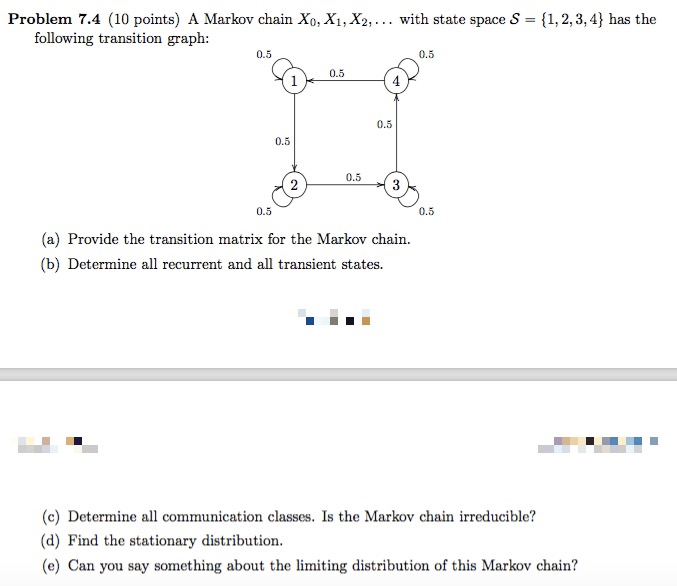
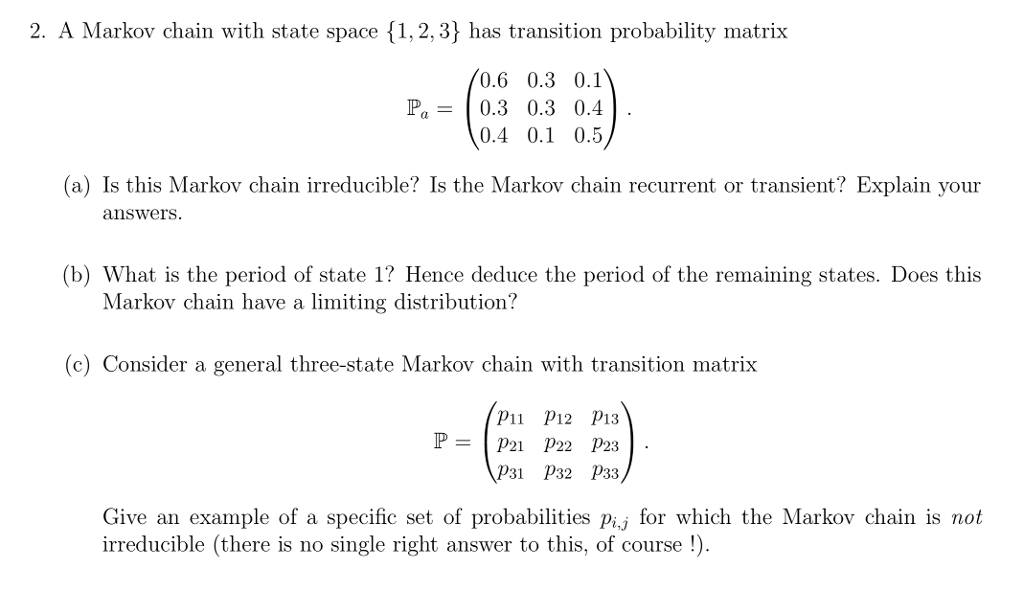
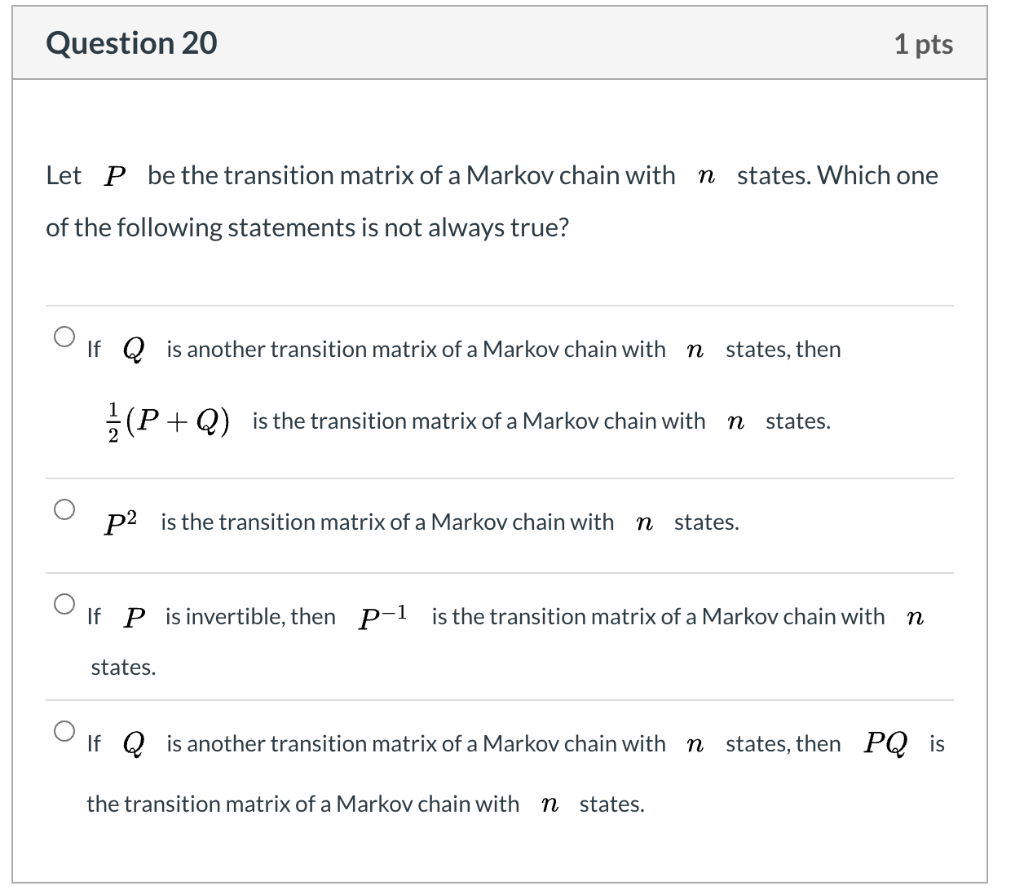
Problem 7.4 (10 points) A Markov chain Xo, X1, X2, ... with state space S = {1, 2,3, 4) has the following transition graph: 0.5 0.5 0.5 1 0.5 0.5 0.5 2 0.5 0.5 (a) Provide the transition matrix for the Markov chain. (b) Determine all recurrent and all transient states. (c) Determine all communication classes. Is the Markov chain irreducible? (d) Find the stationary distribution. (e) Can you say something about the limiting distribution of this Markov chain?2. A Markov chain with state space {1, 2, 3} has transition probability matrix 00 0.3 0.1 a: 0.3 0.3 0.4 0.4 0.1 0.5 (a) Is this Markov chain irreducible? Is the Markov chain recurrent or transient? Explain your answers. (b) What is the period of state 1? Hence deduce the period of the remaining states. Does this Markov chain have a limiting distribution? (c) Consider a general three-state Markov chain with transition matrix 3011 3012 1013 P = P21 P22 P23 1031 P32 P33 Give an example of a specic set of probabilities jag-'3; for which the Markov chain is not irreducible (there is no single right answer to this1 of course l]. Question 20 1 pts Let P be the transition matrix of a Markov chain with n states. Which one of the following statements is not always true? If Q is another transition matrix of a Markov chain with n states, then =(P + Q) is the transition matrix of a Markov chain with n states. O P2 is the transition matrix of a Markov chain with n states. If P is invertible, then p-1 is the transition matrix of a Markov chain with n states. If Q is another transition matrix of a Markov chain with n states, then PQ is the transition matrix of a Markov chain with n states
Step by Step Solution
There are 3 Steps involved in it

Get step-by-step solutions from verified subject matter experts
 Study Help