


Question: can i have help with the whole question please A shop dealing in computer repairs has one trainee repairmen and one expert repairmen. The expert

can i have help with the whole question please can i have help with the whole question please A
can i have help with the whole question please A
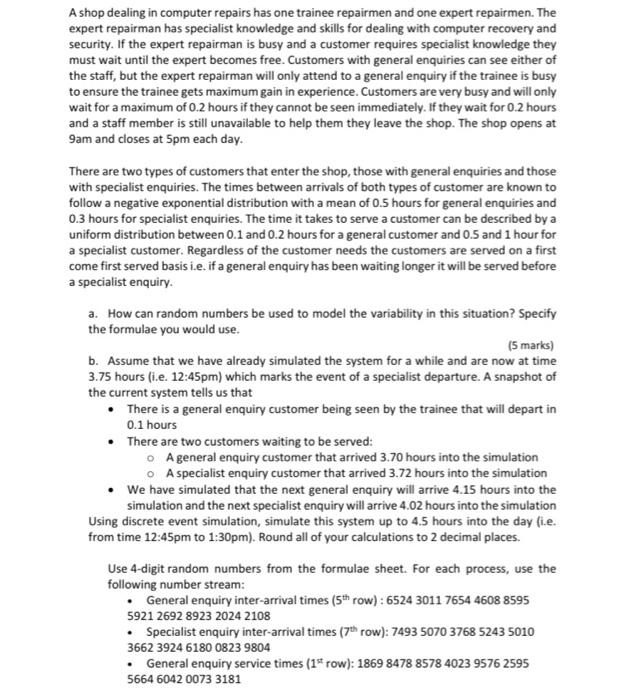
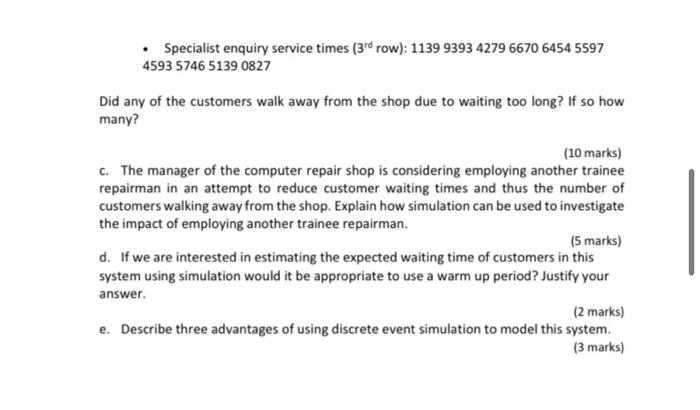
A shop dealing in computer repairs has one trainee repairmen and one expert repairmen. The expert repairman has specialist knowledge and skills for dealing with computer recovery and security. If the expert repairman is busy and a customer requires specialist knowledge they must wait until the expert becomes free. Customers with general enquiries can see either of the staff, but the expert repairman will only attend to a general enquiry if the trainee is busy to ensure the trainee gets maximum gain in experience. Customers are very busy and will only wait for a maximum of 0.2 hours if they cannot be seen immediately. If they wait for 0.2 hours and a staff member is still unavailable to help them they leave the shop. The shop opens at Sam and closes at Spm each day. There are two types of customers that enter the shop, those with general enquiries and those with specialist enquiries. The times between arrivals of both types of customer are known to follow a negative exponential distribution with a mean of 0.5 hours for general enquiries and 0.3 hours for specialist enquiries. The time it takes to serve a customer can be described by a uniform distribution between 0.1 and 0.2 hours for a general customer and 0.5 and 1 hour for a specialist customer. Regardless of the customer needs the customers are served on a first come first served basis i.e. if a general enquiry has been waiting longer it will be served before a specialist enquiry. a. How can random numbers be used to model the variability in this situation? Specify the formulae you would use. 15 marks) b. Assume that we have already simulated the system for a while and are now at time 3.75 hours (i.e. 12:45pm) which marks the event of a specialist departure. A snapshot of the current system tells us that There is a general enquiry customer being seen by the trainee that will depart in 0.1 hours There are two customers waiting to be served: A general enquiry customer that arrived 3.70 hours into the simulation o A specialist enquiry customer that arrived 3.72 hours into the simulation We have simulated that the next general enquiry will arrive 4.15 hours into the simulation and the next specialist enquiry will arrive 4.02 hours into the simulation Using discrete event simulation, simulate this system up to 4.5 hours into the day (i.e. from time 12:45pm to 1:30pm). Round all of your calculations to 2 decimal places. Use 4-digit random numbers from the formulae sheet. For each process, use the following number stream: General enquiry inter-arrival times (5th row): 6524 3011 7654 4608 8595 5921 2692 8923 2024 2108 Specialist enquiry inter-arrival times (7th row): 7493 5070 3768 5243 5010 3662 3924 6180 0823 9804 General enquiry service times (1* row): 1869 8478 8578 4023 9576 2595 5664 6042 0073 3181 Specialist enquiry service times (3rd row): 1139 9393 4279 6670 6454 5597 4593 5746 5139 0827 Did any of the customers walk away from the shop due to waiting too long? If so how many? (10 marks) c. The manager of the computer repair shop is considering employing another trainee repairman in an attempt to reduce customer waiting times and thus the number of customers walking away from the shop. Explain how simulation can be used to investigate the impact of employing another trainee repairman. (5 marks) d. If we are interested in estimating the expected waiting time of customers in this system using simulation would it be appropriate to use a warm up period? Justify your answer. (2 marks) e. Describe three advantages of using discrete event simulation to model this system. (3 marks) A shop dealing in computer repairs has one trainee repairmen and one expert repairmen. The expert repairman has specialist knowledge and skills for dealing with computer recovery and security. If the expert repairman is busy and a customer requires specialist knowledge they must wait until the expert becomes free. Customers with general enquiries can see either of the staff, but the expert repairman will only attend to a general enquiry if the trainee is busy to ensure the trainee gets maximum gain in experience. Customers are very busy and will only wait for a maximum of 0.2 hours if they cannot be seen immediately. If they wait for 0.2 hours and a staff member is still unavailable to help them they leave the shop. The shop opens at Sam and closes at Spm each day. There are two types of customers that enter the shop, those with general enquiries and those with specialist enquiries. The times between arrivals of both types of customer are known to follow a negative exponential distribution with a mean of 0.5 hours for general enquiries and 0.3 hours for specialist enquiries. The time it takes to serve a customer can be described by a uniform distribution between 0.1 and 0.2 hours for a general customer and 0.5 and 1 hour for a specialist customer. Regardless of the customer needs the customers are served on a first come first served basis i.e. if a general enquiry has been waiting longer it will be served before a specialist enquiry. a. How can random numbers be used to model the variability in this situation? Specify the formulae you would use. 15 marks) b. Assume that we have already simulated the system for a while and are now at time 3.75 hours (i.e. 12:45pm) which marks the event of a specialist departure. A snapshot of the current system tells us that There is a general enquiry customer being seen by the trainee that will depart in 0.1 hours There are two customers waiting to be served: A general enquiry customer that arrived 3.70 hours into the simulation o A specialist enquiry customer that arrived 3.72 hours into the simulation We have simulated that the next general enquiry will arrive 4.15 hours into the simulation and the next specialist enquiry will arrive 4.02 hours into the simulation Using discrete event simulation, simulate this system up to 4.5 hours into the day (i.e. from time 12:45pm to 1:30pm). Round all of your calculations to 2 decimal places. Use 4-digit random numbers from the formulae sheet. For each process, use the following number stream: General enquiry inter-arrival times (5th row): 6524 3011 7654 4608 8595 5921 2692 8923 2024 2108 Specialist enquiry inter-arrival times (7th row): 7493 5070 3768 5243 5010 3662 3924 6180 0823 9804 General enquiry service times (1* row): 1869 8478 8578 4023 9576 2595 5664 6042 0073 3181 Specialist enquiry service times (3rd row): 1139 9393 4279 6670 6454 5597 4593 5746 5139 0827 Did any of the customers walk away from the shop due to waiting too long? If so how many? (10 marks) c. The manager of the computer repair shop is considering employing another trainee repairman in an attempt to reduce customer waiting times and thus the number of customers walking away from the shop. Explain how simulation can be used to investigate the impact of employing another trainee repairman. (5 marks) d. If we are interested in estimating the expected waiting time of customers in this system using simulation would it be appropriate to use a warm up period? Justify your answer. (2 marks) e. Describe three advantages of using discrete event simulation to model this system

Step by Step Solution

There are 3 Steps involved in it

1 Expert Approved Answer
Step: 1 Unlock blur-text-image

Question Has Been Solved by an Expert!

Get step-by-step solutions from verified subject matter experts

Step: 2 Unlock
Step: 3 Unlock

Students Have Also Explored These Related General Management Questions!