Question: case analysis: when will P&G play to win again? I need help to do case analysis on that topic. When Will P&G Play to Win
case analysis: when will P&G play to win again?
I need help to do case analysis on that topic.
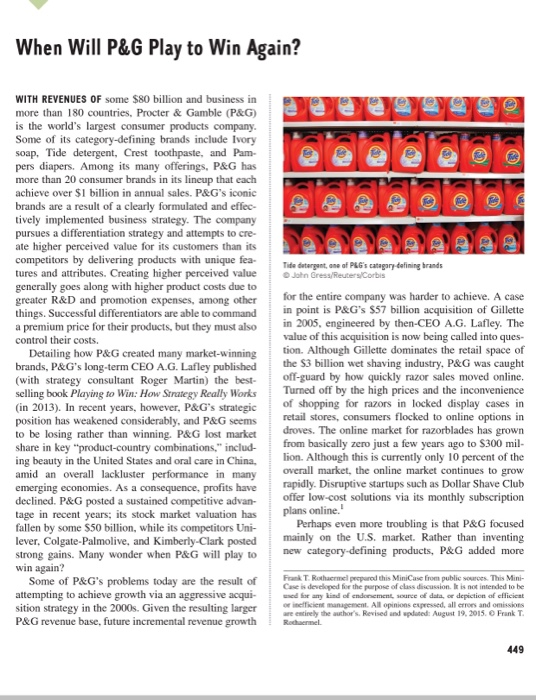
When Will P&G Play to Win Again? Tide detergent one of PEG's category defining brands on Oress/Reuters Corbis WITH REVENUES OF some $80 billion and business in more than 180 countries, Procter & Gamble (P&G) is the world's largest consumer products company. Some of its category-defining brands include Ivory soap. Tide detergent, Crest toothpaste, and Pam- pers diapers. Among its many offerings, P&G has more than 20 consumer brands in its lineup that cach achieve over $1 billion in annual sales. P&G's iconic brands are a result of a clearly formulated and effec- tively implemented business strategy. The company pursues a differentiation strategy and attempts to cre- ate higher perceived value for its customers than its competitors by delivering products with unique fea- tures and attributes. Creating higher perceived value generally goes along with higher product costs due to greater R&D and promotion expenses, among other things. Successful differentiators are able to command a premium price for their products, but they must also control their costs. Detailing how P&G created many market-winning brands, P&G's long-term CEO A.G. Lafley published (with strategy consultant Roger Martin) the best selling book Playing to Win: How Strategy Really Works (in 2013). In recent years, however, P&G's strategic position has weakened considerably, and P&G seems to be losing rather than winning. P&G lost market share in key "product-country combinations, includ- ing beauty in the United States and oral care in China, amid an overall lackluster performance in many emerging economies. As a consequence, profits have declined. P&G posted a sustained competitive advan- tage in recent years, its stock market valuation has fallen by some $50 billion, while its competitors Uni- lever, Colgate-Palmolive, and Kimberly-Clark posted strong gains. Many wonder when P&G will play to win again? Some of P&G's problems today are the result of attempting to achieve growth via an aggressive acqui- sition strategy in the 2000s. Given the resulting larger P&G revenue base, future incremental revenue growth for the entire company was harder to achieve. A case in point is P&G's $57 billion acquisition of Gillette in 2005, engineered by then-CEO A.G. Lafley. The value of this acquisition is now being called into ques- tion. Although Gillette dominates the retail space of the S3 billion wet shaving industry. P&G was caught off-guard by how quickly razor sales moved online, Turned off by the high prices and the inconvenience of shopping for razors in locked display cases in retail stores, consumers flocked to online options in droves. The online market for razorblades has grown from basically zero just a few years ago to $300 mil- lion. Although this is currently only 10 percent of the overall market, the online market continues to grow rapidly. Disruptive startups such as Dollar Shave Club offer low-cost solutions via its monthly subscription plans online. Perhaps even more troubling is that P&G focused mainly on the U.S. market. Rather than inventing new category-defining products, P&G added more F T. Rotherme propred this MiniCase from public sources. This Mini- Case is developed for the purpose of class dission. It is not intended to be ned for any land of endomment source of data or depiction of efficient eficient management. All opinions expressed, all trees and omission we entirely the author's Revised and puted: August 19, 2015. Frank T. Racharel D 449 features to its existing brands, such as Olay's extra- moisturizing creams and ultra-soft and sensitive Charmin toilet paper, while raising prices. Reflect- ing higher value creation based on its differentiation strategy, P&G generally charges a 20 to 40 percent premium for its products in comparison to retailers private-label and other brands. The strategic decision to focus on the domestic market combined with incre- mentally adding minor features to its existing products created two serious problems for P&G. First, following the deep recession of 2008-2009 U.S. consumers moved away from higher-priced brands, such as those offered by P&G, to lower-cost alternatives. Moreover, P&G's direct rivals in branded goods, including Colgate-Palmolive, Kimberly-Clark, and Unilever, were faster in cutting costs and prices in response to more frugal customers. P&G also fum- bled recent launches of reformulated products such as Tide Pods (detergent scaled in single-use pouches) and the Pantene line of shampoos and conditioners. The decline in U.S. demand hit P&G especially hard because the domestic market delivers about one-third of sales, but almost two-thirds of profits. Second, by focusing on the U.S. market, P&G not only missed out on the booming growth years that the emerging econ- omies experienced during the 2000s, but it also left these markets to its rivals. As a consequence, Colgate- Palmolive, Kimberly-Clark, and Unilever all outper- formed P&G in recent years. As a result of its sustained competitive advantage, P&G also had a revolving door in its executive suites. Within a three-year period (from 2013 to 2015). P&G went through three CEOs. After 30 years with P&G, the former Army Ranger Robert McDonald was appointed CEO in 2009, but was replaced in the spring of 2013 in the face of P&G's deteriorating per formance. The company's board of directors brought back A.G. Lafley. This was an interesting choice because Lafley had previously served as P&G's CEO from 2000 to 2009, and some of the strategic decisions that led to a weakening of P&G's strategic position were made under his watch. Lafley served a second term as CEO from 2013 to 2015. In late 2015, P&G named David Taylor as new CEO, again promoting from within, while Lafley will continue to serve as executive chairman. To strengthen its competitive position, P&G launched two strategic initiatives. First, P&G began to refocus its portfolio on the company's 70 to 80 most lucrative product-market combinations, which are responsible for 90 percent of P&G's revenues and almost all of its profits. Some argue that P&G had become too big and spread out to compete effectively in today's dynamic marketplace. To refocus on core products such as Tide, Pampers, and Olay (with these three brands alone accounting for more than 50 per cent of the company's revenuesP&G already sold or plans to divest almost 100 brands in its far-flung prod- uct portfolio, including well-known brands such lams pet food, Duracell batteries, Wella shampoos, Clairol hair dye, and Cover Girl makeup, but mainly a slew of lesser known brands. Part of this strategic initiative is also to expand P&G's presence in large emerging economies. As an example, P&G launched Tide in India and Pan- tene shampoos in Brazil. Moreover, P&G began to leverage its Crest brand globally, to take on Colgate Palmolive's global dominance in toothpaste. Yet, the strong dollar in recent years is hurting P&G's international results. Second, P&G implemented strict cost-cutting measures through eliminating all spending not directly related to selling. As part of its cost-cutting initiative, P&G also eliminated thousands of jobs. The goal of the two strategic initiatives is to increase the perceived value of P&G's brands in the minds of the consumer, while lowering production costs. The combined effort should if successful increase P&G's economic value creation (V-). The hope is that P&G's revised business strategy would strengthen its strategic position and help it regain its competitive advantage. It remains to be seen if this will be the case. DISCUSSION QUESTIONS 1 P&G differentiates itself from competitors by offering branded consumer product goods with distinct features and attributes. This business strategy implies that P&G focuses on increasing the perceived value created for customers, which allows it to charge a premium price. This approach proved quite successful in the past, especially in rich countries such as the United States and many European countries. What went wrong in the recent post? Detail P&G's internal weaknesses and external challenges. Derive recommendations on how to improve P&G's strategic position going forward. Be specific









 Study Help