







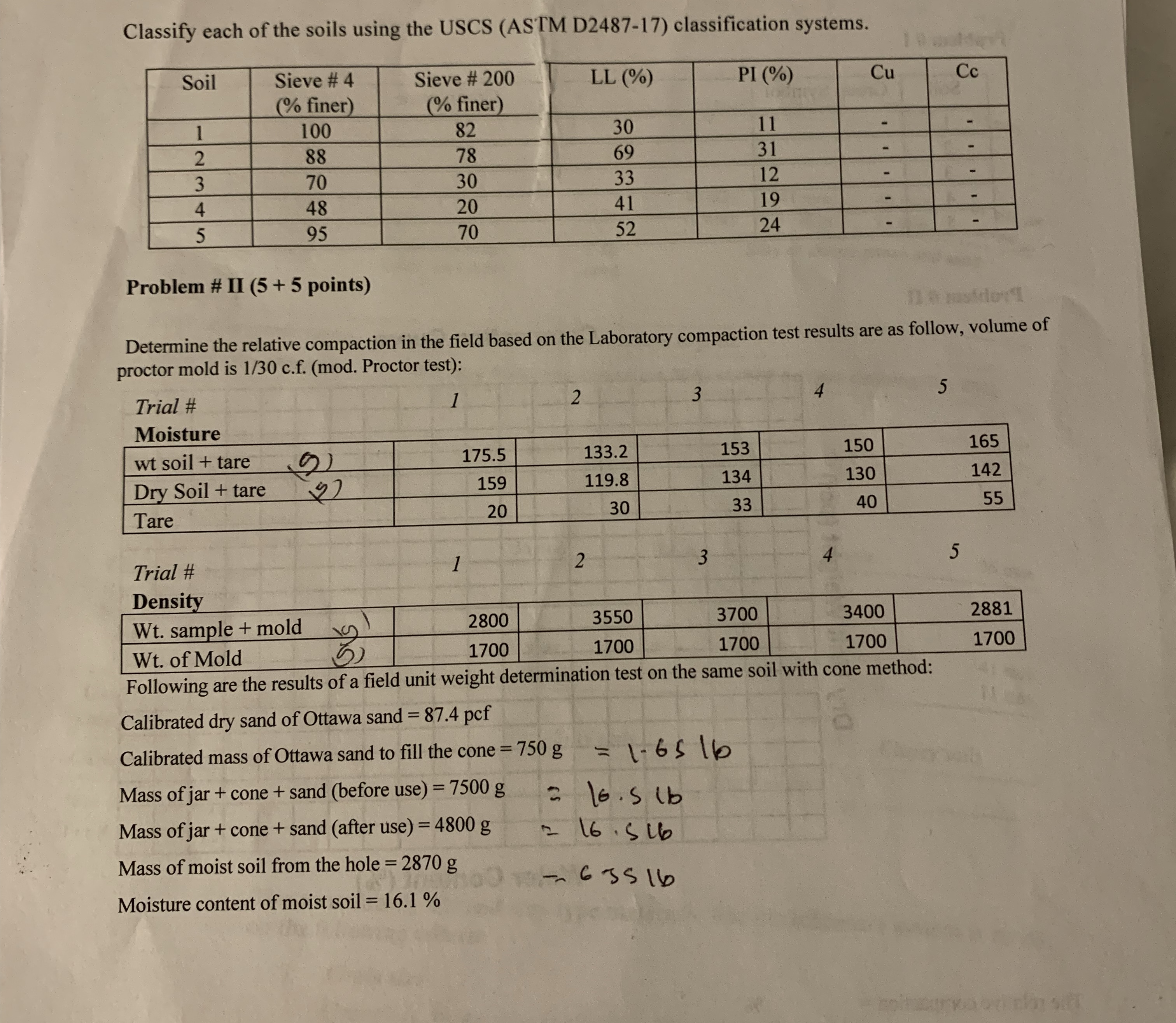
Question: Classify each of the soils using the USCS ( ASTM D 2 4 8 7 - 1 7 ) classification systems. table [ [
Classify each of the soils using the USCS ASTM D classification systems.
tableSoiltableSieve # finertableSieve # finerLL PI CuCc
Problem # II points
Determine the relative compaction in the field based on the Laboratory compaction test results are as follow, volume of proctor mold is cfmod Proctor test:
Trial #
Moisture
tablewt soil tare,Dry Soil tare,yTare
Trial #
Density
tableWt sample mold,Wt of Mold,
Following are the results of a field unit weight determination test on the same soil with cone method:
Calibrated dry sand of Ottawa sand
Calibrated mass of Ottawa sand to fill the cone
Mass of jar cone sand before use
Mass of jar cone sand after use
Step by Step Solution
There are 3 Steps involved in it
1 Expert Approved Answer
Step: 1 Unlock

Question Has Been Solved by an Expert!
Get step-by-step solutions from verified subject matter experts
Step: 2 Unlock
Step: 3 Unlock
 Study Help