







Question: Create and test the VLANs a . On each switch, create only the following VLANs: i . VLAN 1 0 - Guest ii . VLAN
Create and test the VLANs
a On each switch, create only the following VLANs:
i VLAN Guest
ii VLAN Student
iii. VLAN Management
iv VLAN Native
b Display the created VLANs using the show vlan command and verify.
Create and test the trunks
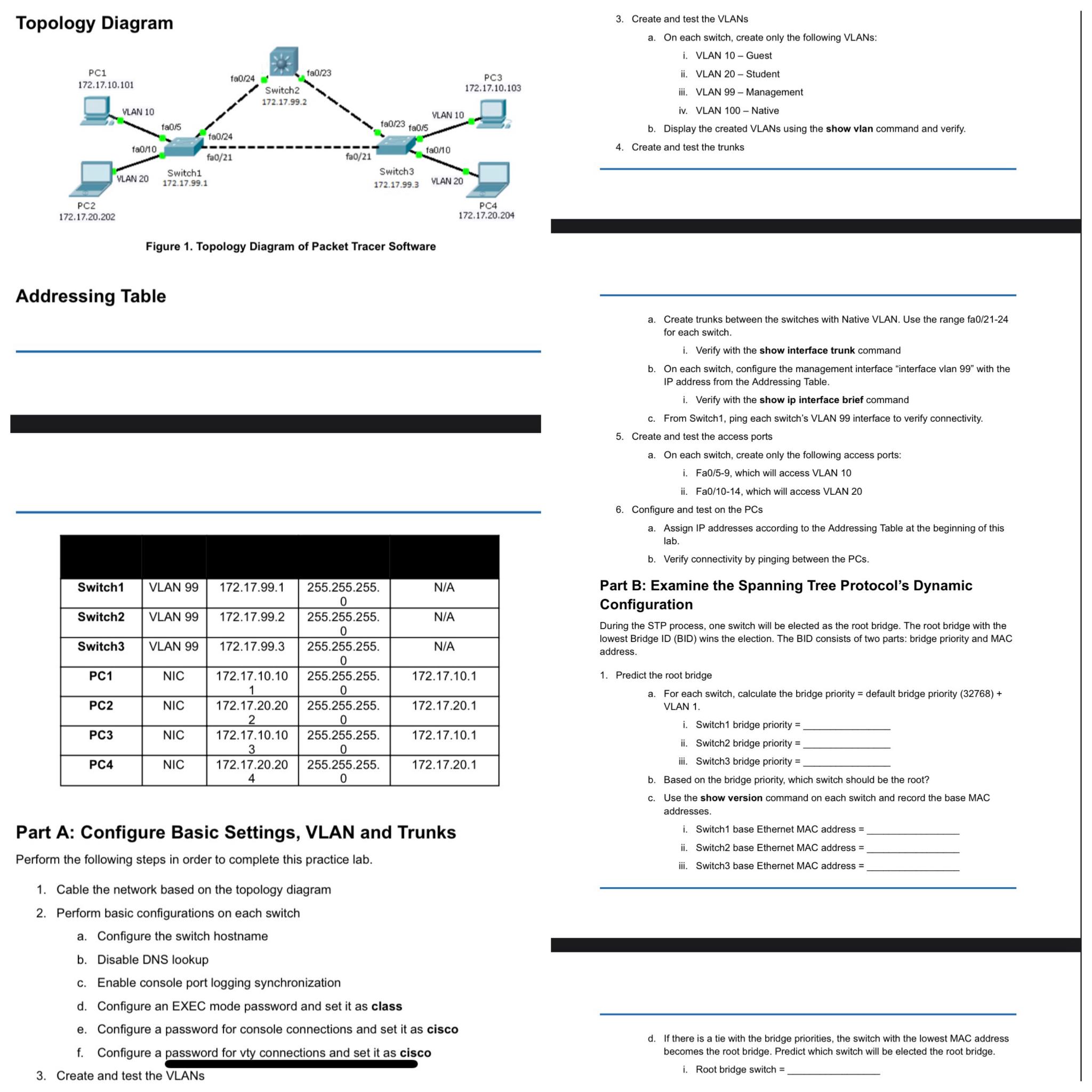
Addressing Table
Part A: Configure Basic Settings, VLAN and Trunks
Perform the following steps in order to complete this practice lab.
Cable the network based on the topology diagram
Perform basic configurations on each switch
a Configure the switch hostname
b Disable DNS lookup
c Enable console port logging synchronization
d Configure an EXEC mode password and set it as class
e Configure a password for console connections and set it as cisco
f Configure a password for vty connections and set it as cisco
Create and test the VLANs
a Create trunks between the switches with Native VLAN. Use the range fa for each switch.
i Verify with the show interface trunk command
b On each switch, configure the management interface "interface vlan with the IP address from the Addressing Table.
i Verify with the show ip interface brief command
c From Switch ping each switch's VLAN interface to verify connectivity.
Create and test the access ports
a On each switch, create only the following access ports:
i Fa which will access VLAN
ii Fa which will access VLAN
Configure and test on the PCs
a Assign IP addresses according to the Addressing Table at the beginning of this lab.
b Verify connectivity by pinging between the PCs
Part B: Examine the Spanning Tree Protocol's Dynamic Configuration
During the STP process, one switch will be elected as the root bridge. The root bridge with the lowest Bridge ID BID wins the election. The BID consists of two parts: bridge priority and MAC address.
Predict the root bridge
a For each switch, calculate the bridge priority default bridge priority VLAN
i Switch bridge priority
ii Switch bridge priority
iii. Switch bridge priority
b Based on the bridge priority, which switch should be the root?
c Use the show version command on each switch and record the base MAC addresses.
i Switch base Ethernet MAC address
ii Switch base Ethernet MAC address
iii. Switch base Ethernet MAC address
d If there is a tie with the bridge priorities, the switch with the lowest MAC address becomes the root bridge. Predict which switch will be elected the root bridge.
i Root bridge switch
Step by Step Solution
There are 3 Steps involved in it
1 Expert Approved Answer
Step: 1 Unlock

Question Has Been Solved by an Expert!
Get step-by-step solutions from verified subject matter experts
Step: 2 Unlock
Step: 3 Unlock
 Study Help