Question: Critical path practice: Sharpen your pencil Take a forward pass through each of the four paths in the diagram and the early starts and early
Critical path practice: Sharpen your pencil Take
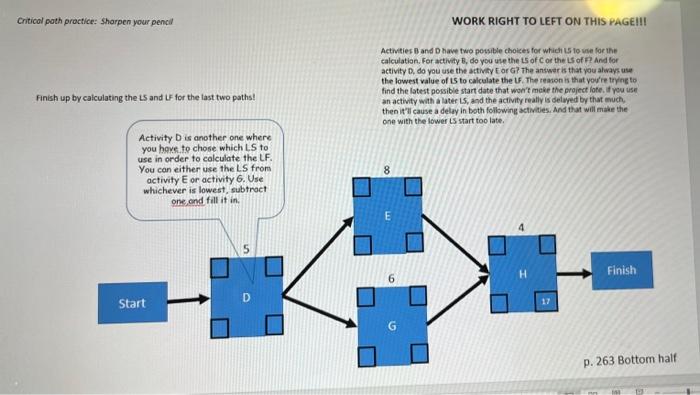
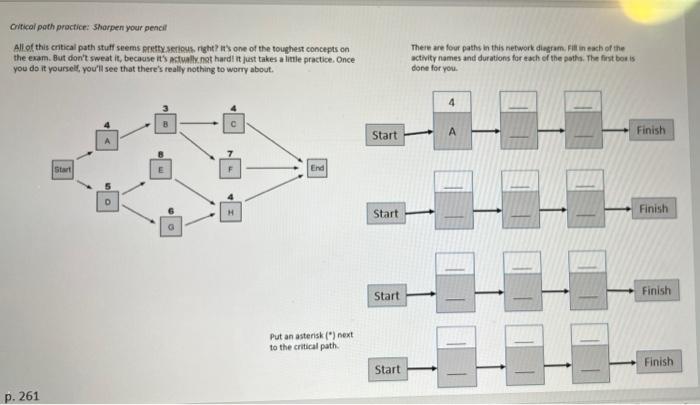
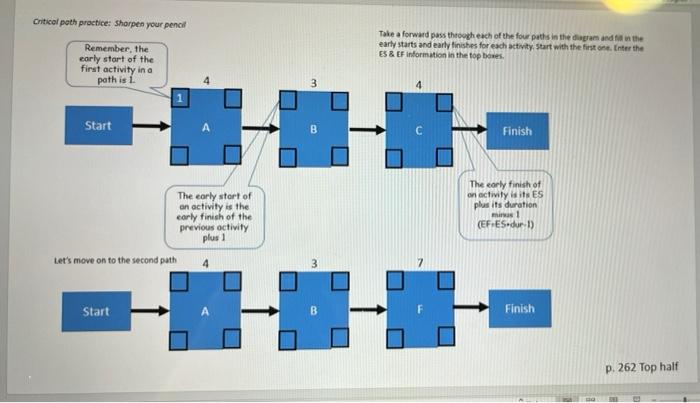
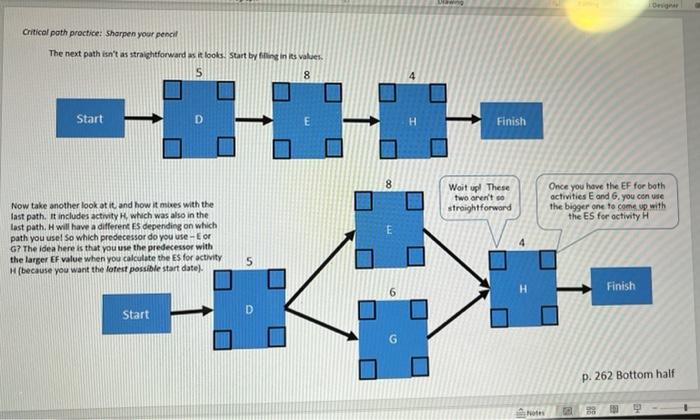
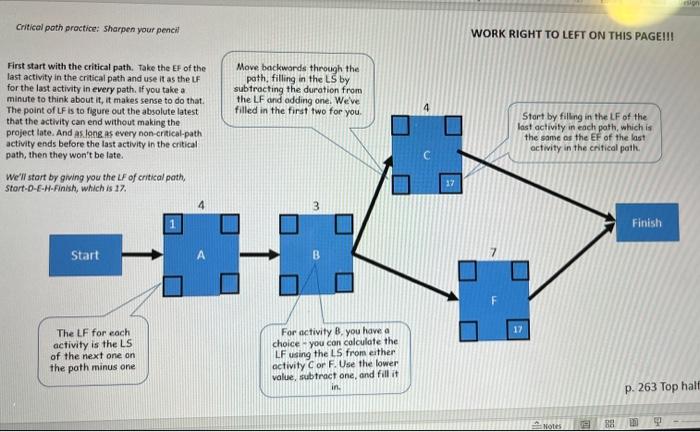
Critical path practice: Sharpen your pencil Take a forward pass through each of the four paths in the diagram and the early starts and early finishes for each activity Start with the first on Enter the ES & EF information in the top bones Remember, the carly start of the first activity in a path is 1. 3 Start B Finish The early start of an activity is the early finish of the previous activity plus Let's move on to the second path 4 The carly finish of or activity its ES plus its duration mis 1 (EF.ESudur1) 3 Start Finish p. 262 Top half De Critical path practice: Sharpen your pencil The next path isn't as straightforward as it looks. Start by filling in its values 5 8 4 Start Finish Woit up! These two aren't straightforward Once you have the EF for both activities and 6. you con de the bigger one to come up with the ES for activity H Now take another look at it and how it mixes with the last path. It includes activity, which was also in the Last path. H will have a different ES depending on which path you usel So which predecessor do you use of G7 The idea here is that you use the predecessor with the larger EF value when you calculate the ES for activity H(because you want the lofest possible start date). Finish Start p. 262 Bottom half Critical path practice: Sharpen your pencit WORK RIGHT TO LEFT ON THIS PAGE!!! First start with the critical path. Take the EF of the last activity in the critical path and use it as the LF for the last activity in every path. If you take a minute to think about it, it makes sense to do that. The point of LF is to figure out the absolute latest that the activity can end without making the project late. And as long as every non-critical path activity ends before the last activity in the critical path, then they won't be late. Move backwards through the path, filling in the LS by subtracting the duration from the LF and adding one. We've filled in the first two for you. Start by filling in the LF of the last activity in each path, which is the same as the EF of the last activity in the critical path, We'll start by giving you the LF of critical path, Stort-D-E-H-Finish, which is 17. 3 Finish Start 7 17 The LF for each activity is the LS of the next one on the path minus one For activity B. you have a choice - you con calculate the LF using the LS from either activity Cor F. Use the lower value, subtract one, and fill it in. p. 263 Top hall Critical poth practice: Sharpen your pencil WORK RIGHT TO LEFT ON THIS PAGE!!! Activities and have two possible choices for which is to use for the calculation. For activity, do you use the ts of Cor the off And for activity D, do you use the activity or G? The answer is that you always use the lowest value of is to calculate the LF. The reason is that you're trying to find the latest possible start date that won't make the project lote. If you use an activity with a later Ls, and the activity really is delayed by that much. then it'll cause a delay in both following activities. And that will make the one with the lower LS start too late. Finish up by calculating the LS and UF for the last two paths! Activity is another one where you have to chose which LS to use in order to calculate the LF. You can either use the LS from activity E or activity 6. Use whichever is lowest, subtract one and fill it in 8 4 5 Finish D Start 17 p. 263 Bottom half Critical poth practice: Sharpen your pencil All of this critical path stuff seems pretty serious night's one of the toughest concepts on the exam. But don't sweat it, because it's actually not hard it just takes a little practice. Once you do it yourself, you'll see that there's really nothing to worry about There are four paths in this network diagram. Fill in each of the activity names and durations for each of the paths. The first boris done for you. 4 B = Finish Start Start - End H Start Finish Start Finish Put an asterisk (*) next to the critical path Finish Start p. 261
Step by Step Solution

There are 3 Steps involved in it

1 Expert Approved Answer
Step: 1 Unlock blur-text-image

Question Has Been Solved by an Expert!

Get step-by-step solutions from verified subject matter experts

Step: 2 Unlock
Step: 3 Unlock

Students Have Also Explored These Related General Management Questions!