







Question: DETAILS: This assignment is to develop a Project Charter for the scenario described above along with the information within the RFP. REQUIRED ACTIONS: Creating a
DETAILS: This assignment is to develop a Project Charter for the scenario described above along with the information within the RFP.
REQUIRED ACTIONS:
Creating a charter is a complex process that requires considerable prep work and assessment to uncover or "discover" the necessary information to create this authorizing document. Often, you are working with vague, high-level information and need to "sell" your project idea to gain official authorization to move ahead with your project. You may be in competition with other project ideas for limited resources, so you need to do the best you can with the info you have.
Use the scenario below and the attached RFP to complete the Project Charter. You are not replying to the RFP. The assumption is you have been awarded the contract and this is just a document to help write the charter. Yes, you will need to make some assumptions. Just be realistic. Keep in mind that this is an actual RFP so you will need to find additional information out on the web about this City that will be helpful (i.e., such as contact names).
Timeline - make an assumption that this is a new project just starting off. Use an educated guess when you would start the project and create milestones based on that. Do not use past dates (you will get points taken off for using a past date).
Use the Project Charter template provided. The basic sections in the book are ALL required. If there is a section not on the list you could put NA. However, doing just the basics equates to a basic grade (C). You need to make a concerted effort. The more you put into it the better the chance for an A. Perfection is not expected, but a great effort on your part is.
THE PROJECT CHARTER TEMPLATE IS BELOW
DETAILS: This assignment is to develop a Project Charter for the scenario described above along with the information within the RFP.
REQUIRED ACTIONS:
Creating a charter is a complex process that requires considerable prep work and assessment to uncover or "discover" the necessary information to create this authorizing document. Often, you are working with vague, high-level information and need to "sell" your project idea to gain official authorization to move ahead with your project. You may be in competition with other project ideas for limited resources, so you need to do the best you can with the info you have.
Use the scenario below and the attached RFP to complete the Project Charter. You are not replying to the RFP. The assumption is you have been awarded the contract and this is just a document to help write the charter. Yes, you will need to make some assumptions. Just be realistic. Keep in mind that this is an actual RFP so you will need to find additional information out on the web about this City that will be helpful (i.e., such as contact names).
Timeline - make an assumption that this is a new project just starting off. Use an educated guess when you would start the project and create milestones based on that. Do not use past dates (you will get points taken off for using a past date).
Use the Project Charter template provided. The basic sections in the book are ALL required. If there is a section not on the list you could put NA. However, doing just the basics equates to a basic grade (C). You need to make a concerted effort. The more you put into it the better the chance for an A. Perfection is not expected, but a great effort on your part is.
THE PROJECT CHARTER TEMPLATE IS BELOW
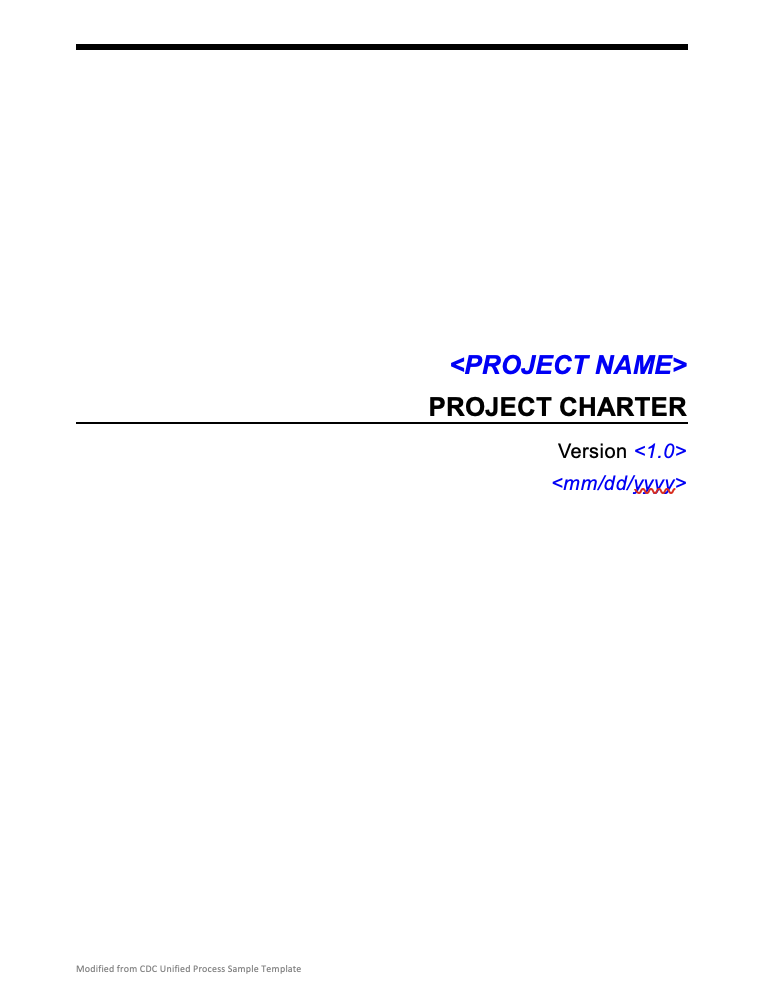
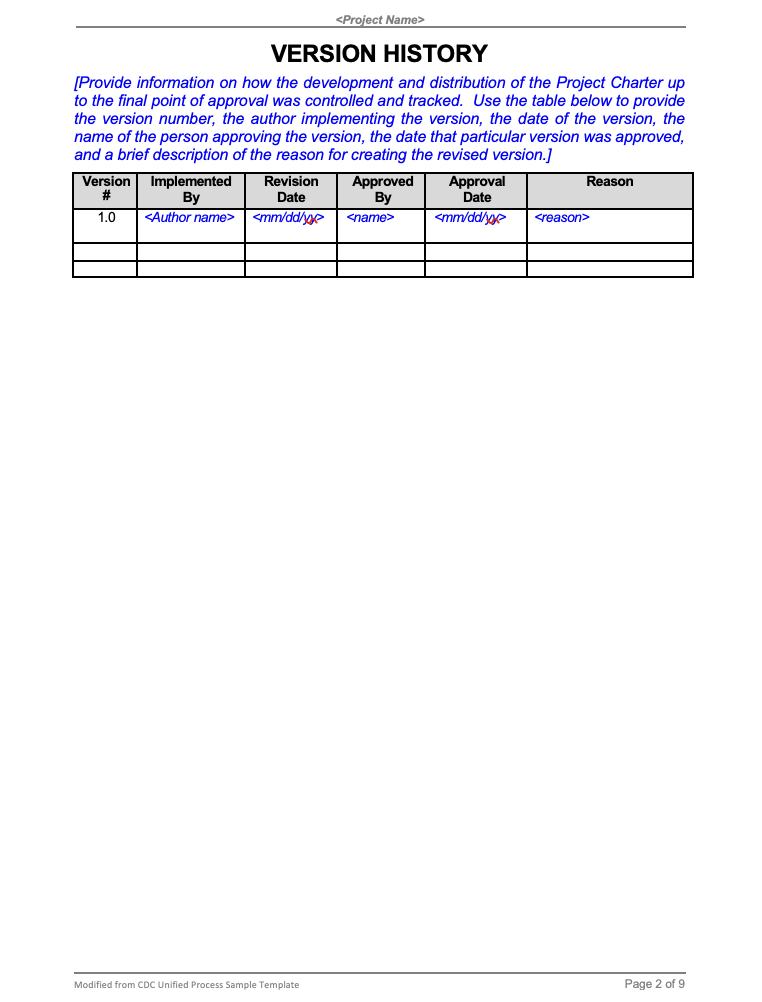
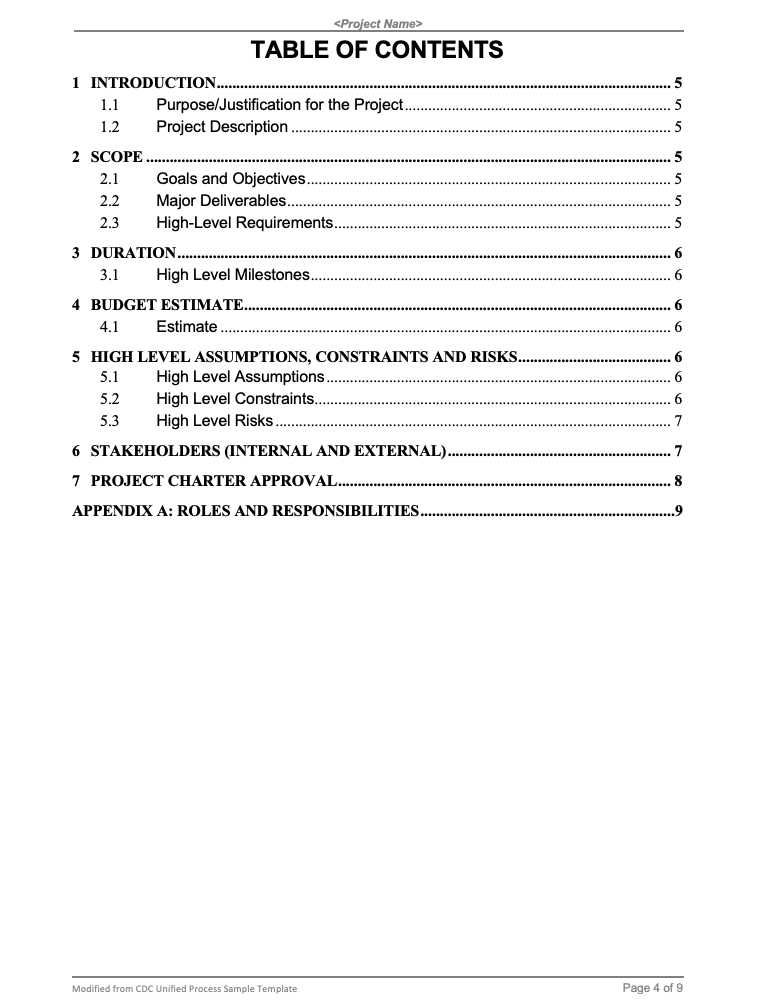
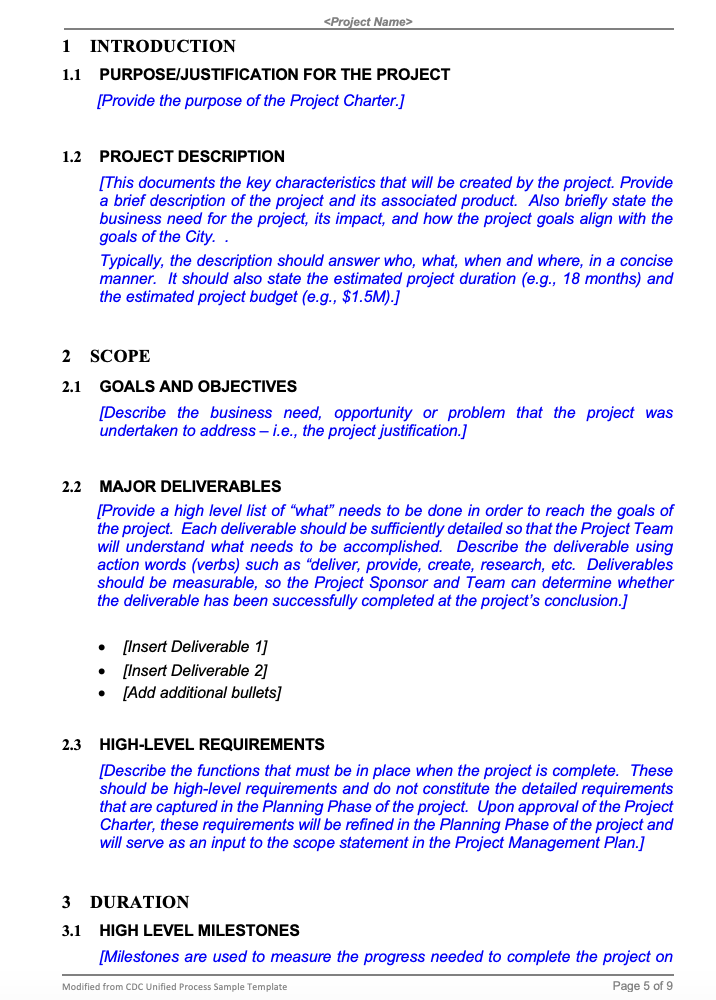
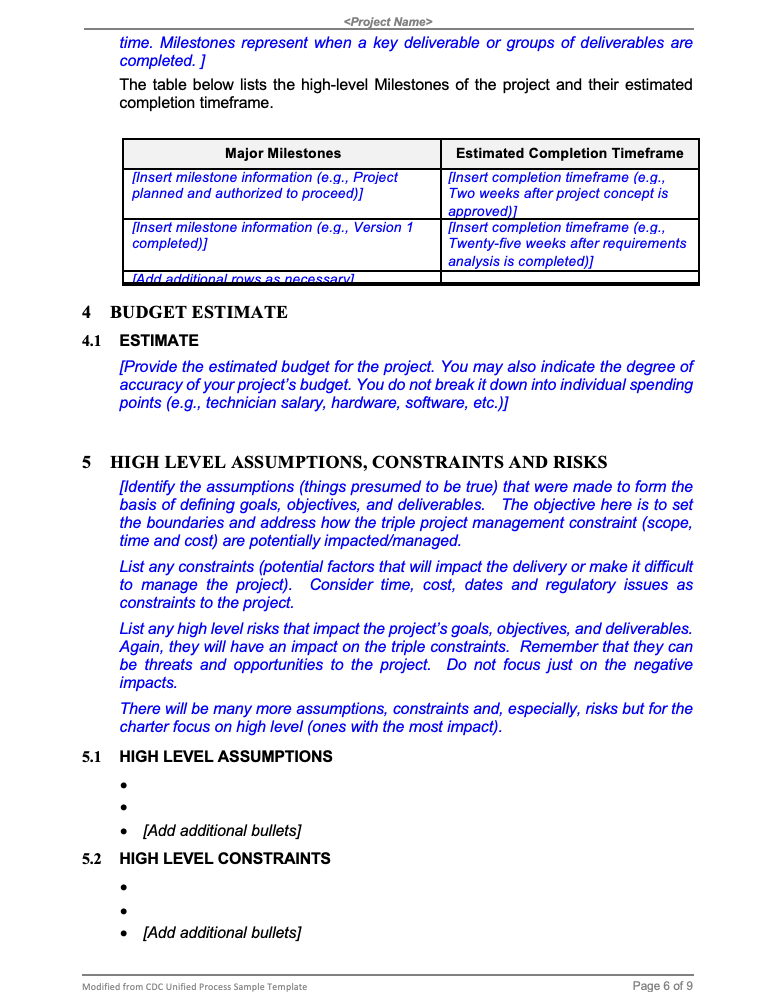
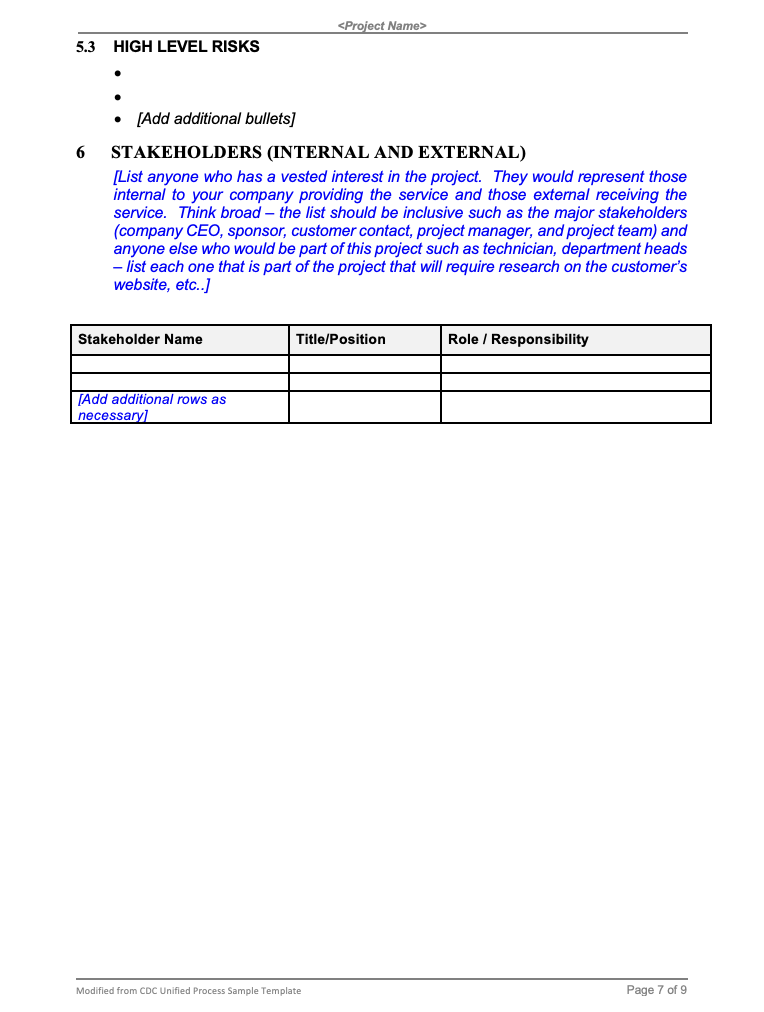
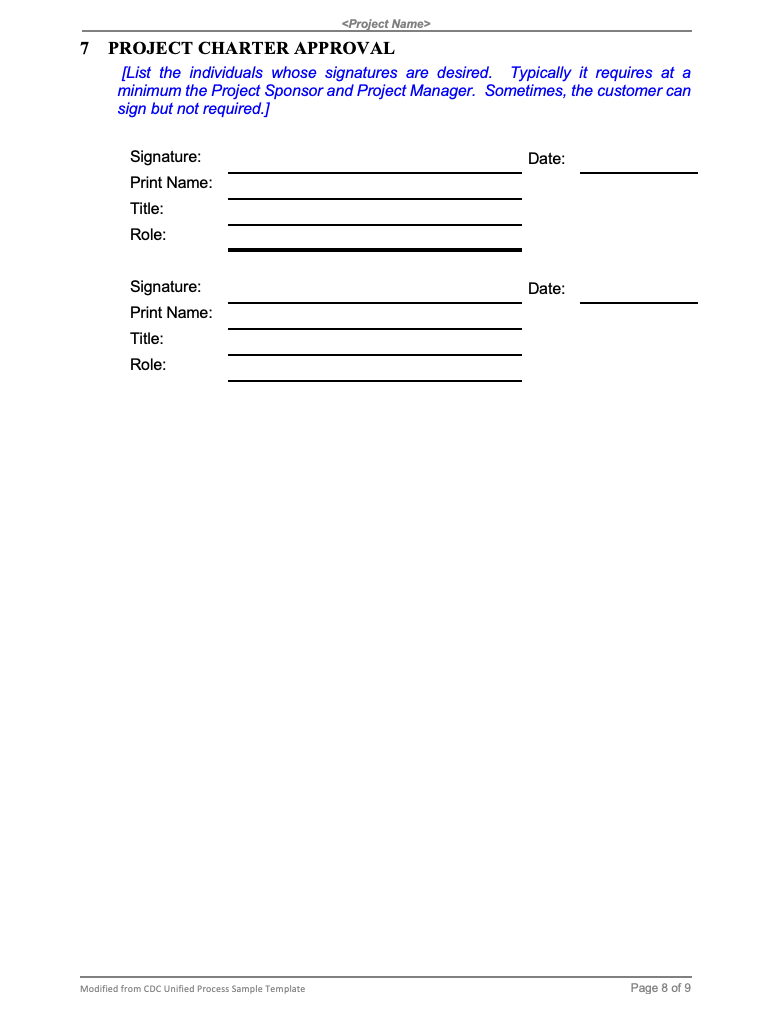
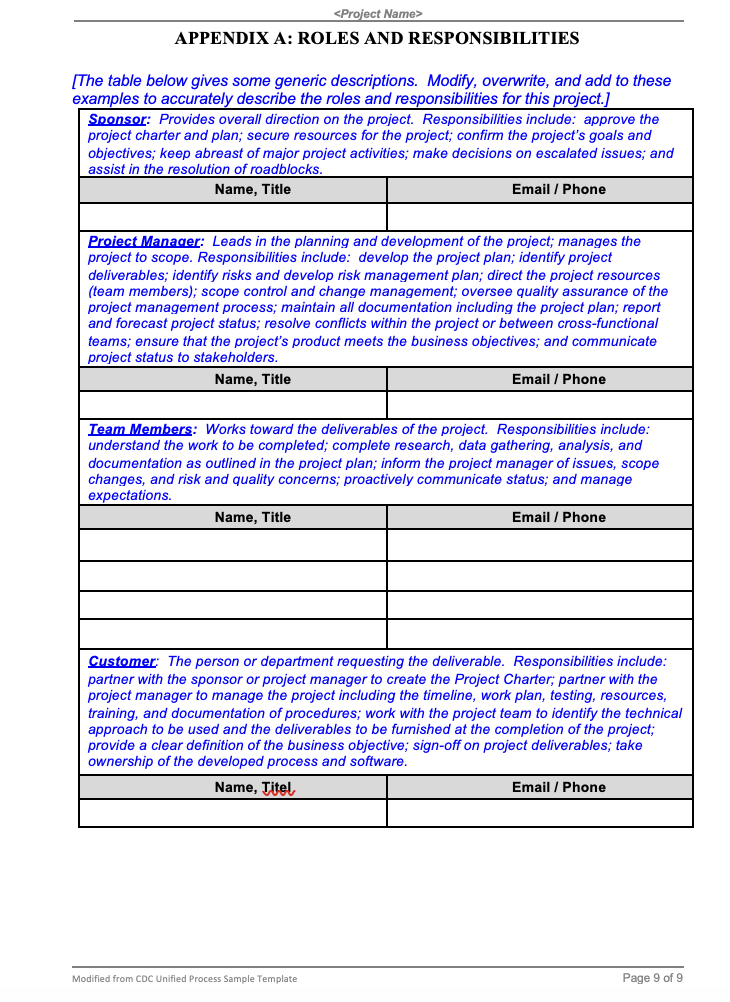
Modified from CDC Unified Process Sample Template VERSION HISTORY [Provide information on how the development and distribution of the Project Charter up to the final point of approval was controlled and tracked. Use the table below to provide the version number, the author implementing the version, the date of the version, the name of the person approving the version, the date that particular version was approved, and a brief description of the reason for creating the revised version.] TABLE OF CONTENTS 1 INTRODUCTION. 5 1.1 Purpose/Justification for the Project. 1.2 Project Description. 5 5 2 SCOPE 5 2.1 Goals and Objectives. 2.2 Major Deliverables.. 2.3 High-Level Requirements.. .5 3 DURATION. 3.1 High Level Milestones. .5 5 4 BUDGET ESTIMATE. 6 4.1 Estimate 6 5 HIGH LEVEL ASSUMPTIONS, CONSTRAINTS AND RISKS. 5.1 High Level Assumptions. 6 5.2 High Level Constraints. 6 5.3 High Level Risks. 6 6 6 6 STAKEHOLDERS (INTERNAL AND EXTERNAL). 7 7 PROJECT CHARTER APPROVAL 7 APPENDIX A: ROLES AND RESPONSIBILITIES. .8 1.1 PURPOSE/JUSTIFICATION FOR THE PROJECT [Provide the purpose of the Project Charter.] 1.2 PROJECT DESCRIPTION [This documents the key characteristics that will be created by the project. Provide a brief description of the project and its associated product. Also briefly state the business need for the project, its impact, and how the project goals align with the goals of the City. . Typically, the description should answer who, what, when and where, in a concise manner. It should also state the estimated project duration (e.g., 18 months) and the estimated project budget (e.g., \$1.5M).] 2 SCOPE 2.1 GOALS AND OBJECTIVES [Describe the business need, opportunity or problem that the project was undertaken to address - i.e., the project justification.] 2.2 MAJOR DELIVERABLES [Provide a high level list of "what" needs to be done in order to reach the goals of the project. Each deliverable should be sufficiently detailed so that the Project Team will understand what needs to be accomplished. Describe the deliverable using action words (verbs) such as "deliver, provide, create, research, etc. Deliverables should be measurable, so the Project Sponsor and Team can determine whether the deliverable has been successfully completed at the project's conclusion.] - [Insert Deliverable 1] - [Insert Deliverable 2] - [Add additional bullets] 2.3 HIGH-LEVEL REQUIREMENTS [Describe the functions that must be in place when the project is complete. These should be high-level requirements and do not constitute the detailed requirements that are captured in the Planning Phase of the project. Upon approval of the Project Charter, these requirements will be refined in the Planning Phase of the project and will serve as an input to the scope statement in the Project Management Plan.] 3 DURATION 3.1 HIGH LEVEL MILESTONES [Milestones are used to measure the progress needed to complete the project on Modified from CDC Unified Process Sample Template Page 5 of 9 Project Name time. Milestones represent when a key deliverable or groups of deliverables are completed.] The table below lists the high-level Milestones of the project and their estimated completion timeframe. 4 BUDGET ESTIMATE 4.1 ESTIMATE [Provide the estimated budget for the project. You may also indicate the degree of accuracy of your project's budget. You do not break it down into individual spending points (e.g., technician salary, hardware, software, etc.)] 5 HIGH LEVEL ASSUMPTIONS, CONSTRAINTS AND RISKS [Identify the assumptions (things presumed to be true) that were made to form the basis of defining goals, objectives, and deliverables. The objective here is to set the boundaries and address how the triple project management constraint (scope, time and cost) are potentially impacted/managed. List any constraints (potential factors that will impact the delivery or make it difficult to manage the project). Consider time, cost, dates and regulatory issues as constraints to the project. List any high level risks that impact the project's goals, objectives, and deliverables. Again, they will have an impact on the triple constraints. Remember that they can be threats and opportunities to the project. Do not focus just on the negative impacts. There will be many more assumptions, constraints and, especially, risks but for the charter focus on high level (ones with the most impact). 5.1 HIGH LEVEL ASSUMPTIONS - [Add additional bullets] 5.2 HIGH LEVEL CONSTRAINTS - [Add additional bullets] 6 STAKEHOLDERS (INTERNAL AND EXTERNAL) [List anyone who has a vested interest in the project. They would represent those internal to your company providing the service and those external receiving the service. Think broad - the list should be inclusive such as the major stakeholders (company CEO, sponsor, customer contact, project manager, and project team) and anyone else who would be part of this project such as technician, department heads - list each one that is part of the project that will require research on the customer's website, etc..] PROJECT CHARTER APPROVAL [List the individuals whose signatures are desired. Typically it requires at a minimum the Project Sponsor and Project Manager. Sometimes, the customer can sign but not required.] Signature: Date: Print Name: Title: Role: Signature: Date: Print Name: Title: Role: APPENDIX A: ROLES AND RESPONSIBILITIES [The table below gives some generic descriptions. Modify, overwrite, and add to these examples to accurately describe the roles and responsibilities for this project.] Sponsor: Provides overall direction on the project. Responsibilities include: approve the project charter and plan; secure resources for the project; confirm the project's goals and objectives; keep abreast of major project activities; make decisions on escalated issues; and assist in the resolution of roadblocks. Project Manager: Leads in the planning and development of the project; manages the project to scope. Responsibilities include: develop the project plan; identify project deliverables; identify risks and develop risk management plan; direct the project resources (team members); scope control and change management; oversee quality assurance of the project management process; maintain all documentation including the project plan; report and forecast project status; resolve conflicts within the project or between cross-functional teams; ensure that the project's product meets the business objectives; and communicate project status to stakeholders. \begin{tabular}{|c|c|} \hline Name, Title & Email / Phone \\ \hline & \\ \hline & \\ \hline \end{tabular} Ieam Members: Works toward the deliverables of the project. Responsibilities include: understand the work to be completed; complete research, data gathering, analysis, and documentation as outlined in the project plan; inform the project manager of issues, scope changes, and risk and quality concerns; proactively communicate status; and manage expectations. Modified from CDC Unified Process Sample Template Page 9 of 9
Step by Step Solution
There are 3 Steps involved in it

Get step-by-step solutions from verified subject matter experts
 Study Help