







Question: Dr. Dres Core Competency: Coolness Factor This activity is important because, as a manager, you must be able to sustain your organizations competitive advantage. To
Dr. Dres Core Competency: Coolness Factor
This activity is important because, as a manager, you must be able to sustain your organizations competitive advantage. To do this, you will need to identify and develop your organizations unique core competencies.
The goal of this exercise is to demonstrate your understanding of the relationship between core competency and competitive advantage by applying these concepts to the story of Beats success.
Read the MiniCase below and answer the questions that follow.
Andre Youngalso known as Dr. Drebecame the first hip-hop billionaire after Apple acquired Beats Electronics for $3 billion (in 2014). Dr. Dre has a long track record as a successful music producer, rapper, and entrepreneur. Known for his strong work ethic, he expects nothing less than perfection from the people he works with. He shares some of the personality traits ascribed to the late Steve Jobs, co-founder and longtime CEO of Apple.
As an entrepreneur, Dr. Dre created and sold several successful music record labels. He also co-founded Beats Electronics with Jimmy Iovine, a record and film producer who is also an entrepreneur. Founded in 2008, Beats Electronics is best known for its premium consumer headphones, Beats by Dr. Dre, which Dr. Dre claims allow listeners to hear all the music. Since 2014, the company has been offering Beats Music, a streaming subscription service. With its headphones and streaming service, Beats strives to bring the energy, emotion, and excitement of playback in the recording studio to the listening experience and introduce an entirely new generation to the possibilities of premium sound entertainment.1 However, many acoustics experts maintain that playback of digitally compressed MP3 audio files is inferior to high fidelity. Also, the sound quality of Beats headphones is considered poor compared to that of other premium-brand headphones such as Bose, JBL, and Sennheiser.
Why, then, would Apple pay $3 billion to acquire Beats Electronicsits largest acquisition to date? Three main reasons: First, Apple hopes that some of Beats coolness will spill over to its brand, which has become somewhat stale. Second, although Apple is the worlds largest music vendor with over 1 billion iTunes accounts, the music industry faced a second wave of disruption (streaming) after first moving from analog (CDs) to digital files. Third, Apple needs a new creative and cultural figurehead, a role that Steve Jobs played masterfully.
Beats Coolness Factor
Beats by Dr. Dre achieved an unprecedented coolness factor with celebrity endorsements from music icons and athletes, actors, and other stars. Before Beats, no musician endorsed audio headphones like a basketball player such as Michael Jordan endorsed his Nike shoes, Air Jordans. Dr. Dre was the first legendary music producer to popularize premium headphones. In addition, he created custom Beats for stars such as Justin Bieber, Lady Gaga, and Nicki Minaj. Other music celebrities, including Skrillex, Lil Wayne, and will.i.am, endorsed Beats by wearing them in their music videos and at live events and mentioning them on social media. But Beats did not stop at musicians. Famous athletesincluding basketball superstar LeBron James, tennis champion Serena Williams, and soccer star Cristiano Ronaldo wear Beats by Dr. Dre in public and endorse the brand in advertisements.
In the coolness space, Apple faces an innovative rival in music streaming service Tidal, founded by rapper and entrepreneur Jay-Z and others. Tidal is innovative because it introduced several novel and differentiating features. First, Tidal is owned by the artists, who get to keep all the profits. When artists sign with a record label (often owned by large media companies), the record label extracts the majority of profits while artists receive a smaller percentage as royalties. In addition to Jay-Z, the founders of Tidal included the top names in pop music: Jason Aldean, Beyonc, J. Cole, deadmau5, Arcade Fire, Calvin Harris, Alicia Keys, Chris Martin, Madonna, Nicki Minaj, Daft Punk, Rihanna, Kanye West, Jack White, and Usher. Tidal has exclusive release contracts with these and other superstar artists. As a second innovation, Tidal was the first music streaming service to offer high-fidelity audio.
To rev up growth, Tidal needed more cash. It sold one-third of the company to Sprint (in 2017), a telecommunications service provider, which in turn was merged into T-Mobile (in 2020). In 2021, the payments company Square (now Block) acquired a majority stake in Tidal for $300 million. Tidal is growing fast, although from a small base. Between 2016 and 2022, the number of paid subscribers more than doubled to 7 million.
Disruption in Content Delivery
During a time of rampant piracy, Apple saved the music industry by unbundling albums and offering legal downloads for 99 cents per song. After disrupting the music industry with the launch of iTunes (in 2003), Apple found its service being disrupted by leaders in the music streaming industry, such as Spotify. In the second wave of disruption, music and video delivery has shifted from ownership of digital files via downloads to streaming on demand. Consequently, purchasing music downloads has declined rapidly while subscription services have taken off.
To address the disruptive threat of content streaming, Apple created iTunes Radio (in 2013), its first music streaming initiative. However, iTunes Radio did not gain traction until Apple bought Beats Music. This acquisition turned Apple into a powerful player again this time in the music streaming space. In 2015, just a year after the Beats acquisition, Apple launched its new streaming service, Apple Music. The strategic intent is to make Apple Music a cultural platform that is a one-stop shop for pop culture. In 2022, Apple Music had over 100 million paid subscribers, up from zero when Apple launched the service in the wake of the Beats acquisition. Spotify, the leader in music streaming, has about 200 million paid subscribers.
The Front Man
Although many observers are convinced that Apple purchased Beats Electronics for its brands coolness factor and to gain a stronger position in the content streaming business, others suggest that what Apple bought are the talents that Beats co-founders, Jimmy Iovine and Dr. Dre, bring to the table. They are two of the best-connected businesspeople in the music industry, with personal networks spanning hundreds and comprising both famous and up-and-coming artists.
Since the premature death of Steve Jobs, Apples visionary leader, the company has lacked the inspired personality it needs to remain a cultural icon. Critics argue that Apple needs someone with a creative vision combined with a wide-reaching industry network and the ability to close a deal, especially in music, where the personalities of celebrities are known to be idiosyncratic. In music jargon, Apple needs a front man. With the acquisition of Beats, it got two of the most creative talents in the music industry, with long and successful track records and profound and far-reaching networks.
Although Jimmy Iovine left Apple (in 2018), Dr. Dre remains in a creative role at Apple. Dr. Dres work at Apple was supposed to expand beyond music to video content. Apple was producing an original series titled Vital Signs, based on the life of Dr. Dre. The idea was to benefit from economies of scope by creating original video content for its fledgling streaming service Apple TV+ while featuring Apple Music. Apple TV+, with a mere 25 million paid subscribers, is not even in the same league as Disney+ (165 million) and Netflix (225 million).
Apple TV+ is struggling because its content library is tiny, a deficit Dr. Dre was supposed to help by creating original content. In 2015, Dr. Dre co-produced Straight Outta Compton, a biographical music crime drama, which generated over $200 million at the box office and had an estimated budget between $28 and $50 million. However, the Vital Signs endeavor failed. Apples CEO Tim Cook canceled the show because it featured gratuitous sex, drawn guns, and people doing lines of cocaine. Tim Cook is adamant that Apple must retain its pristine reputation. Dr. Dres creative role has been reduced since Tim Cook shut down Vital Signs.
In the meantime, Apple still struggles to move beyond hardware. Its services (including Apple Music, Apple TV+, iCloud, and Wallet) bring in only about 20% of its total revenues (in 2022). Continued breakthrough innovation to produce category-defining products is hard. And Apples challenges in generating breakthrough product innovations have further increased since Jony Ive, Apples design chief, left the company in 2019. Ive worked closely with Jobs for almost 30 years to design the most iconic Apple products, from the Mac to the iPhone. The iPhone, one of the most significant consumer product innovations since the turn of the century, is more than 15 years old and has become a commodity, given successful imitations by Samsung and Googles line of Pixel phones.
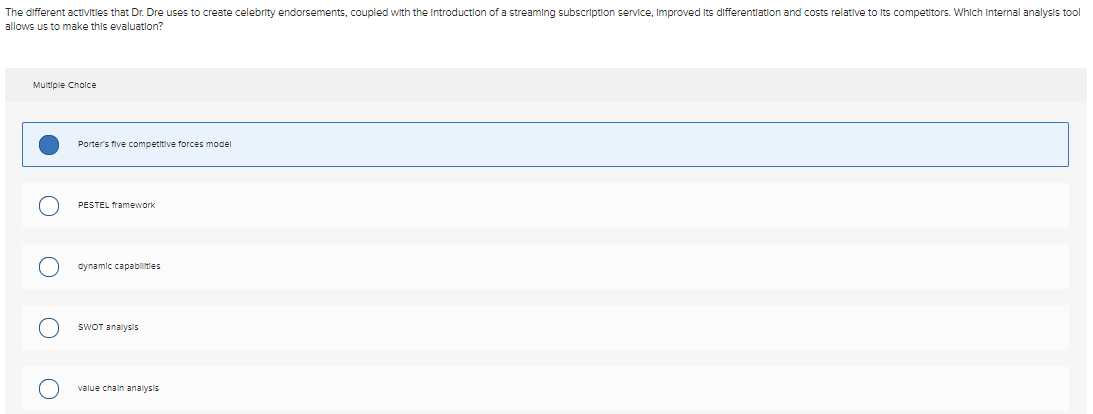
allows us to make this evaluation? Multiple Choice Porter's flve competitlve forces model PESTEL framework dynamic capablittes SWOT analysis value chain analysis
Step by Step Solution
There are 3 Steps involved in it

Get step-by-step solutions from verified subject matter experts
 Study Help