







Question: For each of the following iterations, write just enough code to pass the test... while meeting the principles of TDD. Include the code for each
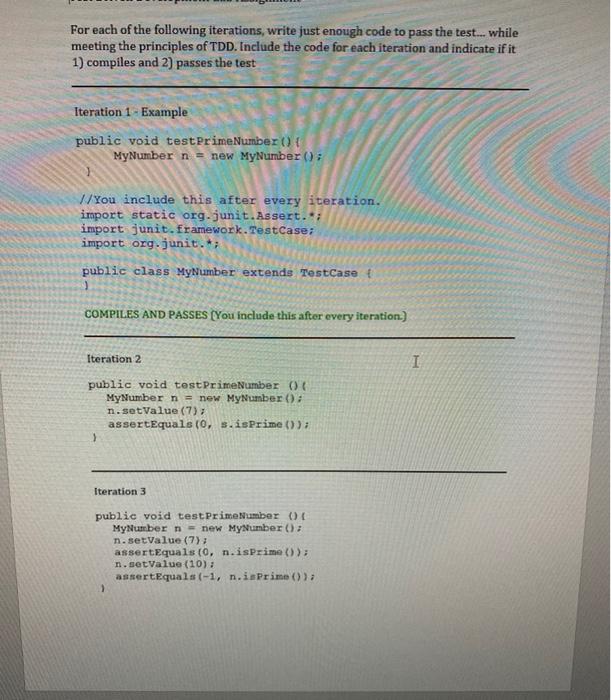
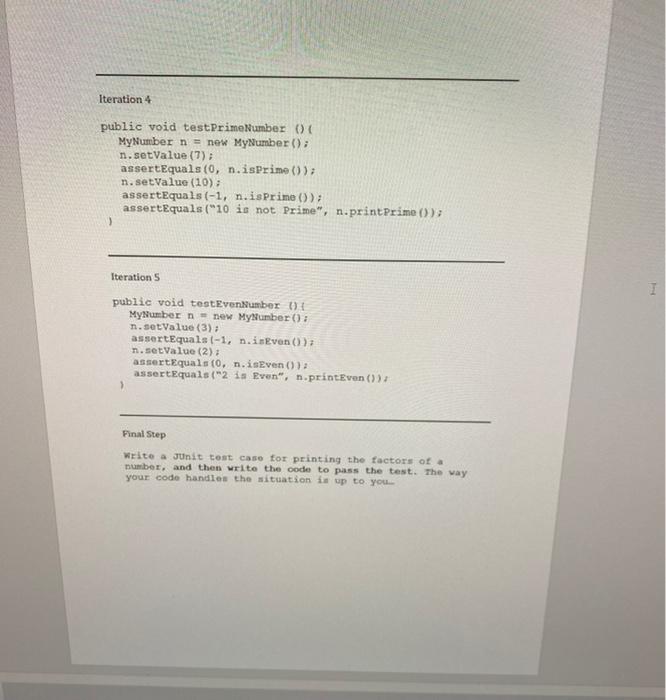
For each of the following iterations, write just enough code to pass the test... while meeting the principles of TDD. Include the code for each iteration and indicate if it 1) compiles and 2) passes the test Iteration 1 - Example public void testPrimeNumber() { MyNumber n = new MyNumber(); W/You include this after every iteration. import static org.junit. Assert.; import junit. framework. Test Case; import org.junit. public class MyNumber extends Testcase COMPILES AND PASSES (You include this after every iteration.) Iteration 2 I public void testPrimeNumber 0 MyNumber n = new MyNumber(); n.setValue (7); assertEquals(0, s.isPrime()); > Iteration 3 public void testPrimeNumber 0 MyNumber n = new MyNumber(); n.setValue (7); assertEquals(0, n.isPrime()); n.setValue(10): assertEquals(-1, n.isPrime()); 2 Iteration 4 public void testPrime Number 01 My Number n = new MyNumber(); n.setValue (7) assertEquals(0, n.isPrime()); n.setValue (10): assertEquals(-1, n.isPrime()); assertEquals("10 is not Prime", n.printPrime()); 1 Iteration 5 public void testEvenNumbert) MyNumber new MyNumber : n.setValue (3); assertEquals(-1, n.isEven()); n.setValue (2): assertEquals(0, n.isEven()); assertEquals("2 is Even", n.printEven()); Final Step Write a Junit test case for printing the factors of a number, and then write the code to pass the test. The way your code handles the situation is up to you
Step by Step Solution
There are 3 Steps involved in it

Get step-by-step solutions from verified subject matter experts
 Study Help