Question: Group Project #2 - Short Consulting Case Problem Several weeks ago, your consulting firm was hired to design, program, and implement a sales forecasting program
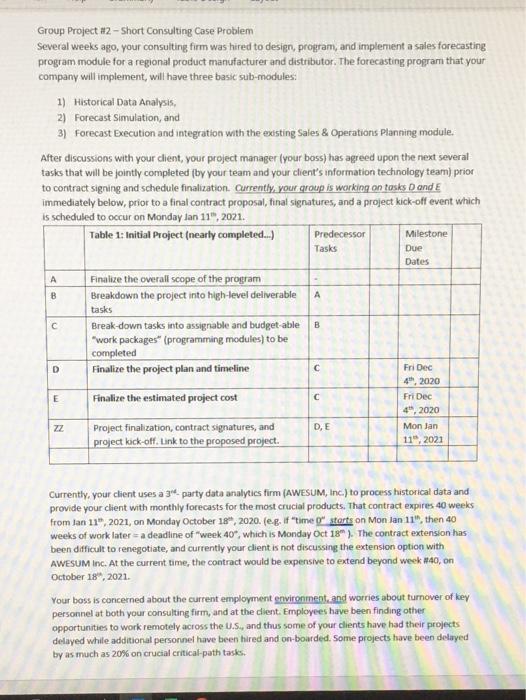
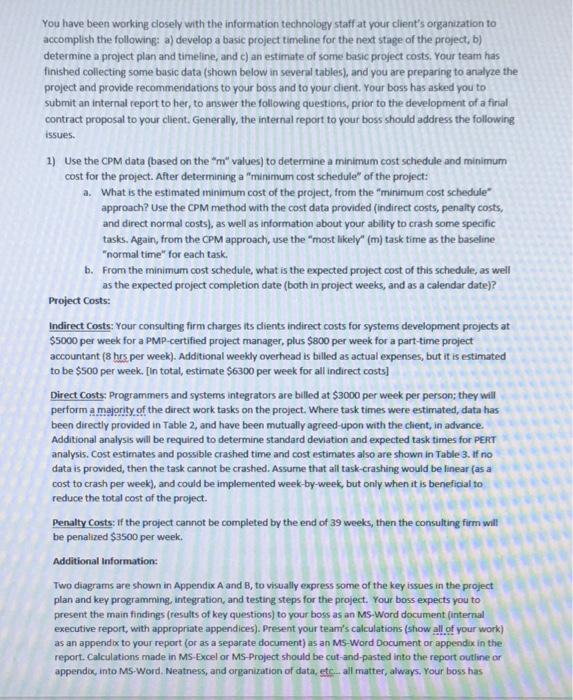
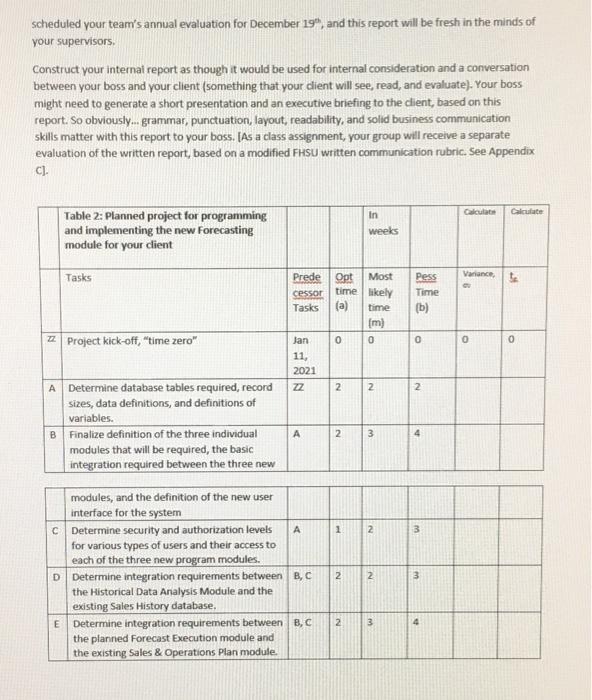
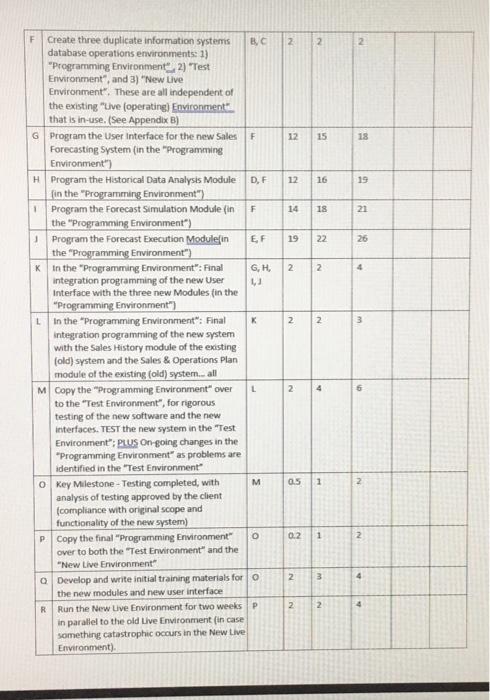
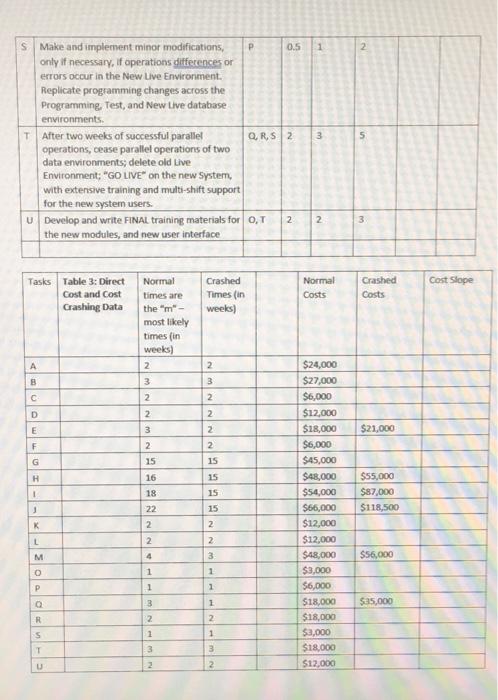
Group Project #2 - Short Consulting Case Problem Several weeks ago, your consulting firm was hired to design, program, and implement a sales forecasting program module for a regional product manufacturer and distributor. The forecasting program that your company will implement, will have three basic sub-modules: 1) Historical Data Analysis 2) Forecast Simulation, and 3) Forecast Execution and integration with the existing Sales & Operations Planning module. After discussions with your client, your project manager (your boss) has agreed upon the next several tasks that will be jointly completed by your team and your client's information technology team) prior to contract signing and schedule finalization. Currently, your group is working on tasks and E immediately below, prior to a final contract proposal, final signatures, and a project kick-off event which is scheduled to occur on Monday Jan 11", 2021. Table 1: Initial Project (nearly completed...) Predecessor Tasks Milestone Due Dates A B A c Finalize the overall scope of the program Breakdown the project into high-level deliverable tasks Break-down tasks into assignable and budget-able "work packages" (programming modules) to be completed Finalize the project plan and timeline B D C E Finalize the estimated project cost Fri Dec 4, 2020 Fri Dec 4, 2020 Mon Jan 11, 2021 ZZ DE Project finalization, contract signatures, and project kick-off. Link to the proposed project. Currently, your client uses a 3 party data analytics firm (AWESUM, Inc.) to process historical data and provide your client with monthly forecasts for the most crucial products. That contract expires 40 weeks from Jan 11, 2021, on Monday October 18, 2020. (eg, if "time" starts on Mon Jan 11, then 40 weeks of work later a deadline of "week 40", which is Monday Oct 18). The contract extension has been difficult to renegotiate, and currently your dient is not discussing the extension option with AWESUM Inc. At the current time, the contract would be expensive to extend beyond week #40, on October 18, 2021. Your boss is concerned about the current employment environment, and worries about turnover of key personnel at both your consulting firm, and at the dient. Employees have been finding other opportunities to work remotely across the U.S., and thus some of your clients have had their projects delayed while additional personnel have been hired and on-boarded. Some projects have been delayed by as much as 20% on crucial critical path tasks. You have been working dosely with the information technology staff at your client's organization to accomplish the following: a) develop a basic project timeline for the next stage of the project, b) determine a project plan and timeline, and c) an estimate of some basic project costs. Your team has finished collecting some basic data (shown below in several tables), and you are preparing to analyze the project and provide recommendations to your boss and to your client. Your boss has asked you to submit an internal report to her, to answer the following questions, prior to the development of a final contract proposal to your client. Generally, the internal report to your boss should address the following issues. 1) Use the CPM data (based on the "m" values) to determine a minimum cost schedule and minimum cost for the project. After determining a "minimum cost schedule" of the project: a. What is the estimated minimum cost of the project from the "minimum cost schedule approach? Use the CPM method with the cost data provided (indirect costs, penalty costs, and direct normal costs), as well as information about your ability to crash some specific tasks. Again, from the CPM approach, use the "most likely" (m) task time as the baseline "normal time" for each task. b. From the minimum cost schedule, what is the expected project cost of this schedule, as well as the expected project completion date (both in project weeks, and as a calendar date)? Project Costs: Indirect Costs: Your consulting firm charges its clients indirect costs for systems development projects at $5000 per week for a PMP-certified project manager, plus $800 per week for a part-time project accountant (8 hrs per week). Additional weekly overhead is billed as actual expenses, but it is estimated to be $500 per week. (In total, estimate $6300 per week for all indirect costs] Direct Costs: Programmers and systems integrators are billed at $3000 per week per person; they will perform a majority of the direct work tasks on the project. Where task times were estimated data has been directly provided in Table 2, and have been mutually agreed-upon with the client, in advance. Additional analysis will be required to determine standard deviation and expected task times for PERT analysis. Cost estimates and possible crashed time and cost estimates also are shown in Table 3. If no data is provided, then the task cannot be crashed. Assume that all task-crashing would be linear (as a cost to crash per week), and could be implemented week-by-week, but only when it is beneficial to reduce the total cost of the project. Penalty Costs: If the project cannot be completed by the end of 39 weeks, then the consulting firm will be penalized $3500 per week. Additional information: Two diagrams are shown in Appendix A and B, to visually express some of the key issues in the project plan and key programming, integration, and testing steps for the project. Your boss expects you to present the main findings (results of key questions to your boss as an MS-Word document (internal executive report, with appropriate appendices). Present your team's calculations (show all of your work) as an appendix to your report (or as a separate document) as an MS-Word Document or appendix in the report. Calculations made in MS-Excel or MS Project should be cut-and-pasted into the report outline or appendo, into MS-Word. Neatness, and organization of data, etc... all matter, always. Your boss has scheduled your team's annual evaluation for December 19", and this report will be fresh in the minds of your supervisors. Construct your internal report as though it would be used for internal consideration and a conversation between your boss and your client (something that your dient will see, read, and evaluate). Your boss might need to generate a short presentation and an executive briefing to the client, based on this report. So obviously.. grammar, punctuation, layout, readability, and solid business communication skills matter with this report to your boss. (As a class assignment, your group will receive a separate evaluation of the written report, based on a modified FHSU written communication rubric. See Appendix C) Calculate Calculate Table 2: Planned project for programming and implementing the new Forecasting module for your dient In weeks Tasks Variance 17 2 Prede cessor Tasks Opt Most time likely (a) time {m} 0 Pess Time b) 22 Project kick-off, "time zero" o 0 0 0 Jan 11, 2021 ZZ 2 2 2 A Determine database tables required, record sizes, data definitions, and definitions of variables. B Finalize definition of the three individual modules that will be required, the basic integration required between the three new A NI 3 4 A 1 2 3 modules, and the definition of the new user interface for the system c Determine security and authorization levels for various types of users and their access to each of the three new program modules. D Determine integration requirements between B, C the Historical Data Analysis Module and the existing Sales History database, E Determine integration requirements between B, C the planned Forecast Execution module and the existing Sales & Operations Plan module N 2 3 2 3 4 F 2 2 2 12 15 18 12 16 19 14 IS 21 19 22 26 K 2 2 4 2 2 2 3 Create three duplicate information systems BC database operations environments: 1) "Programming Environment 2) Test Environment, and 3) "New Live Environment". These are all independent of the existing "Live (operating) Environment that is in-use. (See Appendix B) 6 Program the User Interface for the new Sales F Forecasting System (in the "Programming Environment") H Program the Historical Data Analysis Module DF fin the "Programming Environment") 1 Program the Forecast Simulation Module (in F the "Programming Environment") Program the Forecast Execution Module in EF the "Programming Environment") In the "Programming Environment": Final G H integration programming of the new User Interface with the three new Modules in the "Programming Environment") In the Programming Environment": Final K Integration programming of the new system with the Sales History module of the existing (old) system and the Sales & Operations Plan module of the existing (old) system.. all M Copy the "Programming Environment over L to the "Test Environment", for rigorous testing of the new software and the new interfaces. TEST the new system in the "Test Environment":PLUS On-going changes in the "Programming Environment" as problems are identified in the "Test Environment O Key Milestone - Testing completed, with analysis of testing approved by the client compliance with original scope and functionality of the new system) pCopy the final "Programming Environment O over to both the "Test Environment and the "New Live Environment Q Develop and write initial training materials for o the new modules and new user interface R Run the New Live Environment for two weeks P in parallel to the old Live Environment in case something catastrophic occurs in the New Live Environment) 2 4 6 M 05 1 2 0.2 1 2 N 3 4 2 2 4 S P 2 3 5 Make and implement minor modifications, 0.5 only if necessary, If operations differences or errors occur in the New Live Environment. Replicate programming changes across the Programming, Test, and New Live database environments. T After two weeks of successful parallel O, RS2 operations, cease parallel operations of two data environments, delete old Live Environment; "GO LIVE on the new System, with extensive training and multi-shift support for the new system users. Develop and write FINAL training materials for OT the new modules, and new user interface 2 2 3 Cost Slope Tasks Table 3: Direct Cost and Cost Grashing Data Crashed Times (in weeks) Normal Costs Crashed Costs Normal times are the "m"- most likely times (in weeks) 2 3 A 2 B 3 2 2 NNNNN 2 D E 3 $21,000 F 2 2 G 15 15 H 16 15 1 18 15 15 2 22 2 $24,000 $27,000 $6,000 $12,000 $18,000 $6,000 $45,000 $48,000 $54,000 $66,000 $12,000 $12,000 $48.000 $3,000 $6,000 $18,000 $18,000 $3,000 $18,000 $12,000 $55,000 $87,000 $118,500 K L 2 2 3 M 4 $56,000 0 1 1 1 P 1 3 1 $35,000 2 2 R s 1 1 3 3 T U 2 2 Group Project #2 - Short Consulting Case Problem Several weeks ago, your consulting firm was hired to design, program, and implement a sales forecasting program module for a regional product manufacturer and distributor. The forecasting program that your company will implement, will have three basic sub-modules: 1) Historical Data Analysis 2) Forecast Simulation, and 3) Forecast Execution and integration with the existing Sales & Operations Planning module. After discussions with your client, your project manager (your boss) has agreed upon the next several tasks that will be jointly completed by your team and your client's information technology team) prior to contract signing and schedule finalization. Currently, your group is working on tasks and E immediately below, prior to a final contract proposal, final signatures, and a project kick-off event which is scheduled to occur on Monday Jan 11", 2021. Table 1: Initial Project (nearly completed...) Predecessor Tasks Milestone Due Dates A B A c Finalize the overall scope of the program Breakdown the project into high-level deliverable tasks Break-down tasks into assignable and budget-able "work packages" (programming modules) to be completed Finalize the project plan and timeline B D C E Finalize the estimated project cost Fri Dec 4, 2020 Fri Dec 4, 2020 Mon Jan 11, 2021 ZZ DE Project finalization, contract signatures, and project kick-off. Link to the proposed project. Currently, your client uses a 3 party data analytics firm (AWESUM, Inc.) to process historical data and provide your client with monthly forecasts for the most crucial products. That contract expires 40 weeks from Jan 11, 2021, on Monday October 18, 2020. (eg, if "time" starts on Mon Jan 11, then 40 weeks of work later a deadline of "week 40", which is Monday Oct 18). The contract extension has been difficult to renegotiate, and currently your dient is not discussing the extension option with AWESUM Inc. At the current time, the contract would be expensive to extend beyond week #40, on October 18, 2021. Your boss is concerned about the current employment environment, and worries about turnover of key personnel at both your consulting firm, and at the dient. Employees have been finding other opportunities to work remotely across the U.S., and thus some of your clients have had their projects delayed while additional personnel have been hired and on-boarded. Some projects have been delayed by as much as 20% on crucial critical path tasks. You have been working dosely with the information technology staff at your client's organization to accomplish the following: a) develop a basic project timeline for the next stage of the project, b) determine a project plan and timeline, and c) an estimate of some basic project costs. Your team has finished collecting some basic data (shown below in several tables), and you are preparing to analyze the project and provide recommendations to your boss and to your client. Your boss has asked you to submit an internal report to her, to answer the following questions, prior to the development of a final contract proposal to your client. Generally, the internal report to your boss should address the following issues. 1) Use the CPM data (based on the "m" values) to determine a minimum cost schedule and minimum cost for the project. After determining a "minimum cost schedule" of the project: a. What is the estimated minimum cost of the project from the "minimum cost schedule approach? Use the CPM method with the cost data provided (indirect costs, penalty costs, and direct normal costs), as well as information about your ability to crash some specific tasks. Again, from the CPM approach, use the "most likely" (m) task time as the baseline "normal time" for each task. b. From the minimum cost schedule, what is the expected project cost of this schedule, as well as the expected project completion date (both in project weeks, and as a calendar date)? Project Costs: Indirect Costs: Your consulting firm charges its clients indirect costs for systems development projects at $5000 per week for a PMP-certified project manager, plus $800 per week for a part-time project accountant (8 hrs per week). Additional weekly overhead is billed as actual expenses, but it is estimated to be $500 per week. (In total, estimate $6300 per week for all indirect costs] Direct Costs: Programmers and systems integrators are billed at $3000 per week per person; they will perform a majority of the direct work tasks on the project. Where task times were estimated data has been directly provided in Table 2, and have been mutually agreed-upon with the client, in advance. Additional analysis will be required to determine standard deviation and expected task times for PERT analysis. Cost estimates and possible crashed time and cost estimates also are shown in Table 3. If no data is provided, then the task cannot be crashed. Assume that all task-crashing would be linear (as a cost to crash per week), and could be implemented week-by-week, but only when it is beneficial to reduce the total cost of the project. Penalty Costs: If the project cannot be completed by the end of 39 weeks, then the consulting firm will be penalized $3500 per week. Additional information: Two diagrams are shown in Appendix A and B, to visually express some of the key issues in the project plan and key programming, integration, and testing steps for the project. Your boss expects you to present the main findings (results of key questions to your boss as an MS-Word document (internal executive report, with appropriate appendices). Present your team's calculations (show all of your work) as an appendix to your report (or as a separate document) as an MS-Word Document or appendix in the report. Calculations made in MS-Excel or MS Project should be cut-and-pasted into the report outline or appendo, into MS-Word. Neatness, and organization of data, etc... all matter, always. Your boss has scheduled your team's annual evaluation for December 19", and this report will be fresh in the minds of your supervisors. Construct your internal report as though it would be used for internal consideration and a conversation between your boss and your client (something that your dient will see, read, and evaluate). Your boss might need to generate a short presentation and an executive briefing to the client, based on this report. So obviously.. grammar, punctuation, layout, readability, and solid business communication skills matter with this report to your boss. (As a class assignment, your group will receive a separate evaluation of the written report, based on a modified FHSU written communication rubric. See Appendix C) Calculate Calculate Table 2: Planned project for programming and implementing the new Forecasting module for your dient In weeks Tasks Variance 17 2 Prede cessor Tasks Opt Most time likely (a) time {m} 0 Pess Time b) 22 Project kick-off, "time zero" o 0 0 0 Jan 11, 2021 ZZ 2 2 2 A Determine database tables required, record sizes, data definitions, and definitions of variables. B Finalize definition of the three individual modules that will be required, the basic integration required between the three new A NI 3 4 A 1 2 3 modules, and the definition of the new user interface for the system c Determine security and authorization levels for various types of users and their access to each of the three new program modules. D Determine integration requirements between B, C the Historical Data Analysis Module and the existing Sales History database, E Determine integration requirements between B, C the planned Forecast Execution module and the existing Sales & Operations Plan module N 2 3 2 3 4 F 2 2 2 12 15 18 12 16 19 14 IS 21 19 22 26 K 2 2 4 2 2 2 3 Create three duplicate information systems BC database operations environments: 1) "Programming Environment 2) Test Environment, and 3) "New Live Environment". These are all independent of the existing "Live (operating) Environment that is in-use. (See Appendix B) 6 Program the User Interface for the new Sales F Forecasting System (in the "Programming Environment") H Program the Historical Data Analysis Module DF fin the "Programming Environment") 1 Program the Forecast Simulation Module (in F the "Programming Environment") Program the Forecast Execution Module in EF the "Programming Environment") In the "Programming Environment": Final G H integration programming of the new User Interface with the three new Modules in the "Programming Environment") In the Programming Environment": Final K Integration programming of the new system with the Sales History module of the existing (old) system and the Sales & Operations Plan module of the existing (old) system.. all M Copy the "Programming Environment over L to the "Test Environment", for rigorous testing of the new software and the new interfaces. TEST the new system in the "Test Environment":PLUS On-going changes in the "Programming Environment" as problems are identified in the "Test Environment O Key Milestone - Testing completed, with analysis of testing approved by the client compliance with original scope and functionality of the new system) pCopy the final "Programming Environment O over to both the "Test Environment and the "New Live Environment Q Develop and write initial training materials for o the new modules and new user interface R Run the New Live Environment for two weeks P in parallel to the old Live Environment in case something catastrophic occurs in the New Live Environment) 2 4 6 M 05 1 2 0.2 1 2 N 3 4 2 2 4 S P 2 3 5 Make and implement minor modifications, 0.5 only if necessary, If operations differences or errors occur in the New Live Environment. Replicate programming changes across the Programming, Test, and New Live database environments. T After two weeks of successful parallel O, RS2 operations, cease parallel operations of two data environments, delete old Live Environment; "GO LIVE on the new System, with extensive training and multi-shift support for the new system users. Develop and write FINAL training materials for OT the new modules, and new user interface 2 2 3 Cost Slope Tasks Table 3: Direct Cost and Cost Grashing Data Crashed Times (in weeks) Normal Costs Crashed Costs Normal times are the "m"- most likely times (in weeks) 2 3 A 2 B 3 2 2 NNNNN 2 D E 3 $21,000 F 2 2 G 15 15 H 16 15 1 18 15 15 2 22 2 $24,000 $27,000 $6,000 $12,000 $18,000 $6,000 $45,000 $48,000 $54,000 $66,000 $12,000 $12,000 $48.000 $3,000 $6,000 $18,000 $18,000 $3,000 $18,000 $12,000 $55,000 $87,000 $118,500 K L 2 2 3 M 4 $56,000 0 1 1 1 P 1 3 1 $35,000 2 2 R s 1 1 3 3 T U 2 2









 Study Help