







Question: Heat transfer problem - show all work A plane wall consisting of two dissimilar layers is insulated on one side (AB). The other side EF
Heat transfer problem - show all work
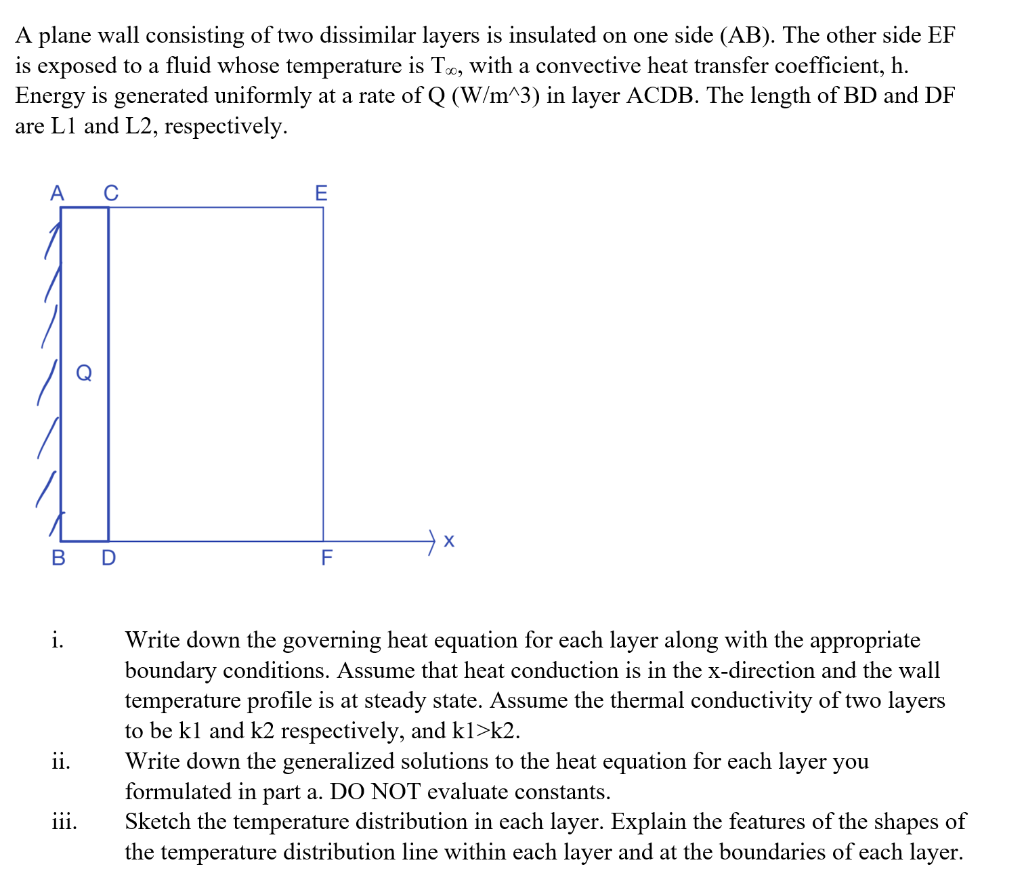
A plane wall consisting of two dissimilar layers is insulated on one side (AB). The other side EF is exposed to a fluid whose temperature is T, with a convective heat transfer coefficient, h. Energy is generated uniformly at a rate of Q(W/m3) in layer ACDB. The length of BD and DF are L1 and L2, respectively. i. Write down the governing heat equation for each layer along with the appropriate boundary conditions. Assume that heat conduction is in the x-direction and the wall temperature profile is at steady state. Assume the thermal conductivity of two layers to be k1 and k2 respectively, and k1>k2. ii. Write down the generalized solutions to the heat equation for each layer you formulated in part a. DO NOT evaluate constants. iii. Sketch the temperature distribution in each layer. Explain the features of the shapes of the temperature distribution line within each layer and at the boundaries of each layer
Step by Step Solution
There are 3 Steps involved in it

Get step-by-step solutions from verified subject matter experts
 Study Help