







Question: import numpy as np; import pylab as pl def fx): return y N-200 a-0 b-1 x-np.linspace(a,b.N+1) np.linspace(a,b.N+1) y- for k in range (O,N+1): pl. grid(b=True)
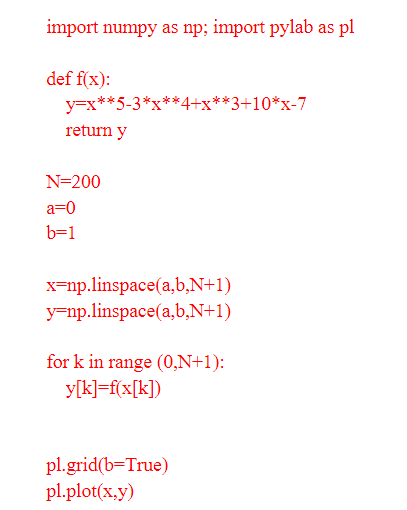


import numpy as np; import pylab as pl def fx): return y N-200 a-0 b-1 x-np.linspace(a,b.N+1) np.linspace(a,b.N+1) y- for k in range (O,N+1): pl. grid(b=True) pl.plot(x.y) 1. Using the above plotting program plot In(1x) together with the Taylor polynomial of degree n with a -0 on the interval [.5,.5] together. Use different colors for the two curves in each pictures. Do this for n 0,..3. 2, Do the same for exp(x) on the interval [-3,3] for n = 0, ,5. Find the general formula for the degree n Taylor polynomials with a sin(x) and cos(x) 3. 0 for import numpy as np; import pylab as pl def fx): return y N-200 a-0 b-1 x-np.linspace(a,b.N+1) np.linspace(a,b.N+1) y- for k in range (O,N+1): pl. grid(b=True) pl.plot(x.y) 1. Using the above plotting program plot In(1x) together with the Taylor polynomial of degree n with a -0 on the interval [.5,.5] together. Use different colors for the two curves in each pictures. Do this for n 0,..3. 2, Do the same for exp(x) on the interval [-3,3] for n = 0, ,5. Find the general formula for the degree n Taylor polynomials with a sin(x) and cos(x) 3. 0 for
Step by Step Solution
There are 3 Steps involved in it

Get step-by-step solutions from verified subject matter experts
 Study Help