Question: Instructions: This is your final assignment. It is due as a PDF file posted to Blackboard by the date listed on the course schedule. Late
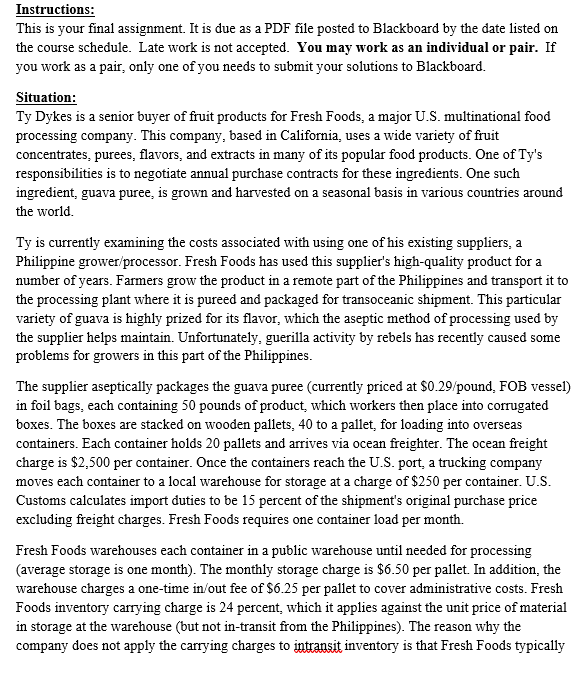
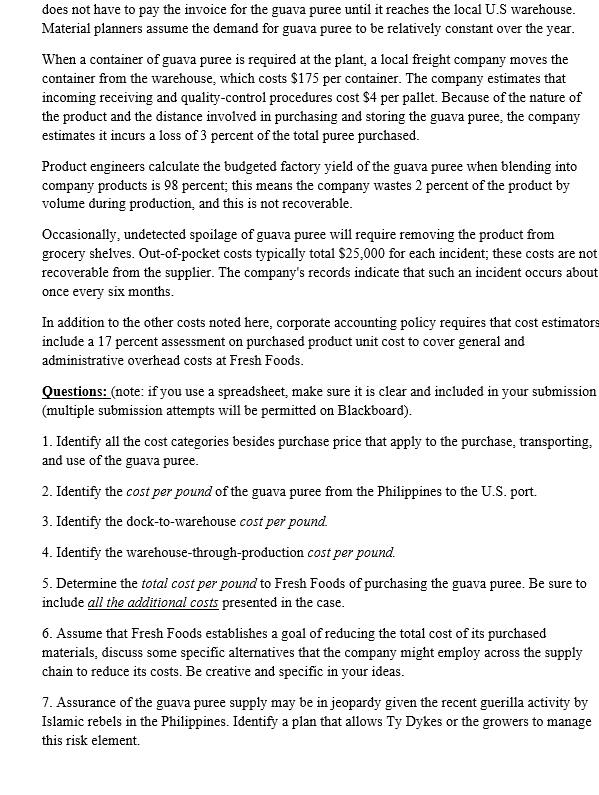
Instructions: This is your final assignment. It is due as a PDF file posted to Blackboard by the date listed on the course schedule. Late work is not accepted. You may work as an individual or pair. If you work as a pair, only one of you needs to submit your solutions to Blackboard. Situation: Ty Dykes is a senior buyer of fruit products for Fresh Foods, a major U.S. multinational food processing company. This company, based in California, uses a wide variety of fruit concentrates, purees, flavors, and extracts in many of its popular food products. One of Ty's responsibilities is to negotiate annual purchase contracts for these ingredients. One such ingredient, guava puree, is grown and harvested on a seasonal basis in various countries around the world Ty is currently examining the costs associated with using one of his existing suppliers, a Philippine grower/processor. Fresh Foods has used this supplier's high-quality product for a number of years. Farmers grow the product in a remote part of the Philippines and transport it to the processing plant where it is pureed and packaged for transoceanic shipment. This particular variety of guava is highly prized for its flavor, which the aseptic method of processing used by the supplier helps maintain. Unfortunately, guerilla activity by rebels has recently caused some problems for growers in this part of the Philippines. The supplier aseptically packages the guava puree (currently priced at $0.29 pound. FOB vessel) in foil bags, each containing 50 pounds of product, which workers then place into corrugated boxes. The boxes are stacked on wooden pallets, 40 to a pallet, for loading into overseas containers. Each container holds 20 pallets and arrives via ocean freighter. The ocean freight charge is $2,500 per container. Once the containers reach the U.S. port, a trucking company moves each container to a local warehouse for storage at a charge of $250 per container. U.S. Customs calculates import duties to be 15 percent of the shipment's original purchase price excluding freight charges. Fresh Foods requires one container load per month. Fresh Foods warehouses each container in a public warehouse until needed for processing (average storage is one month). The monthly storage charge is $6.50 per pallet. In addition, the warehouse charges a one-time in/out fee of $6.25 per pallet to cover administrative costs. Fresh Foods inventory carrying charge is 24 percent, which it applies against the unit price of material in storage at the warehouse (but not in-transit from the Philippines). The reason why the company does not apply the carrying charges to intransit inventory is that Fresh Foods typically does not have to pay the invoice for the guava puree until it reaches the local U.S warehouse. Material planners assume the demand for guava puree to be relatively constant over the year. When a container of guava puree is required at the plant, a local freight company moves the container from the warehouse, which costs $175 per container. The company estimates that incoming receiving and quality-control procedures cost $4 per pallet. Because of the nature of the product and the distance involved in purchasing and storing the guava puree, the company estimates it incurs a loss of 3 percent of the total puree purchased. Product engineers calculate the budgeted factory yield of the guava puree when blending into company products is 98 percent; this means the company wastes 2 percent of the product by volume during production, and this is not recoverable. Occasionally, undetected spoilage of guava puree will require removing the product from grocery shelves. Out-of-pocket costs typically total $25,000 for each incident; these costs are not recoverable from the supplier. The company's records indicate that such an incident occurs about once every six months. In addition to the other costs noted here, corporate accounting policy requires that cost estimators include a 17 percent assessment on purchased product unit cost to cover general and administrative overhead costs at Fresh Foods. Questions: (note: if you use a spreadsheet, make sure it is clear and included in your submission (multiple submission attempts will be permitted on Blackboard). 1. Identify all the cost categories besides purchase price that apply to the purchase, transporting, and use of the guava puree. 2. Identify the cost per pound of the guava puree from the Philippines to the U.S. port. 3. Identify the dock-to-warehouse cost per pound. 4. Identify the warehouse-through-production cost per pound. 5. Determine the total cost per pound to Fresh Foods of purchasing the guava puree. Be sure to include all the additional costs presented in the case. 6. Assume that Fresh Foods establishes a goal of reducing the total cost of its purchased materials, discuss some specific alternatives that the company might employ across the supply chain to reduce its costs. Be creative and specific in your ideas. 7. Assurance of the guava puree supply may be in jeopardy given the recent guerilla activity by Islamic rebels in the Philippines. Identify a plan that allows Ty Dykes or the growers to manage this risk element









 Study Help