Question: Introduction and Instructions: We will be using the same case of ED&I (used for both WBS and schedule assignment). This will help us to understand
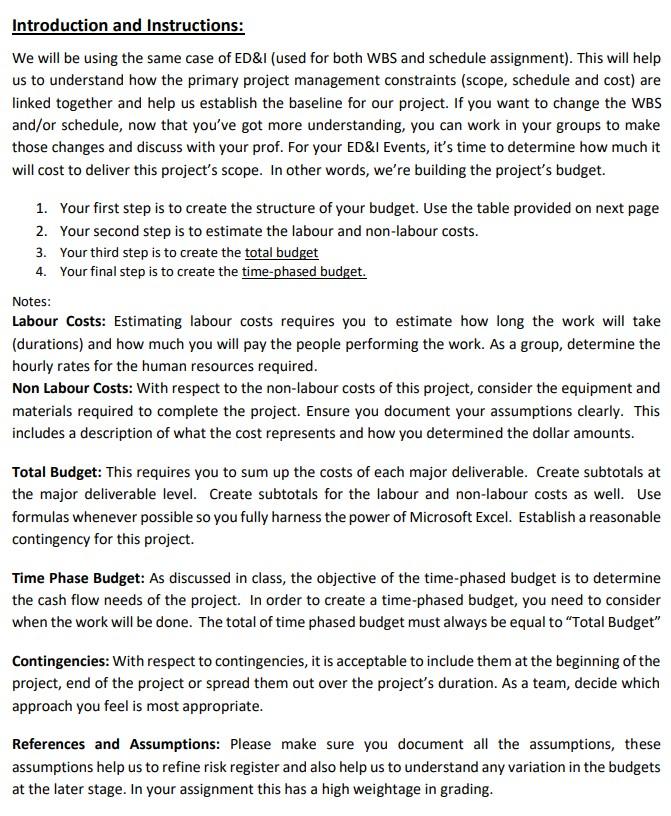
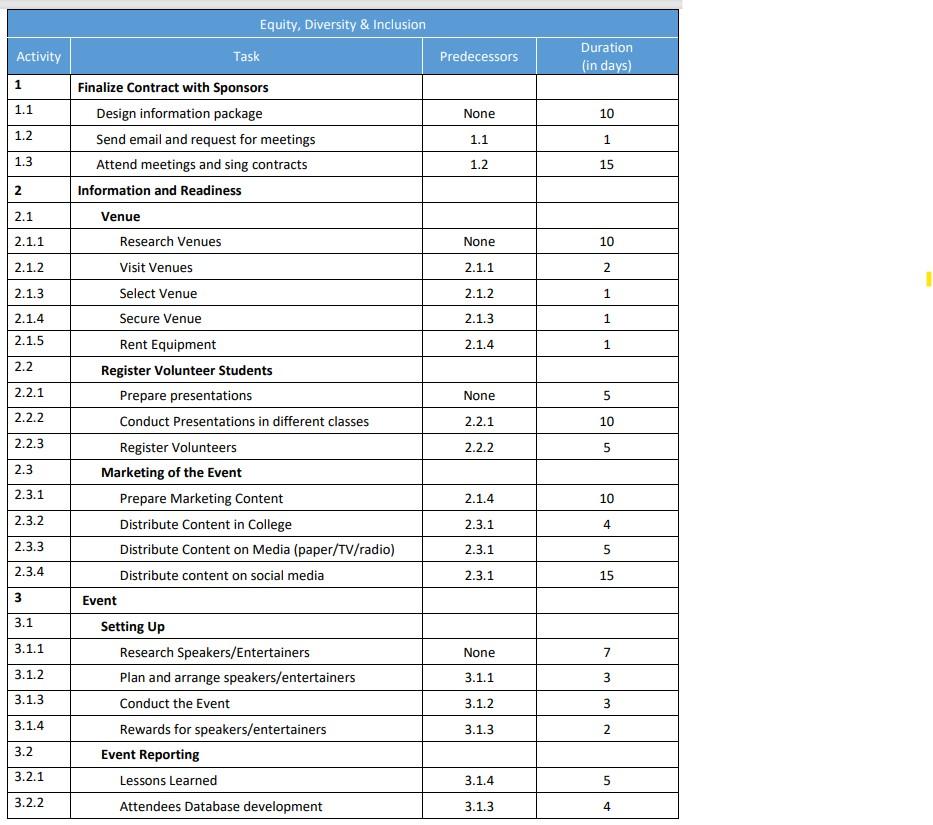
Introduction and Instructions: We will be using the same case of ED\&I (used for both WBS and schedule assignment). This will help us to understand how the primary project management constraints (scope, schedule and cost) are linked together and help us establish the baseline for our project. If you want to change the WBS and/or schedule, now that you've got more understanding, you can work in your groups to make those changes and discuss with your prof. For your ED\&I Events, it's time to determine how much it will cost to deliver this project's scope. In other words, we're building the project's budget. 1. Your first step is to create the structure of your budget. Use the table provided on next page 2. Your second step is to estimate the labour and non-labour costs. 3. Your third step is to create the total budget 4. Your final step is to create the time-phased budget. Notes: Labour Costs: Estimating labour costs requires you to estimate how long the work will take (durations) and how much you will pay the people performing the work. As a group, determine the hourly rates for the human resources required. Non Labour Costs: With respect to the non-labour costs of this project, consider the equipment and materials required to complete the project. Ensure you document your assumptions clearly. This includes a description of what the cost represents and how you determined the dollar amounts. Total Budget: This requires you to sum up the costs of each major deliverable. Create subtotals at the major deliverable level. Create subtotals for the labour and non-labour costs as well. Use formulas whenever possible so you fully harness the power of Microsoft Excel. Establish a reasonable contingency for this project. Time Phase Budget: As discussed in class, the objective of the time-phased budget is to determine the cash flow needs of the project. In order to create a time-phased budget, you need to consider when the work will be done. The total of time phased budget must always be equal to "Total Budget" Contingencies: With respect to contingencies, it is acceptable to include them at the beginning of the project, end of the project or spread them out over the project's duration. As a team, decide which approach you feel is most appropriate. References and Assumptions: Please make sure you document all the assumptions, these assumptions help us to refine risk register and also help us to understand any variation in the budgets at the later stage. In your assignment this has a high weightage in grading. Introduction and Instructions: We will be using the same case of ED\&I (used for both WBS and schedule assignment). This will help us to understand how the primary project management constraints (scope, schedule and cost) are linked together and help us establish the baseline for our project. If you want to change the WBS and/or schedule, now that you've got more understanding, you can work in your groups to make those changes and discuss with your prof. For your ED\&I Events, it's time to determine how much it will cost to deliver this project's scope. In other words, we're building the project's budget. 1. Your first step is to create the structure of your budget. Use the table provided on next page 2. Your second step is to estimate the labour and non-labour costs. 3. Your third step is to create the total budget 4. Your final step is to create the time-phased budget. Notes: Labour Costs: Estimating labour costs requires you to estimate how long the work will take (durations) and how much you will pay the people performing the work. As a group, determine the hourly rates for the human resources required. Non Labour Costs: With respect to the non-labour costs of this project, consider the equipment and materials required to complete the project. Ensure you document your assumptions clearly. This includes a description of what the cost represents and how you determined the dollar amounts. Total Budget: This requires you to sum up the costs of each major deliverable. Create subtotals at the major deliverable level. Create subtotals for the labour and non-labour costs as well. Use formulas whenever possible so you fully harness the power of Microsoft Excel. Establish a reasonable contingency for this project. Time Phase Budget: As discussed in class, the objective of the time-phased budget is to determine the cash flow needs of the project. In order to create a time-phased budget, you need to consider when the work will be done. The total of time phased budget must always be equal to "Total Budget" Contingencies: With respect to contingencies, it is acceptable to include them at the beginning of the project, end of the project or spread them out over the project's duration. As a team, decide which approach you feel is most appropriate. References and Assumptions: Please make sure you document all the assumptions, these assumptions help us to refine risk register and also help us to understand any variation in the budgets at the later stage. In your assignment this has a high weightage in grading









 Study Help