







Question: Introduction Solving Equation (3.5) for 7 and plugging into Equa- tion (3.6) yields In this laboratory a metal ball will be launched hori- zontally from
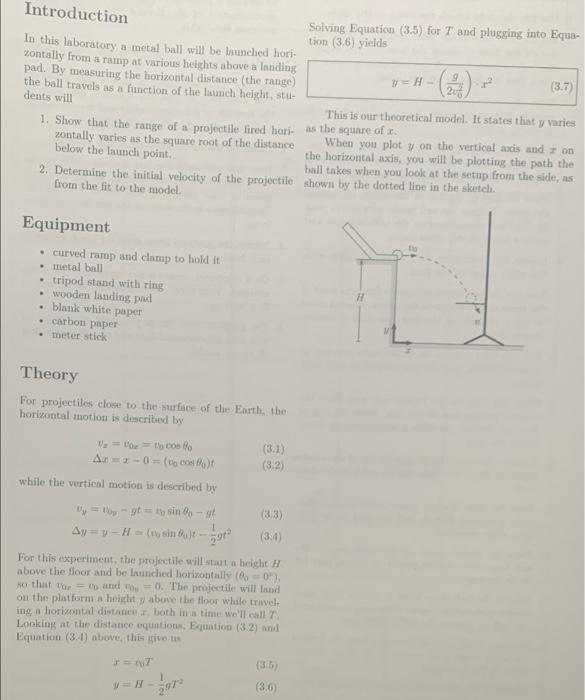

Introduction Solving Equation (3.5) for 7 and plugging into Equa- tion (3.6) yields In this laboratory a metal ball will be launched hori- zontally from a ramp at various heights above a landing pad. By measuring the horizontal distance (the range) 1 = H - (3.7) the ball travels as a function of the launch height, stu- dents will This is our theoretical model. It states that y varies 1. Show that the range of a projectile fired hori- as the square of r. zontally varies as the square root of the distance When you plot y on the vertical axis and i on below the launch point. the horizontal axis, you will be plotting the path the ball takes when you look at the setup from the side, as 2. Determine the initial velocity of the projectile shown by the dotted line in the sketch. from the fit to the model. Equipment . curved ramp and clamp to hold it . metal ball tripod stand with ring wooden landing prod blank white paper carbon paper meter stick Theory For projectiles close to the surface of the Earth, the horizontal motion is described by (3.1) (3.2) while the vertical motion is described by (3.3) (3:4) For this experiment, the projectile will start a bright H above the floor and be launched horizontally (8 = 0), so that Tor = Up and co. = 0. The projectile will land on the platform a height p above the floor while travel ing a horizontal distance . both in a time we'll call 7 Looking at the distance equations, Equation (3.2) and Equation (3.0) above, this give us (3 5) (3.0)In all these questions, assume up is positive.y 1. A metal ball is held at rest H = 65.0 cm above the floor. The ball is released with no initial velocity. How much time does it take to hit the floor
Step by Step Solution
There are 3 Steps involved in it

Get step-by-step solutions from verified subject matter experts
 Study Help