







Question: Leti , i = 1, . . . , n be positive numbers that sum to 1. LetQbe an irreducible transition probability matrix with transition
Leti , i = 1, . . . , n be positive numbers that sum to 1. LetQbe an irreducible
transition probability matrix with transition probabilities q(i, j ), i, j =
1, . . . , n. Suppose that we simulate a Markov chain in the following manner:
if the current state of this chain is i , then we generate a random variable that
is equal to k with probability q(i, k), k = 1, . . . , n. If the generated value is j
then the next state of the Markov chain is either i or j , being equal to j with
probability j q( j,i )
i q(i, j )+ j q( j,i ) and to i with probability 1 j q( j,i )
i q(i, j )+ j q( j,i ) .
(a) Give the transition probabilities of the Markov chain we are simulating.
(b) Show that {1, . . . , n} are the stationary probabilities of this chain.
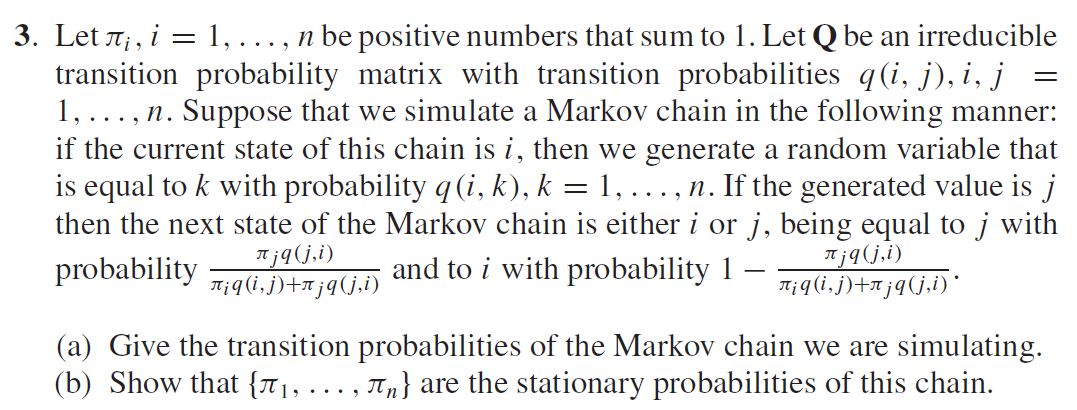
3. Let 31;, i = l, . . . , n be positive numbers that sum to 1. Let Q be an irreducible transition probability matrix with transition probabilities q(i, j ), i, j = l, . . . , 11. Suppose that we simulate a Markov chain in the following manner: if the current state of this chain is i, then we generate a random variable that is equal to k with probability q(i, k), k = 1, . . . , at. If the generated value is j then the next state of the Markov chain is either i or j, being equal to j with probability W W) 31' jIUJ) :r;q(i,j)+njq(j,i) and to; With probab111ty l Kt_q(1.7j) +Jrthjai)' (a) Give the transition probabilities of the Markov chain we are simulating. (b) Show that {31], . . . , 31\"} are the stationary probabilities of this chain
Step by Step Solution
There are 3 Steps involved in it

Get step-by-step solutions from verified subject matter experts
 Study Help