







Question: . . necessities study the give records deeply and Drawing conclusions refers to records this is implied or inferred. ... the use of those clues
.
. necessities study the give records deeply and Drawing conclusions refers to records this is implied or inferred. ... the use of those clues to give for deeper information And provide the details Conclusions
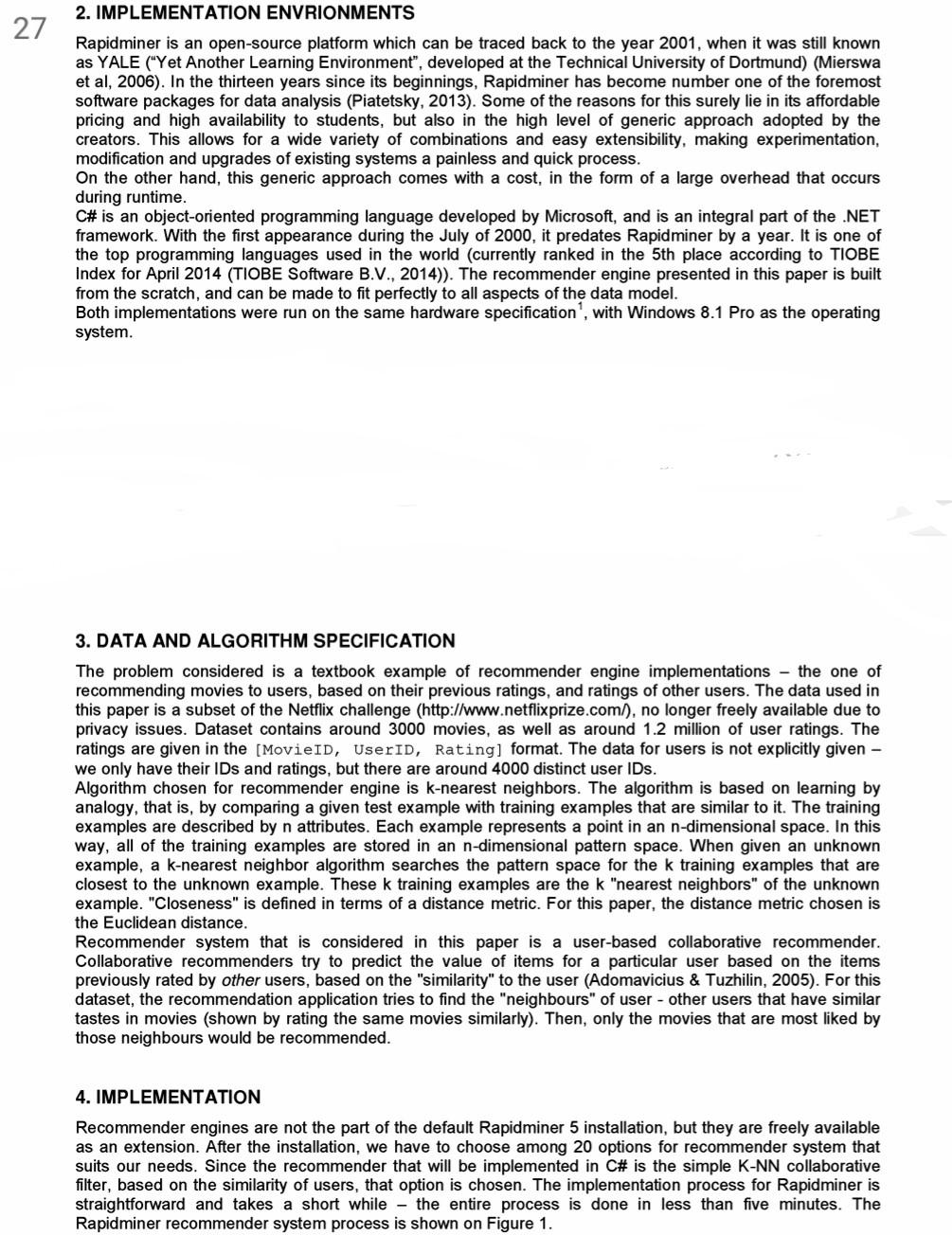
27 2. IMPLEMENTATION ENVRIONMENTS Rapidminer is an open-source platform which can be traced back to the year 2001, when it was still known as YALE ("Yet Another Learning Environment", developed at the Technical University of Dortmund) (Mierswa et al, 2006). In the thirteen years since its beginnings, Rapidminer has become number one of the foremost software packages for data analysis (Piatetsky, 2013). Some of the reasons for this surely lie in its affordable pricing and high availability to students, but also in the high level of generic approach adopted by the creators. This allows for a wide variety of combinations and easy extensibility, making experimentation, modification and upgrades of existing systems a painless and quick process. On the other hand, this generic approach comes with a cost, in the form of a large overhead that occurs during runtime. C# is an object-oriented programming language developed by Microsoft, and is an integral part of the .NET framework. With the first appearance during the July of 2000, it predates Rapidminer by a year. It is one of the top programming languages used in the world (currently ranked in the 5th place according to TIOBE Index for April 2014 (TIOBE Software B.V., 2014)). The recommender engine presented in this paper is built from the scratch, and can be made to fit perfectly to all aspects of the data model. Both implementations were run on the same hardware specification, with Windows 8.1 Pro as the operating system. 3. DATA AND ALGORITHM SPECIFICATION The problem considered is a textbook example of recommender engine implementations - the one of recommending movies to users, based on their previous ratings, and ratings of other users. The data used in this paper is a subset of the Netflix challenge (http://www.netflixprize.com), no longer freely available due to privacy issues. Dataset contains around 3000 movies, as well as around 1.2 million of user ratings. The ratings are given in the [MovieID, UserID, Rating] format. The data for users is not explicitly given - we only have their IDs and ratings, but there are around 4000 distinct user IDs. Algorithm chosen for recommender engine is k-nearest neighbors. The algorithm is based on learning by analogy, that is, by comparing a given test example with training examples that are similar to it. The training examples are described by n attributes. Each example represents a point in an n-dimensional space. In this way, all of the training examples are stored in an n-dimensional pattern space. When given an unknown example, a k-nearest neighbor algorithm searches the pattern space for the k training examples that are closest to the unknown example. These k training examples are the k "nearest neighbors" of the unknown example. "Closeness" is defined in terms of a distance metric. For this paper, the distance metric chosen is the Euclidean distance. Recommender system that is considered in this paper is a user-based collaborative recommender. Collaborative recommenders try to predict the value of items for a particular user based on the items previously rated by other users, based on the "similarity" to the user (Adomavicius & Tuzhilin, 2005). For this dataset, the recommendation application tries to find the "neighbours" of user - other users that have similar tastes in movies (shown by rating the same movies similarly). Then, only the movies that are most liked by those neighbours would be recommended. 4. IMPLEMENTATION Recommender engines are not the part of the default Rapidminer 5 installation, but they are freely available as an extension. After the installation, we have to choose among 20 options for recommender system that suits our needs. Since the recommender that will be implemented in C# is the simple K-NN collaborative filter, based on the similarity of users, that option is chosen. The implementation process for Rapidminer is straightforward and takes a short while the entire process is done in less than five minutes. The Rapidminer recommender system process is shown on Figure 1Step by Step Solution
There are 3 Steps involved in it
1 Expert Approved Answer
Step: 1 Unlock

Question Has Been Solved by an Expert!
Get step-by-step solutions from verified subject matter experts
Step: 2 Unlock
Step: 3 Unlock
 Study Help