







Question: Old MathJax webview Old MathJax webview please do Q.1 only ASAP.... I'll give you up thumb definitely Please solve Q.4 only ASAP and please no
Old MathJax webview
Old MathJax webview
please do Q.1 only ASAP.... I'll give you up thumb definitely
Please solve Q.4 only ASAP and please no need to solve any other question... I'll give you up thumb definitely
please do only Q.4 please please urgently... I'll give you up thumb definitely
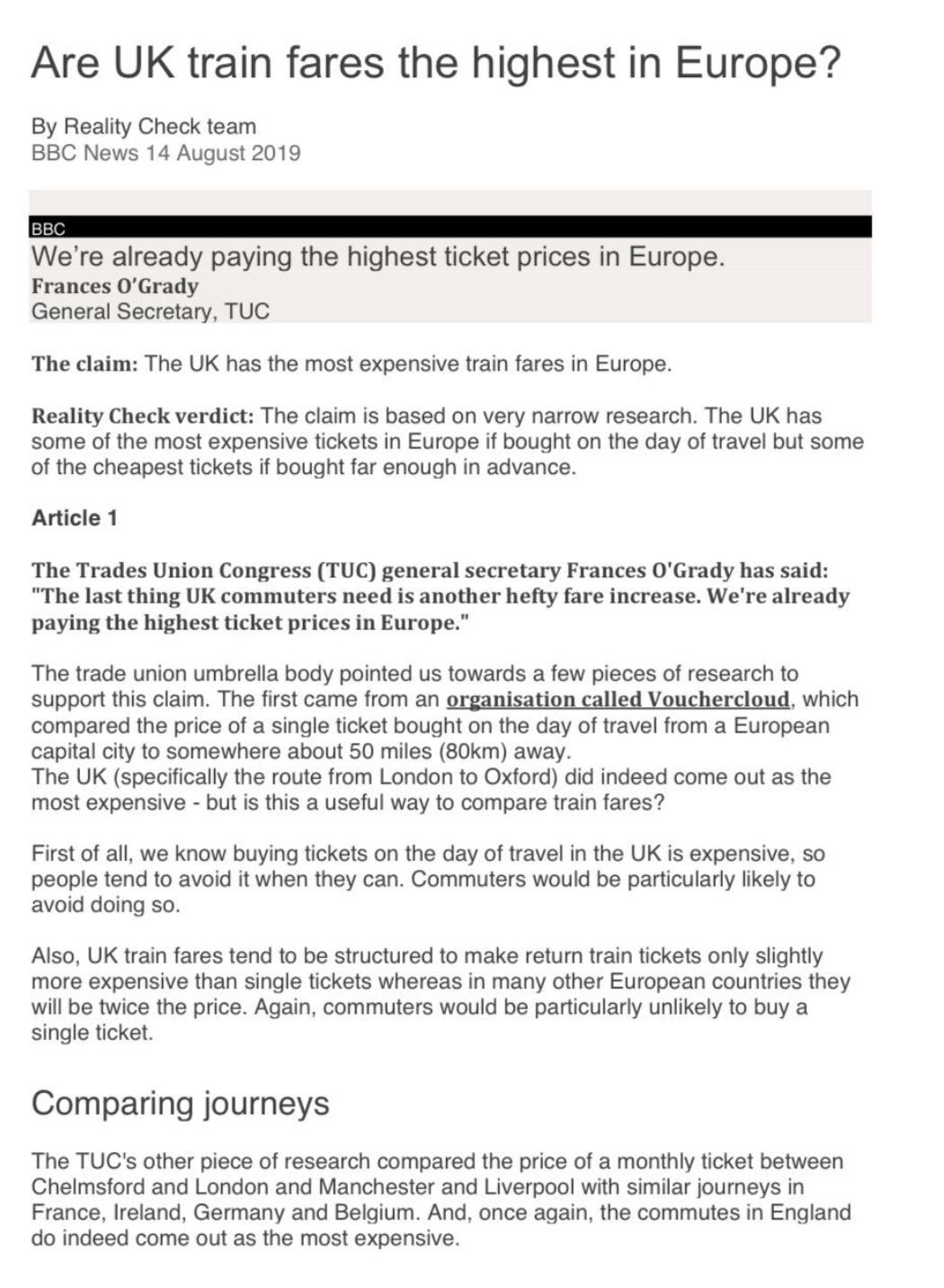
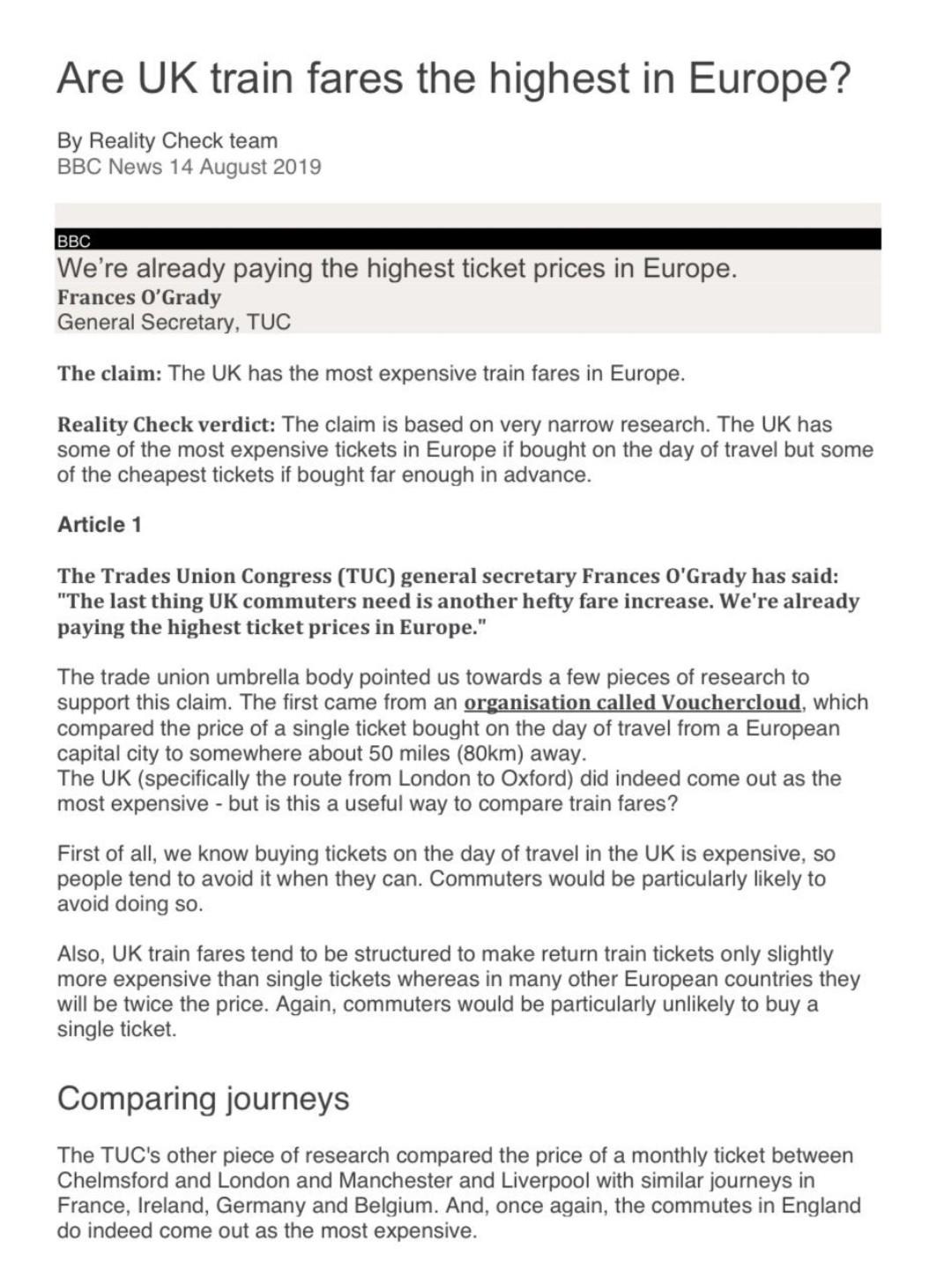
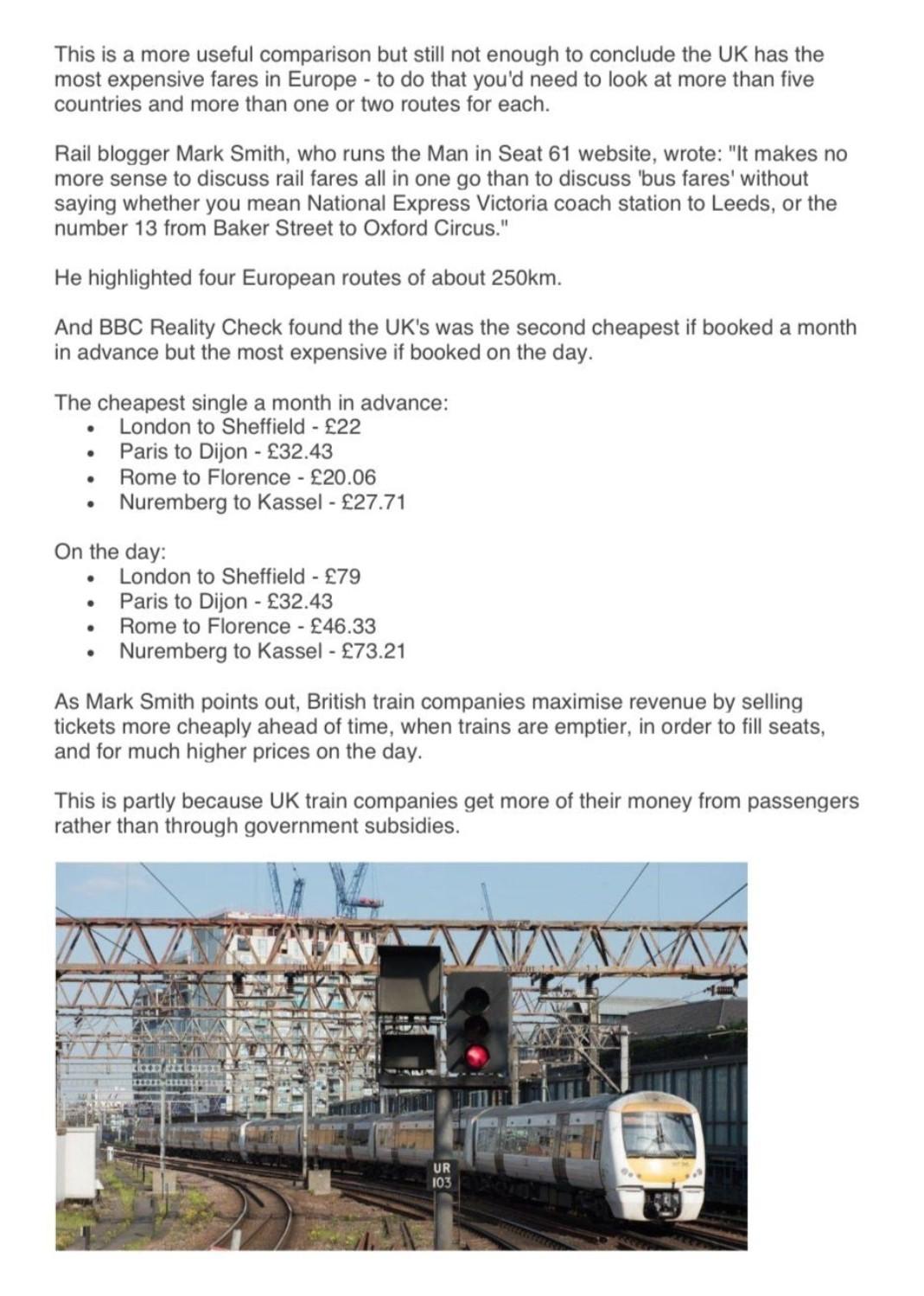
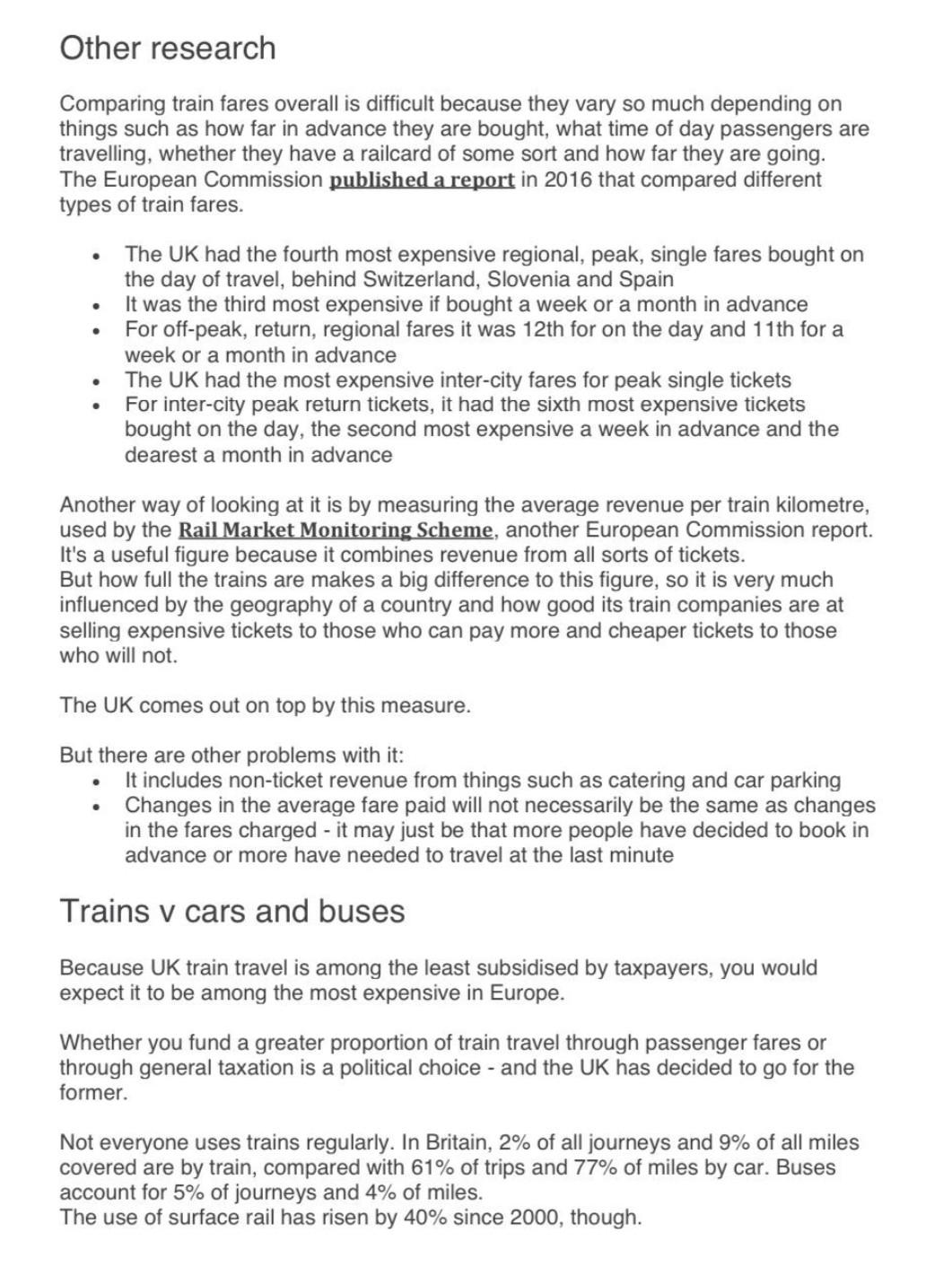
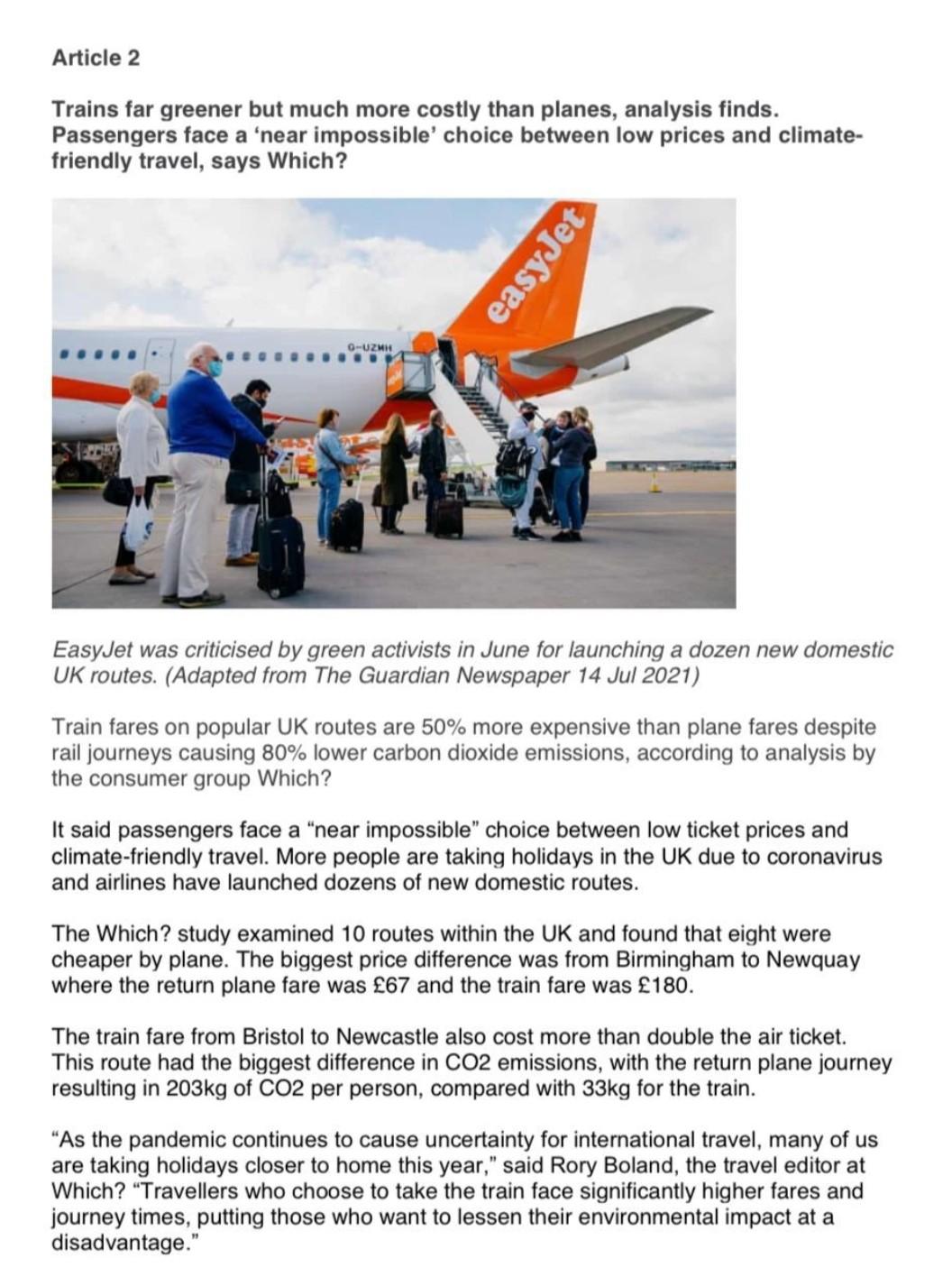
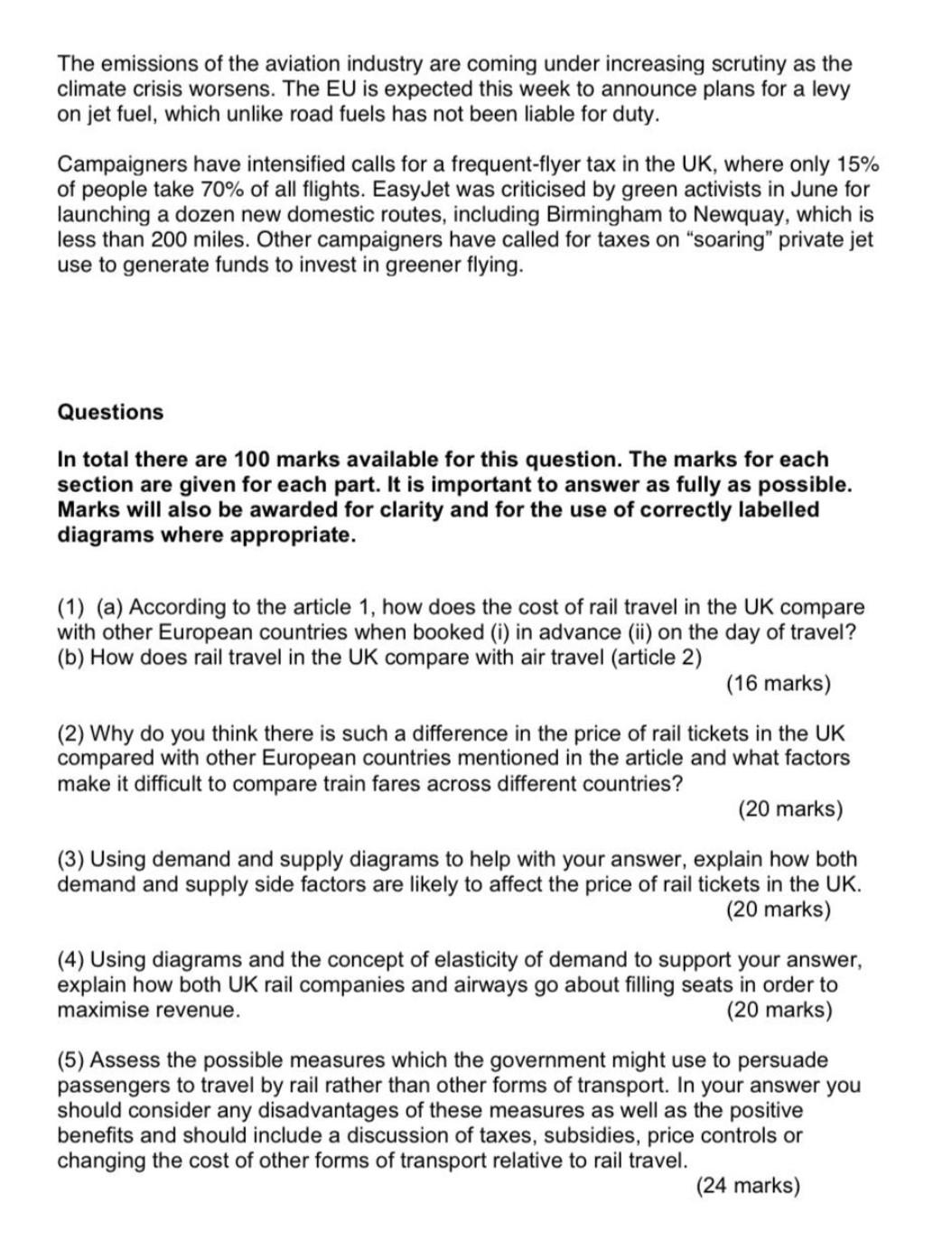
Are UK train fares the highest in Europe? By Reality Check team BBC News 14 August 2019 BBC We're already paying the highest ticket prices in Europe. Frances O'Grady General Secretary, TUC The claim: The UK has the most expensive train fares in Europe. Reality Check verdict: The claim is based on very narrow research. The UK has some of the most expensive tickets in Europe if bought on the day of travel but some of the cheapest tickets if bought far enough in advance. Article 1 The Trades Union Congress (TUC) general secretary Frances O'Grady has said: "The last thing UK commuters need is another hefty fare increase. We're already paying the highest ticket prices in Europe." The trade union umbrella body pointed us towards a few pieces of research to support this claim. The first came from an organisation called Vouchercloud, which compared the price of a single ticket bought on the day of travel from a European capital city to somewhere about 50 miles (80km) away. The UK (specifically the route from London to Oxford) did indeed come out as the most expensive - but is this a useful way to compare train fares? First of all, we know buying tickets on the day of travel in the UK is expensive, so people tend to avoid it when they can. Commuters would be particularly likely to avoid doing so. Also, UK train fares tend to be structured to make return train tickets only slightly more expensive than single tickets whereas in many other European countries they will be twice the price. Again, commuters would be particularly unlikely to buy a single ticket Comparing journeys The TUC's other piece of research compared the price of a monthly ticket between Chelmsford and London and Manchester and Liverpool with similar journeys in France, Ireland, Germany and Belgium. And, once again, the commutes in England do indeed come out as the most expensive. Are UK train fares the highest in Europe? By Reality Check team BBC News 14 August 2019 BBC We're already paying the highest ticket prices in Europe. Frances O'Grady General Secretary, TUC The claim: The UK has the most expensive train fares in Europe. Reality Check verdict: The claim is based on very narrow research. The UK has some of the most expensive tickets in Europe if bought on the day of travel but some of the cheapest tickets if bought far enough in advance. Article 1 The Trades Union Congress (TUC) general secretary Frances O'Grady has said: "The last thing UK commuters need is another hefty fare increase. We're already paying the highest ticket prices in Europe." The trade union umbrella body pointed us towards a few pieces of research to support this claim. The first came from an organisation called Vouchercloud, which compared the price of a single ticket bought on the day of travel from a European capital city to somewhere about 50 miles (80km) away. The UK (specifically the route from London to Oxford) did indeed come out as the most expensive - but is this a useful way to compare train fares? First of all, we know buying tickets on the day of travel in the UK is expensive, so people tend to avoid it when they can. Commuters would be particularly likely to avoid doing so. Also, UK train fares tend to be structured to make return train tickets only slightly more expensive than single tickets whereas in many other European countries they will be twice the price. Again, commuters would be particularly unlikely to buy a single ticket. Comparing journeys The TUC's other piece of research compared the price of a monthly ticket between Chelmsford and London and Manchester and Liverpool with similar journeys in France, Ireland, Germany and Belgium. And, once again, the commutes in England do indeed come out as the most expensive. This is a more useful comparison but still not enough to conclude the UK has the most expensive fares in Europe - to do that you'd need to look at more than five countries and more than one or two routes for each. Rail blogger Mark Smith, who runs the Man in Seat 61 website, wrote: "It makes no more sense to discuss rail fares all in one go than to discuss 'bus fares' without saying whether you mean National Express Victoria coach station to Leeds, or the number 13 from Baker Street to Oxford Circus." He highlighted four European routes of about 250km. And BBC Reality Check found the UK's was the second cheapest if booked a month in advance but the most expensive if booked on the day. The cheapest single a month in advance: London to Sheffield - 22 Paris to Dijon - 32.43 Rome to Florence - 20.06 Nuremberg to Kassel - 27.71 On the day: London to Sheffield - 79 Paris to Dijon - 32.43 Rome to Florence - 46.33 Nuremberg to Kassel - 73.21 As Mark Smith points out, British train companies maximise revenue by selling tickets more cheaply ahead of time, when trains are emptier, in order to fill seats, and for much higher prices on the day. This is partly because UK train companies get more of their money from passengers rather than through government subsidies. UR 103 Other research Comparing train fares overall is difficult because they vary so much depending on things such as how far in advance they are bought, what time of day passengers are travelling, whether they have a railcard of some sort and how far they are going. The European Commission published a report in 2016 that compared different types of train fares. The UK had the fourth most expensive regional, peak, single fares bought on the day of travel, behind Switzerland, Slovenia and Spain It was the third most expensive if bought a week or a month in advance For off-peak, return, regional fares it was 12th for on the day and 11th for a week or a month in advance The UK had the most expensive inter-city fares for peak single tickets For inter-city peak return tickets, it had the sixth most expensive tickets bought on the day, the second most expensive a week in advance and the dearest a month in advance Another way of looking at it is by measuring the average revenue per train kilometre, used by the Rail Market Monitoring Scheme, another European Commission report. It's a useful figure because it combines revenue from all sorts of tickets. But how full the trains are makes a big difference to this figure, so it is very much influenced by the geography of a country and how good its train companies are at selling expensive tickets to those who can pay more and cheaper tickets to those who will not The UK comes out on top by this meas easure. But there are other problems with it: It includes non-ticket revenue from things such as catering and car parking Changes in the average fare paid will not necessarily be the same as changes in the fares charged - it may just be that more people have decided to book in advance or more have needed to travel at the last minute . Trains v cars and buses Because UK train travel is among the least subsidised by taxpayers, you would expect it to be among the most expensive in Europe. Whether you fund a greater proportion of train travel through passenger fares or through general taxation is a political choice - and the UK has decided to go for the former. Not everyone uses trains regularly. In Britain, 2% of all journeys and 9% of all miles covered are by train, compared with 61% of trips and 77% of miles by car. Buses account for 5% of journeys and 4% of miles. The use of surface rail has risen by 40% since 2000, though. Article 2 Trains far greener but much more costly than planes, analysis finds. Passengers face a 'near impossible' choice between low prices and climate- friendly travel, says Which? easyJet 0-UZMW EasyJet was criticised by green activists in June for launching a dozen new domestic UK routes. (Adapted from The Guardian Newspaper 14 Jul 2021) Train fares on popular UK routes are 50% more expensive than plane fares despite rail journeys causing 80% lower carbon dioxide emissions, according to analysis by the consumer group Which? It said passengers face a near impossible" choice between low ticket prices and climate-friendly travel. More people are taking holidays in the UK due to coronavirus and airlines have launched dozens of new domestic routes. The Which? study examined 10 routes within the UK and found that eight were cheaper by plane. The biggest price difference was from Birmingham to Newquay where the return plane fare was 67 and the train fare was 180. The train fare from Bristol to Newcastle also cost more than double the air ticket. This route had the biggest difference in CO2 emissions, with the return plane journey resulting in 203kg of CO2 per person, compared with 33kg for the train. As the pandemic continues to cause uncertainty for international travel, many of us are taking holidays closer to home this year," said Rory Boland, the travel editor at Which? "Travellers who choose to take the train face significantly higher fares and journey times, putting those who want to lessen their environmental impact at a disadvantage." The emissions of the aviation industry are coming under increasing scrutiny as the climate crisis worsens. The EU is expected this week to announce plans for a levy on jet fuel, which unlike road fuels has not been liable for duty. Campaigners have intensified calls for a frequent-flyer tax in the UK, where only 15% of people take 70% of all flights. EasyJet was criticised by green activists in June for launching a dozen new domestic routes, including Birmingham to Newquay, which is less than 200 miles. Other campaigners have called for taxes on "soaring private jet use to generate funds to invest in greener flying. Questions In total there are 100 marks available for this question. The marks for each section are given for each part. It is important to answer as fully as possible. Marks will also be awarded for clarity and for the use of correctly labelled diagrams where appropriate. (1) (a) According to the article 1, how does the cost of rail travel in the UK compare with other European countries when booked (i) in advance (ii) on the day of travel? (b) How does rail travel in the UK compare with air travel (article 2) (16 marks) (2) Why do you think there is such a difference in the price of rail tickets in the UK compared with other European countries mentioned in the article and what factors make it difficult to compare train fares across different countries? (20 marks) (3) Using demand and supply diagrams to help with your answer, explain how both demand and supply side factors are likely to affect the price of rail tickets in the UK. (20 marks) (4) Using diagrams and the concept of elasticity of demand to support your answer, explain how both UK rail companies and airways go about filling seats in order to maximise revenue. (20 marks) (5) Assess the possible measures which the government might use to persuade passengers to travel by rail rather than other forms of transport. In your answer you should consider any disadvantages of these measures as well as the positive benefits and should include a discussion of taxes, subsidies, price controls or changing the cost of other forms of transport relative to rail travel. (24 marks)Step by Step Solution
There are 3 Steps involved in it
1 Expert Approved Answer
Step: 1 Unlock

Question Has Been Solved by an Expert!
Get step-by-step solutions from verified subject matter experts
Step: 2 Unlock
Step: 3 Unlock
 Study Help