







Question: One way to quantify a risk is to consider the standard deviation and the coefficient of variation. The standard deviation will measure the values and
One way to quantify a risk is to consider the standard deviation and the coefficient of variation. The standard deviation will measure the values and probabilities for each possible outcome, while the coefficient of variation, which is the ratio of the standard deviation to the expected value, can be used to make a comparison. Based on the data provided below, quantify the risks to the organization by calculating the expected impact of each of the risks, the standard deviation, and the coefficient of variation. Interpret your results in a 1- to 2-page memo to the organization's senior management.
You have been asked to assess certain risks of an organization and quantify their potential impact on the organization’s profitability. As a result of your inquiry, you have determined that the firm is exposed to two primary risks. One is a commodity price risk, namely the cost of oil, which is a large component of the organization’s production costs. The second risk is sovereign risk because the organization maintains significant facilities in another country that is considering imposing new taxes on foreign-owned businesses.
You have further determined that there is a 25% chance that oil prices will increase, which would reduce profits by $25,000. However, there is a 25% chance that oil prices will fall significantly, which would increase profits by $50,000. There is also a 50% chance that oil prices will only fall slightly, improving profits by $5,000. With regard to the sovereign risk, there is a 50% chance that the country’s government will impose a new tax, which would reduce profits by $50,000, and a 50% chance that no change will be made to the tax code.
Quantitatively evaluate this data by calculating the expected impact, the standard deviation, and the coefficient of variation for each risk. What do these statistics tell you about the possible risks?
Resources:
Chapters 12 & 13 from the following link
http://wafaa-sherif.com/new/ar/wp-content/uploads/2012/11/Enterprise%20Risk%20Management.pdf
-and-
http://search.proquest.com.ezp.waldenulibrary.org/docview/235943346?accountid=14872
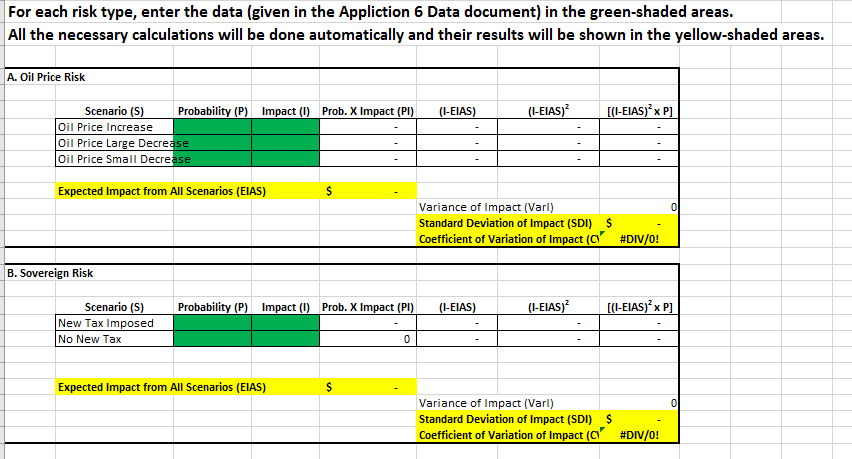
For each risk type, enter the data (given in the Appliction 6 Data document) in the green-shaded areas. All the necessary calculations will be done automatically and their results will be shown in the yellow-shaded areas. A. Oil Price Risk Scenario (S) Probability (P) Impact (I) Prob. X Impact (PI) (I-EIAS) (I-EIAS) [(I-EIAS) x P] Oil Price Increase Oil Price Large Decrease Oil Price Small Decrease Expected Impact from All Scenarios (EIAS) Variance of Impact (Varl) Standard Deviation of Impact (SDI) $ Coefficient of Variation of Impact (C #DIV/O! B. Sovereign Risk (I-EIAS)? [(I-EIAS) x P] Scenario (S) New Tax Imposed No New Tax Probability (P) Impact (I) Prob. X Impact (PI) (I-EIAS) Expected Impact from All Scenarios (EIAS) Variance of Impact (Varl) Standard Deviation of Impact (SDI) $ Coefficient of Variation of Impact (C #DIv/O!
Step by Step Solution
3.35 Rating (155 Votes )
There are 3 Steps involved in it
SOLUTION Calculation of variance xX Now ... View full answer

Get step-by-step solutions from verified subject matter experts
 Study Help