







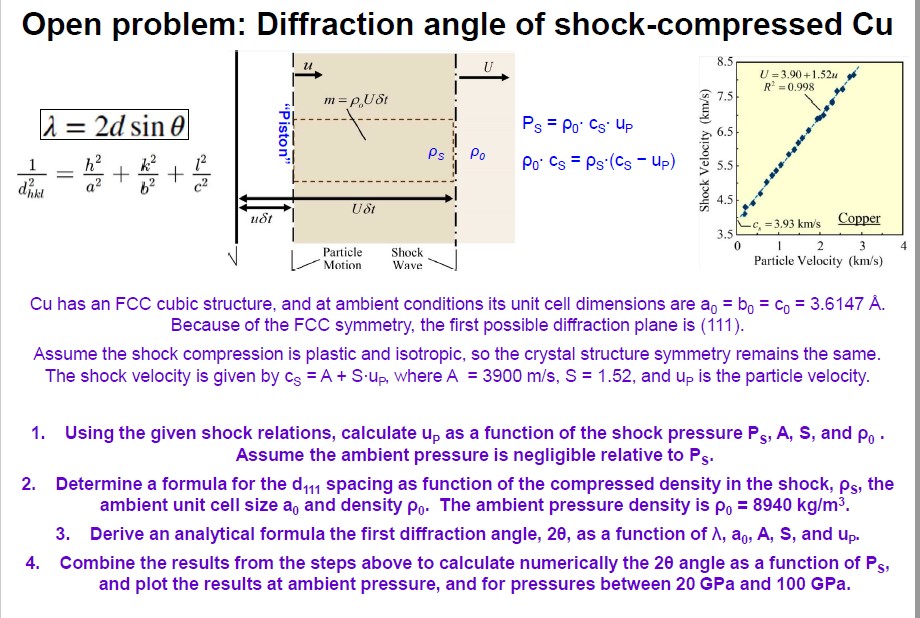
Question: Open problem: Diffraction angle of shock - compressed Cu lambda = 2 dsin theta ( 1 ) / ( d _ ( hkl
Open problem: Diffraction angle of shockcompressed Cu
lambda dsintheta
dhklhakblc
PSrho cSuP
rho cSrho ScSuP
Cu has an FCC cubic structure, and at ambient conditions its unit cell dimensions are abcangstrom
Because of the FCC symmetry, the first possible diffraction plane is
Assume the shock compression is plastic and isotropic, so the crystal structure symmetry remains the same.
The shock velocity is given by cSASup where AmsS and up is the particle velocity.
Using the given shock relations, calculate up as a function of the shock pressure PSAS and rho
Assume the ambient pressure is negligible relative to PS
Determine a formula for the d spacing as function of the compressed density in the shock, rho s the
ambient unit cell size a and density rho The ambient pressure density is rho kgm
Derive an analytical formula the first diffraction angle, theta as a function of lambda aAS and up
Combine the results from the steps above to calculate numerically the theta angle as a function of PS
and plot the results at ambient pressure, and for pressures between GPa and GPa
Step by Step Solution
There are 3 Steps involved in it
1 Expert Approved Answer
Step: 1 Unlock

Question Has Been Solved by an Expert!
Get step-by-step solutions from verified subject matter experts
Step: 2 Unlock
Step: 3 Unlock
 Study Help