







Question: please chose the write answer then briefly justified by explaining (in a 1-line sentence) your rationale for picking that choice as the answer , you
please chose the write answer then briefly justified by explaining (in a 1-line sentence) your rationale for picking that choice as the answer , you may also explain your answer choice with an example to illustrate your rationale.
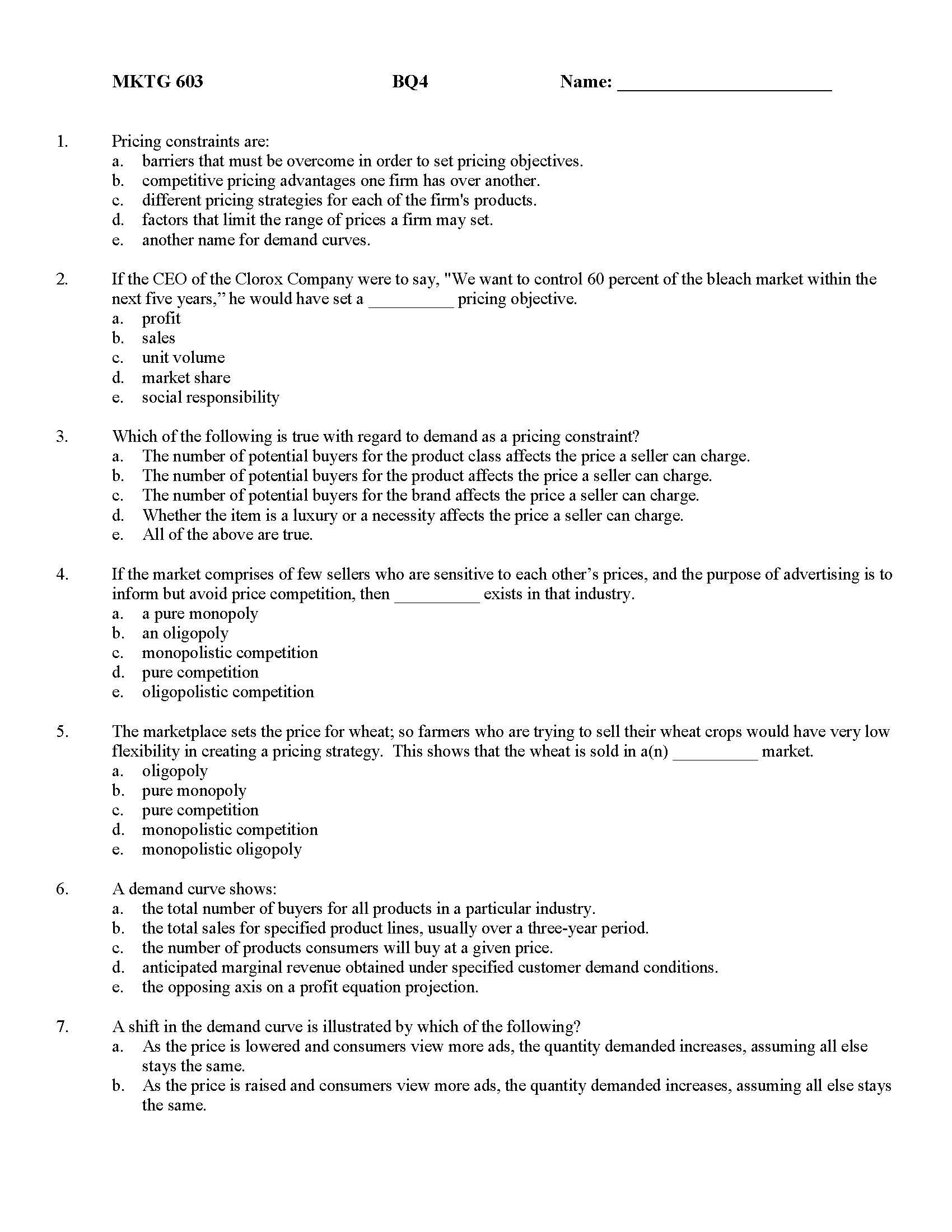
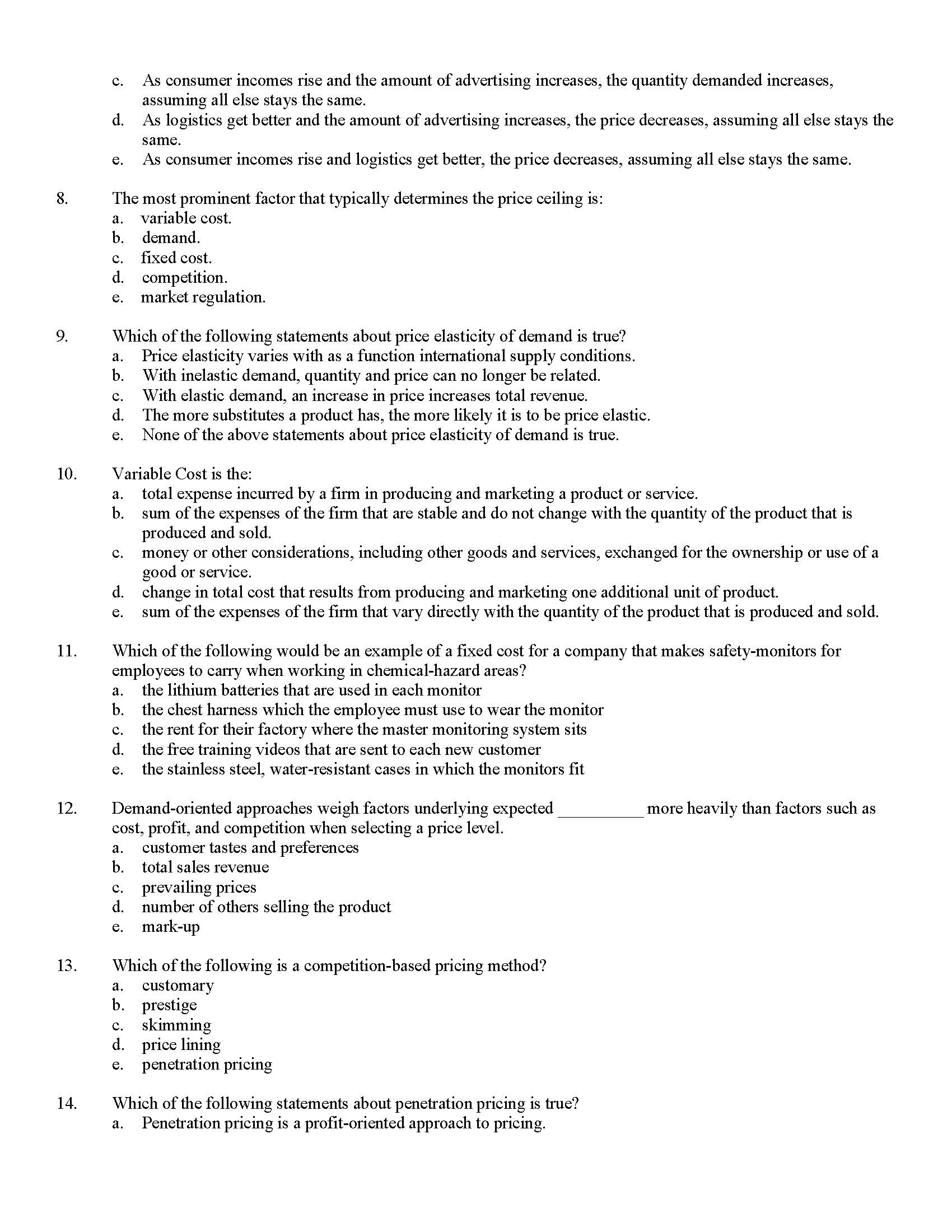
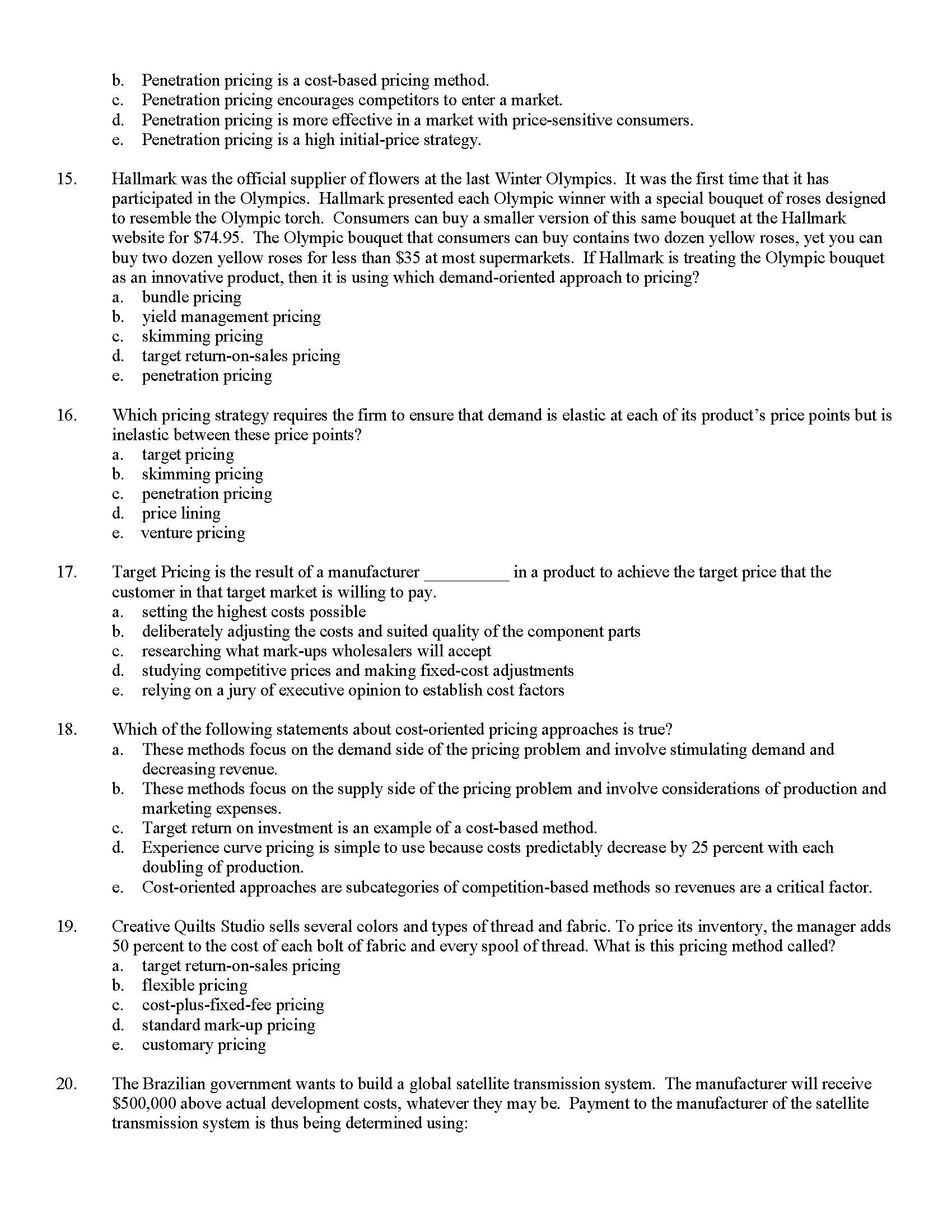
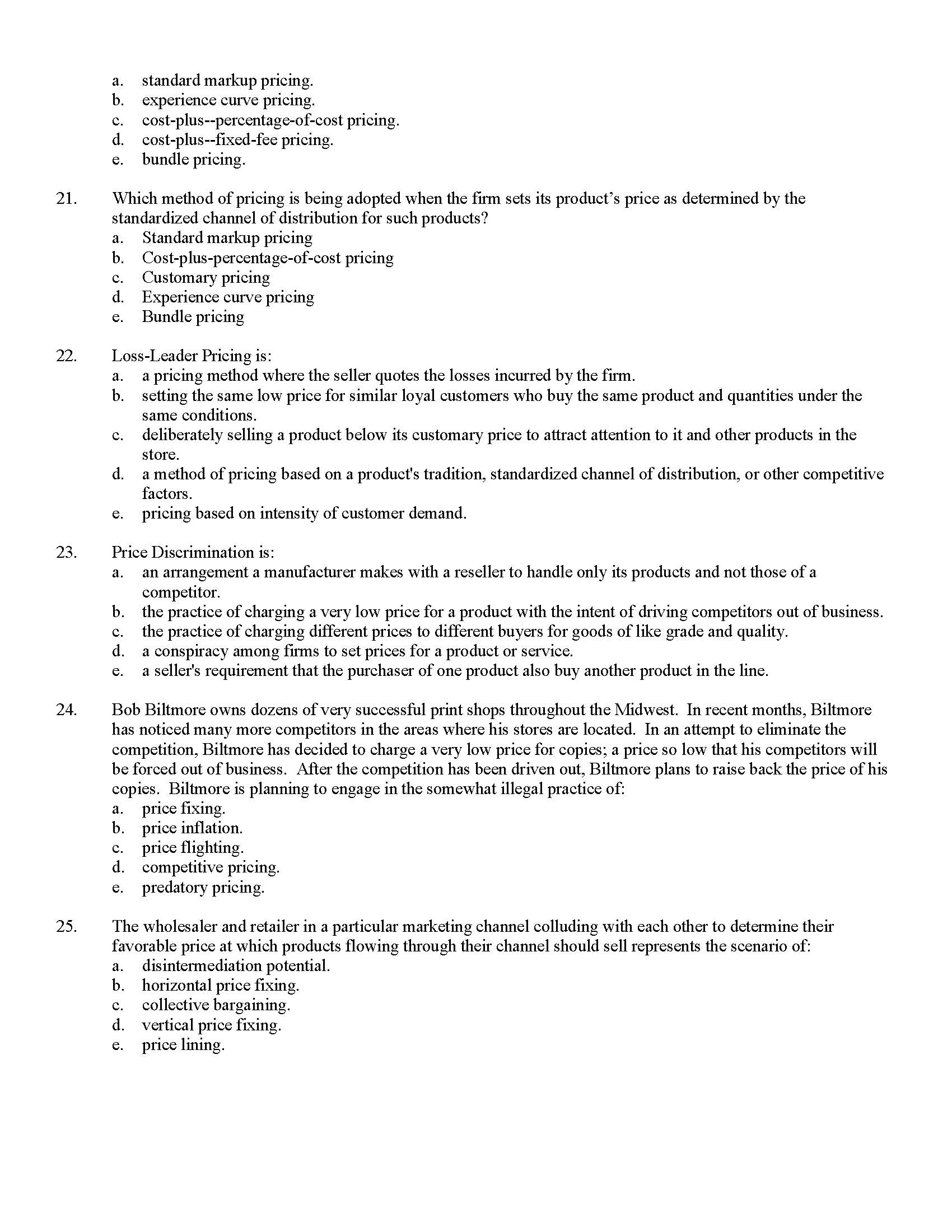
MKTG 603 BQ4 Name: 1. Pricing constraints are: a. barriers that must be overcome in order to set pricing objectives. b. competitive pricing advantages one firm has over another. c. different pricing strategies for each of the firm's products. d. factors that limit the range of prices a firm may set. e. another name for demand curves. 2. If the CEO of the Clorox Company were to say, "We want to control 60 percent of the bleach market within the next five years," he would have set a pricing objective. a. profit b. sales c. unit volume d. market share e. social responsibility 3. Which of the following is true with regard to demand as a pricing constraint? a. The number of potential buyers for the product class affects the price a seller can charge. b. The number of potential buyers for the product affects the price a seller can charge. c. The number of potential buyers for the brand affects the price a seller can charge. d. Whether the item is a luxury or a necessity affects the price a seller can charge. e. All of the above are true. 4. If the market comprises of few sellers who are sensitive to each other's prices, and the purpose of advertising is to inform but avoid price competition, then exists in that industry. a. a pure monopoly b. an oligopoly c. monopolistic competition d. pure competition e. oligopolistic competition 5. The marketplace sets the price for wheat; so farmers who are trying to sell their wheat crops would have very low flexibility in creating a pricing strategy. This shows that the wheat is sold in a(n) market. a. oligopoly b. pure monopoly c. pure competition d. monopolistic competition e. monopolistic oligopoly 6. A demand curve shows: a. the total number of buyers for all products in a particular industry. b. the total sales for specified product lines, usually over a three-year period. c. the number of products consumers will buy at a given price. d. anticipated marginal revenue obtained under specified customer demand conditions. e. the opposing axis on a profit equation projection. 7. A shift in the demand curve is illustrated by which of the following? a. As the price is lowered and consumers view more ads, the quantity demanded increases, assuming all else stays the same. b. As the price is raised and consumers view more ads, the quantity demanded increases, assuming all else stays the same. c. As consumer incomes rise and the amount of advertising increases, the quantity demanded increases, assuming all else stays the same. d. As logistics get better and the amount of advertising increases, the price decreases, assuming all else stays the same. e. As consumer incomes rise and logistics get better, the price decreases, assuming all else stays the same. 8. The most prominent factor that typically determines the price ceiling is: a. variable cost. b. demand. c. fixed cost. d. competition. e. market regulation. 9. Which of the following statements about price elasticity of demand is true? a. Price elasticity varies with as a function international supply conditions. b. With inelastic demand, quantity and price can no longer be related. c. With elastic demand, an increase in price increases total revenue. d. The more substitutes a product has, the more likely it is to be price elastic. e. None of the above statements about price elasticity of demand is true. 10. Variable Cost is the: a. total expense incurred by a firm in producing and marketing a product or service. b. sum of the expenses of the firm that are stable and do not change with the quantity of the product that is produced and sold. c. money or other considerations, including other goods and services, exchanged for the ownership or use of a good or service. d. change in total cost that results from producing and marketing one additional unit of product. e. sum of the expenses of the firm that vary directly with the quantity of the product that is produced and sold. 11. Which of the following would be an example of a fixed cost for a company that makes safety-monitors for employees to carry when working in chemical-hazard areas? a. the lithium batteries that are used in each monitor b. the chest harness which the employee must use to wear the monitor c. the rent for their factory where the master monitoring system sits d. the free training videos that are sent to each new customer e. the stainless steel, water-resistant cases in which the monitors fit 12. Demand-oriented approaches weigh factors underlying expected more heavily than factors such as cost, profit, and competition when selecting a price level. a. customer tastes and preferences b. total sales revenue c. prevailing prices d. number of others selling the product e. mark-up 13. Which of the following is a competition-based pricing method? a. customary b. prestige c. skimming d. price lining e. penetration pricing 14. Which of the following statements about penetration pricing is true? a. Penetration pricing is a profit-oriented approach to pricing. b. Penetration pricing is a cost-based pricing method. c. Penetration pricing encourages competitors to enter a market. d. Penetration pricing is more effective in a market with price-sensitive consumers. e. Penetration pricing is a high initial-price strategy. 15. Hallmark was the official supplier of flowers at the last Winter Olympics. It was the first time that it has participated in the Olympics. Hallmark presented each Olympic winner with a special bouquet of roses designed to resemble the Olympic torch. Consumers can buy a smaller version of this same bouquet at the Hallmark website for $74.95. The Olympic bouquet that consumers can buy contains two dozen yellow roses, yet you can buy two dozen yellow roses for less than $35 at most supermarkets. If Hallmark is treating the Olympic bouquet as an innovative product, then it is using which demand-oriented approach to pricing? a. bundle pricing b. yield management pricing c. skimming pricing d. target return-on-sales pricing e. penetration pricing 16. Which pricing strategy requires the firm to ensure that demand is elastic at each of its product's price points but is inelastic between these price points? a. target pricing b. skimming pricing c. penetration pricing d. price lining e. venture pricing 17. Target Pricing is the result of a manufacturer in a product to achieve the target price that the customer in that target market is willing to pay. a. setting the highest costs possible b. deliberately adjusting the costs and suited quality of the component parts c. researching what mark-ups wholesalers will accept d. studying competitive prices and making fixed-cost adjustments e. relying on a jury of executive opinion to establish cost factors 18. Which of the following statements about cost-oriented pricing approaches is true? a. These methods focus on the demand side of the pricing problem and involve stimulating demand and decreasing revenue. b. These methods focus on the supply side of the pricing problem and involve considerations of production and marketing expenses. c. Target return on investment is an example of a cost-based method. d. Experience curve pricing is simple to use because costs predictably decrease by 25 percent with each doubling of production. e. Cost-oriented approaches are subcategories of competition-based methods so revenues are a critical factor. 19. Creative Quilts Studio sells several colors and types of thread and fabric. To price its inventory, the manager adds 50 percent to the cost of each bolt of fabric and every spool of thread. What is this pricing method called? a. target return-on-sales pricing b. flexible pricing c. cost-plus-fixed-fee pricing d. standard mark-up pricing e. customary pricing 20. The Brazilian government wants to build a global satellite transmission system. The manufacturer will receive $500,000 above actual development costs, whatever they may be. Payment to the manufacturer of the satellite transmission system is thus being determined using: a. standard markup pricing. b. experience curve pricing. c. cost-plus--percentage-of-cost pricing. d. cost-plus--fixed-fee pricing. e. bundle pricing. 21. Which method of pricing is being adopted when the firm sets its product's price as determined by the standardized channel of distribution for such products? a. Standard markup pricing b. Cost-plus-percentage-of-cost pricing c. Customary pricing d. Experience curve pricing e. Bundle pricing 22. Loss-Leader Pricing is: a. a pricing method where the seller quotes the losses incurred by the firm. b. setting the same low price for similar loyal customers who buy the same product and quantities under the same conditions. c. deliberately selling a product below its customary price to attract attention to it and other products in the store. d. a method of pricing based on a product's tradition, standardized channel of distribution, or other competitive factors. e. pricing based on intensity of customer demand. 23. Price Discrimination is: a. an arrangement a manufacturer makes with a reseller to handle only its products and not those of a competitor. b. the practice of charging a very low price for a product with the intent of driving competitors out of business. c. the practice of charging different prices to different buyers for goods of like grade and quality. d. a conspiracy among firms to set prices for a product or service. e. a seller's requirement that the purchaser of one product also buy another product in the line. 24. Bob Biltmore owns dozens of very successful print shops throughout the Midwest. In recent months, Biltmore has noticed many more competitors in the areas where his stores are located. In an attempt to eliminate the competition, Biltmore has decided to charge a very low price for copies; a price so low that his competitors will be forced out of business. After the competition has been driven out, Biltmore plans to raise back the price of his copies. Biltmore is planning to engage in the somewhat illegal practice of: a. price fixing. b. price inflation. c. price flighting. d. competitive pricing. e. predatory pricing. 25. The wholesaler and retailer in a particular marketing channel colluding with each other to determine their favorable price at which products flowing through their channel should sell represents the scenario of: a. disintermediation potential. b. horizontal price fixing. c. collective bargaining. d. vertical price fixing. e. price lining
Step by Step Solution
There are 3 Steps involved in it

Get step-by-step solutions from verified subject matter experts
 Study Help