







Question: Please help! I have completed the experiment below. I need help with identifying the limiting reagent, theoretical yield and percent yield . I have included
Please help! I have completed the experiment below. I need help with identifying the limiting reagent, theoretical yield and percent yield. I have included all information need below (PLEASE SHOW WORK SO I CAN FOLLOW ALONG) THANK YOU!!! Feeback is appreciated as well. :)
Substance: Formula: MW: MP/BP: Density
Sodium Hydroxide NaOH 40 318 C 2.15
Ethanol CH3CH2OH 46.08 -114.3 C 4.61
Sodium Chloride NaCl 58.44 801 C 3.90
Calcium Chloride CaCl2 110.98 772 C 2.15
Experiment completed:
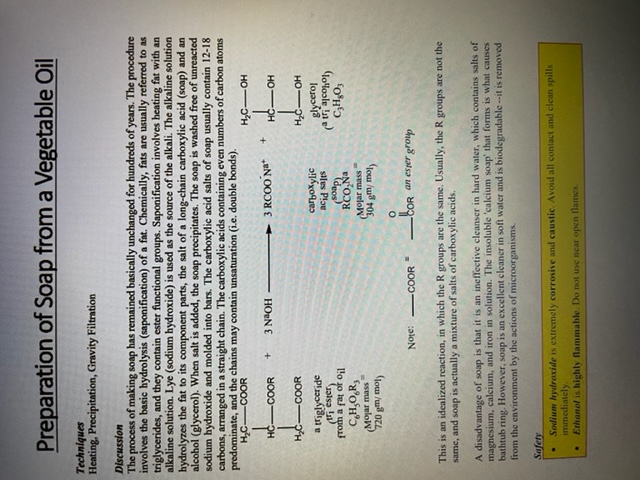
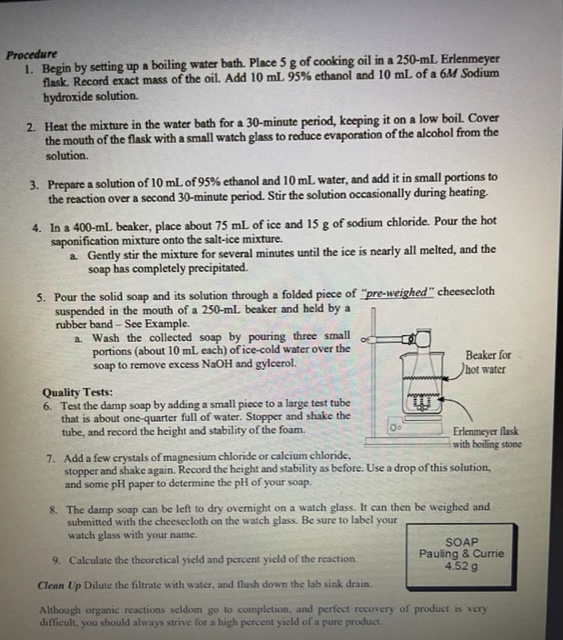
Preparation of Soap from a Vegetable Oil Techniques Heating, Precipitation, Gravity Filtration Discussion The process of making soap has remained basically unchanged for hundreds of years. The procedure involves the basic hydrolysis (saponification) of a fat. Chemically, fats are usually referred to as triglycerides, and they contain ester functional groups. Saponification involves heating fat with an alkaline solution. Lye (sodium hydroxide) is used as the source of the alkali. The alkaline solution hydrolyzes the fat to its component parts, the salt of a long-chain carboxylic acid (soap) and an alcohol (glycerol). When salt is added, the soap precipitates. The soap is washed free of unreacted sodium hydroxide and molded into bars. The carboxylic acid salts of soap usually contain 12-18 carbons, arranged in a straight chain. The carboxylic acids containing even numbers of carbon atoms prednaninata and tha ahaine mau andain wneatumation if a douthla handel This is an idealized reaction, in which the R groups are the same. Usually, the R groups are not the same, and soap is actually a mixture of salts of carboxylic acids. A disadvantage of soap is that it is an ineffective cleanser in hard water, which contains salts of magnesium, calcium, and iron in solution. The insoluble 'calcium soap' that forms is what causes bathtub ring. However, soap is an excellent cleaner in soft water and is biodegradable - it is removed from the environment by the actions of microorganisms. Safety - Sodium hydroxide is extremely corrosive and caustic. Avoid all contact and clean spills immediately. - Ethanol is highly flammable. Do not use near open flames. 1. Begin by setting up a boiling water bath. Place 5g of cooking oil in a 250mL Erlenmeyer flask. Record exact mass of the oil. Add 10mL95% ethanol and 10mL of a 6M Sodium hydroxide solution. 2. Heat the mixture in the water bath for a 30 -minute period, keeping it on a low boil. Cover the mouth of the flask with a small watch glass to reduce evaporation of the alcohol from the solution. 3. Prepare a solution of 10mL of 95% ethanol and 10mL water, and add it in small portions to the reaction over a second 30 -minute period. Stir the solution occasionally during heating. 4. In a 400-mL beaker, place about 75mL of ice and 15g of sodium chloride. Pour the hot saponification mixture onto the salt-ice mixture. a. Gently stir the mixture for several minutes until the ice is nearly all melted, and the soap has completely precipitated. 5. Pour the solid soap and its solution through a folded piece of "pre-weighed" cheesecloth suspended in the mouth of a 250 -mL beaker and held by a rubber band - See Example. a. Wash the collected soap by pouring three small portions (about 10mL each) of ice-cold water over the soap to remove excess NaOH and gylcerol. Quality Tests: 6. Test the damp soap by adding a small piece to a large test tube that is about one-quarter full of water. Stopper and shake the tube, and record the height and stability of the foam. 7. Add a few erystals of magnesium chloride or calcium chloride, stopper and shake again. Record the height and stability as before. Use a drop of this solution, and some pH paper to determine the pH of your soap. 8. The damp soap can be left to dry ovemight on a watch glass. It can then be weighed and submitted with the cheesecloth on the watch glass. Be sure to label your watch glass with your name. 9. Calculate the theoretical yield and percent yield of the reaction. Clean Up Dilute the filtrate with water, and flush down the lab sink drain. Although organic reactions seldom go to completion. and perfect recovery of product is very difficult, you should always strive for a high percent yield of a pure product
Step by Step Solution
There are 3 Steps involved in it

Get step-by-step solutions from verified subject matter experts
 Study Help