







Question: Please include excel sheet used screenshot and matlab code, no spam, any spam will be reported and emailed to chegg. Problem statement A series reaction
Please include excel sheet used screenshot and matlab code, no spam, any spam will be reported and emailed to chegg.
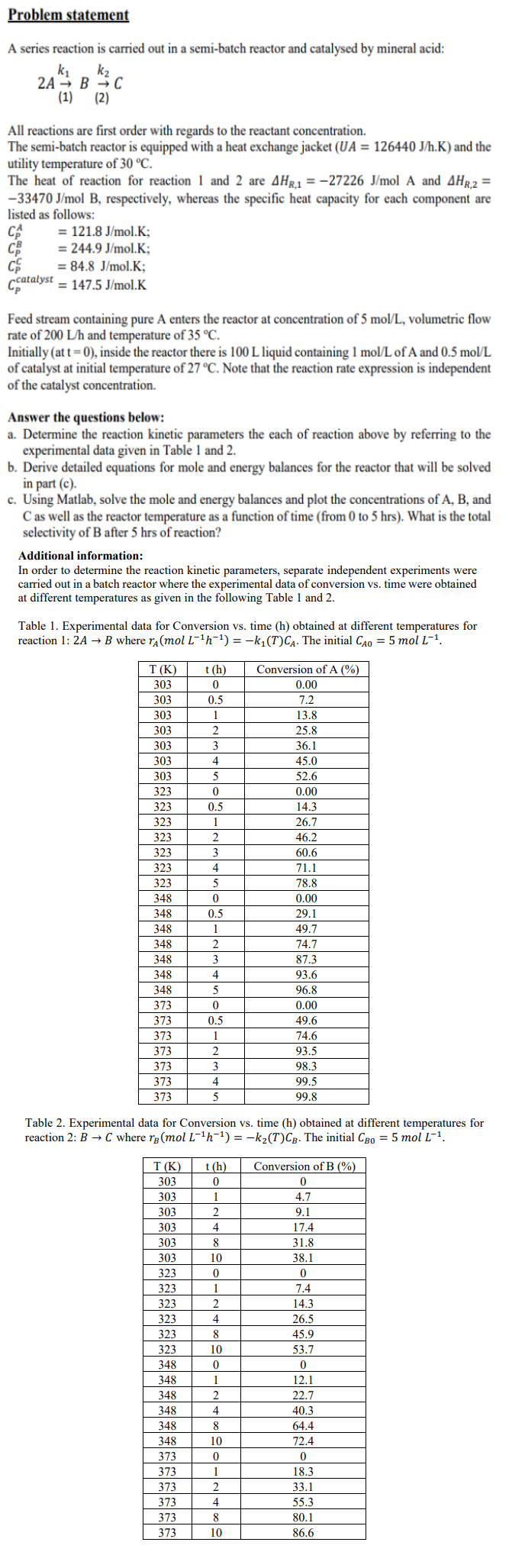
Problem statement A series reaction is carried out in a semi-batch reactor and catalysed by mineral acid: ki k2 2A + B C (1) (2) ) All reactions are first order with regards to the reactant concentration. The semi-batch reactor is equipped with a heat exchange jacket (UA = 126440 J/h.K) and the utility temperature of 30 C. The heat of reaction for reaction 1 and 2 are 4HR,1 = -27226 J/mol A and AHR,2 = -33470 J/mol B, respectively, whereas the specific heat capacity for each component are listed as follows: = 121.8 J/mol.K; = 244.9 J/mol.K; C = 84.8 J/mol.K; ccatalyst = 147.5J/mol.K Feed stream containing pure A enters the reactor at concentration of 5 mol/L, volumetric flow rate of 200 L/h and temperature of 35 C. Initially (at t=0), inside the reactor there is 100 L liquid containing 1 mol/L of A and 0.5 mol/L of catalyst at initial temperature of 27 C. Note that the reaction rate expression is independent of the catalyst concentration. Answer the questions below: a. Determine the reaction kinetic parameters the each of reaction above by referring to the experimental data given in Table 1 and 2. b. Derive detailed equations for mole and energy balances for the reactor that will be solved in part (c). c. Using Matlab, solve the mole and energy balances and plot the concentrations of A, B, and C as well as the reactor temperature as a function of time (from 0 to 5 hrs). What is the total selectivity of B after 5 hrs of reaction? Additional information: In order to determine the reaction kinetic parameters, separate independent experiments were carried out in a batch reactor where the experimental data of conversion vs. time were obtained at different temperatures as given in the following Table 1 and 2. Table 1. Experimental data for Conversion vs. time (h) obtained at different temperatures for reaction 1: 2A + B where ramoll-1h-1) = -k(T)CA. The initial Cao = 5 mol 1-1 T(K) 303 303 303 303 303 303 303 323 323 323 323 323 323 323 348 348 348 348 348 348 348 373 373 373 373 373 373 373 t(h) 0 0.5 1 2 3 4 5 0 0.5 1 2 3 3 4 5 0 0.5 1 2 3 4 5 0 0.5 1 2 3 4 5 Conversion of A (%) 0.00 7.2 13.8 25.8 36.1 45.0 52.6 0.00 14.3 26.7 46.2 60.6 71.1 78.8 0.00 29.1 49.7 74.7 87.3 93.6 96.8 0.00 49.6 74.6 93.5 98.3 99.5 99.8 Table 2. Experimental data for Conversion vs. time (h) obtained at different temperatures for reaction 2: B C where romol L-th-1) = -K (T)CB. The initial CBo = 5 mol 1-1. t(h) 0 1 1 2 4 8 10 0 1 2 2 4 8 T(K) 303 303 303 303 303 303 323 323 323 323 323 323 348 348 348 348 348 348 373 373 373 373 373 373 10 Conversion of B (%) 0 4.7 9.1 17.4 31.8 38.1 0 7.4 14.3 26.5 45.9 53.7 0 12.1 22.7 40.3 64.4 72.4 0 18.3 33.1 55.3 80.1 86.6 0 1 2 4 8 10 0 1 2 4 8 10
Step by Step Solution
There are 3 Steps involved in it

Get step-by-step solutions from verified subject matter experts
 Study Help