







Question: please post all matlab codes & answer parts a, b and c P8-10B The elementary liquid-phase-series reaction A B C is carried out in a
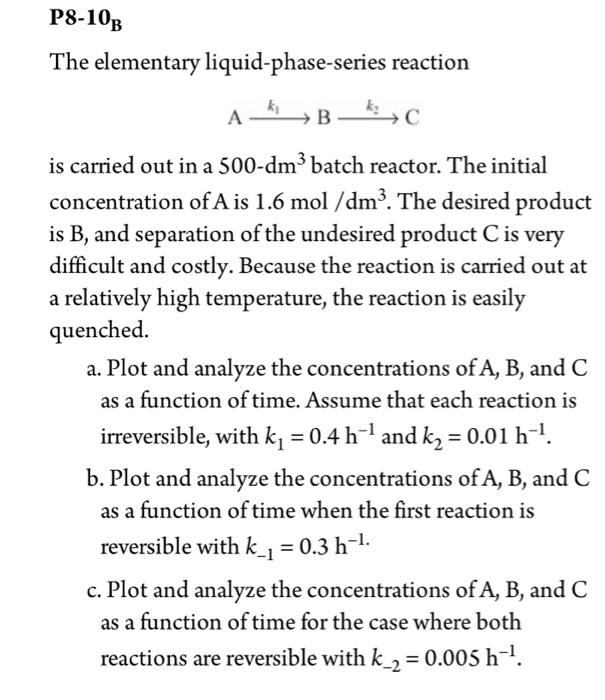
P8-10B The elementary liquid-phase-series reaction A B C is carried out in a 500-dm3 batch reactor. The initial concentration of A is 1.6 mol /dm3. The desired product is B, and separation of the undesired product C is very difficult and costly. Because the reaction is carried out at a relatively high temperature, the reaction is easily quenched. a. Plot and analyze the concentrations of A, B, and C as a function of time. Assume that each reaction is irreversible, with k, = 0.4 h-' and k2 = 0.01 h-! b. Plot and analyze the concentrations of A, B, and C as a function of time when the first reaction is reversible with k_1 = 0.3 h-1. c. Plot and analyze the concentrations of A, B, and C as a function of time for the case where both reactions are reversible with k_2 = 0.005 h-1. = P8-10B The elementary liquid-phase-series reaction A B C is carried out in a 500-dm3 batch reactor. The initial concentration of A is 1.6 mol /dm3. The desired product is B, and separation of the undesired product C is very difficult and costly. Because the reaction is carried out at a relatively high temperature, the reaction is easily quenched. a. Plot and analyze the concentrations of A, B, and C as a function of time. Assume that each reaction is irreversible, with k, = 0.4 h-' and k2 = 0.01 h-! b. Plot and analyze the concentrations of A, B, and C as a function of time when the first reaction is reversible with k_1 = 0.3 h-1. c. Plot and analyze the concentrations of A, B, and C as a function of time for the case where both reactions are reversible with k_2 = 0.005 h-1. =
Step by Step Solution
There are 3 Steps involved in it

Get step-by-step solutions from verified subject matter experts
 Study Help