Question: Please read the question Question : In what ways are educators across the country addressing the needs of ELS? How are these vignettes in the
Please read the question
Question: In what ways are educators across the country addressing the needs of ELS? How are these vignettes in the chapter similar to the ways you have either observed or experienced in schools?

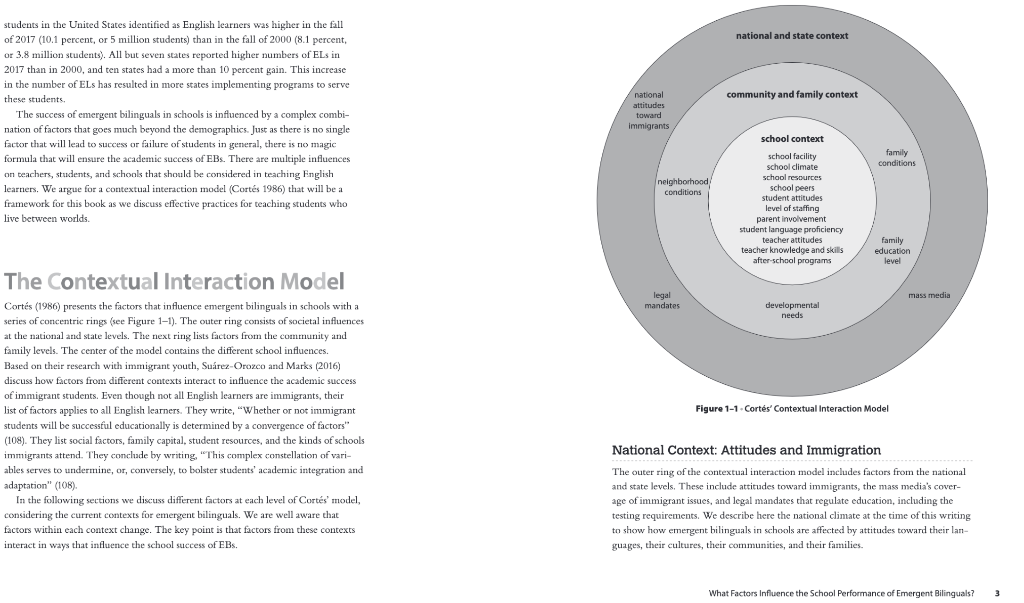
1 What Factors Influence the School Performance of Emergent Bilinguals? Key Points English learners are found in schools across the country. Some states, like California and Texas, have had large numbers of emergent bilinguals for years. Data for California and Texas in 2018-19 indicated that almost 20 percent of the students were consid- ered English learners (CDE 2019a; TEA 2019). In other states, like Georgia and North Carolina, only 8 percent and 7 percent, respectively, were Els in 201718, but those states have experienced a growth rate in emergent bilinguals of over 80 percent, a rate that is double that of other parts of the country (Sugarman and Geary 2018). At the national level, data from the National Center for Education Statistics (nces.ed.gov) shows that the percentage of public school The contextual interaction model of learning includes the factors that influence emergent bilinguals at different levels. At the national level, anti-immigrant attitudes have led to increased racism and immigration policies that negatively impact speakers of languages other than English. National education mandates influence how schools must meet the needs of English learners. State policies and laws dictate programs for emergent bilinguals and change if programs are not successful. Communities and family contexts influence the schooling success of emergent bilingual students. Across the country, educators are addressing the needs of Els in diverse ways. 1 national and state context community and family context students in the United States identified as English learners was higher in the fall of 2017 (10.1 percent, or 5 million students) than in the fall of 2000 (8.1 percent, or 3.8 million students). All but seven states reported higher numbers of Els in 2017 than in 2000, and ten states had a more than 10 percent gain. This increase in the number of Els has resulted in more states implementing programs serve these students. The success of emergent bilinguals in schools is influenced by a complex combi- nation of factors that goes much beyond the demographics. Just as there is no single factor that will lead to success or failure of students in general, there is formula that will ensure the academic success of EBs. There are multiple influences on teachers, students, and schools that should be considered in teaching English learners. We argue for a contextual interaction model (Corts 1986) that will be a framework for this book as we discuss effective practices for teaching students who live between worlds national attitudes toward immigrants magic family conditions neighborhood conditions school context school facility school climate school resources school peers student attitudes level of staffing parent involvement student language proficiency teacher attitudes teacher knowledge and skills after school programs family education level mass media legal mandates developmental needs The Contextual Interaction Model Corts (1986) presents the factors that influence emergent bilinguals in schools with a series of concentric rings (see Figure 1-1). The outer ring consists of societal influences at the national and state levels. The next ring lists factors from the community and family levels. The center of the model contains the different school influences. Based on their research with immigrant youth, Surez Orozco and Marks (2016) discuss how factors from different contexts interact to influence the academic success of immigrant students. Even though not all English learners are immigrants, their list of factors applies to all English learners. They write, "Whether or not immigrant students will be successful educationally is determined by a convergence of factors" (108). They list social factors, family capital, student resources, and the kinds of schools immigrants attend. They conclude boy writing, "This complex constellation of vari ables serves to undermine, or, conversely, to bolster students' academic integration and adaptation" (108) In the following sections we discuss different factors at each level of Corts model, considering the current contexts for emergent bilinguals. We are well aware that factors within each context change. The key point is that factors from these contexts interact in ways that influence the school success of EBs. Figure 1-1. Corts' Contextual Interaction Model National Context: Attitudes and Immigration The outer ring of the contextual interaction model includes factors from the national and state levels. These include attitudes toward immigrants, the mass media's cover- age of immigrant issues, and legal mandates that regulate education, including the testing requirements. We describe here the national climate at the time of this writing to show how emergent bilinguals in schools are affected by attitudes toward their lan guages, their cultures, their communities, and their families. What Factors influence the School Performance of Emergent Bilinguals? 3 of refugees from Somalia were having on their classrooms. These educators had adjusted for their immigrants from Mexico, but immigrants from another part of the world brought new challenges. Teachers in the Southeast had questions about the growing numbers of Latinx and Hmong students in their schools. There had been some Mexican students in the past, but now their Latinx population was changing, and the Southeast Asians brought new cultural and educational challenges. Corts' model is a two-way model. The school context is influenced by the larger social context at different levels, from national to family. It is also important to understand that the social context is impacted by attitudes, knowledge, and skills of the students who graduate and achieve some economic success. Some do return to their neighborhoods, where they serve as role models for students still in schools, but many move away. These immigrants change the mainstream community, but their departure from the neighborhoods where they attended school negatively impacts the immigrant communities. Parents and grandparents often feel abandoned. On the other hand, if educated immigrants return to their communities, they often present a chal- lenge to traditional values. The children of educated immigrants may feel conflicted because they are not sure of their own values or identities. Surez-Orozco and colleagues (2008) describe poi- gnantly the feelings of the immigrant Chinese and Haitian parents whose children are succeeding academically but losing some of their Chinese and Haitian roots. Students' success or failure results from complex interactions of dynamic contexts. No single factor can explain success or failure, but change in any one area may alter the dynamics of the whole system in such a way that success is more or less likely. 22









 Study Help