



Question: Please read the question Question: Why is the position of translanguage linked to the idea of being together? can you tell us something about the
Please read the question
Question: Why is the position of translanguage linked to the idea of being together?
can you tell us something about the translanguaging stance what what you guys mean by this and why it's so important I remember and kate i'll get to you in just a second but i remember you saying at dinner i think as a celebration of this work that we had in new york city that night i think i asked you what has stood out for you over the course of this doing this book and you said the importance of the stance so i'd like you to talk a little bit about the stance and maybe think about it in different kinds of contexts so um we did think a lot about the stance and we even thought about where it belongs right does it belong in the beginning does it belong at the end what is it and uh we called it the juntos stance and the hunter stance has to do with the fact that you see things in relationship right you don't see a bilingual child or monolingual child and see only one part of who she she is but actually you see them holistically you see them with the experiences that they bring from home what they have from other places what they get in school you see the the juntos in their language practices um and so it's the idea of making sure that you see the child holistically that you see their strengths rather than um just one language or the other so that punto stance was very important for us uh and i do remember um you know in our dialogues among the three of us kate insisting no no it has to be in the beginning in order to design something in order to think about instruction you have to have a belief that this is important that at the center of the instruction is the child and their strengths and therefore what you have to believe in is that the child is much more than just what they do in school is much more than english it's just a lot more and you have to think of the whole thing in relationship collaboratively
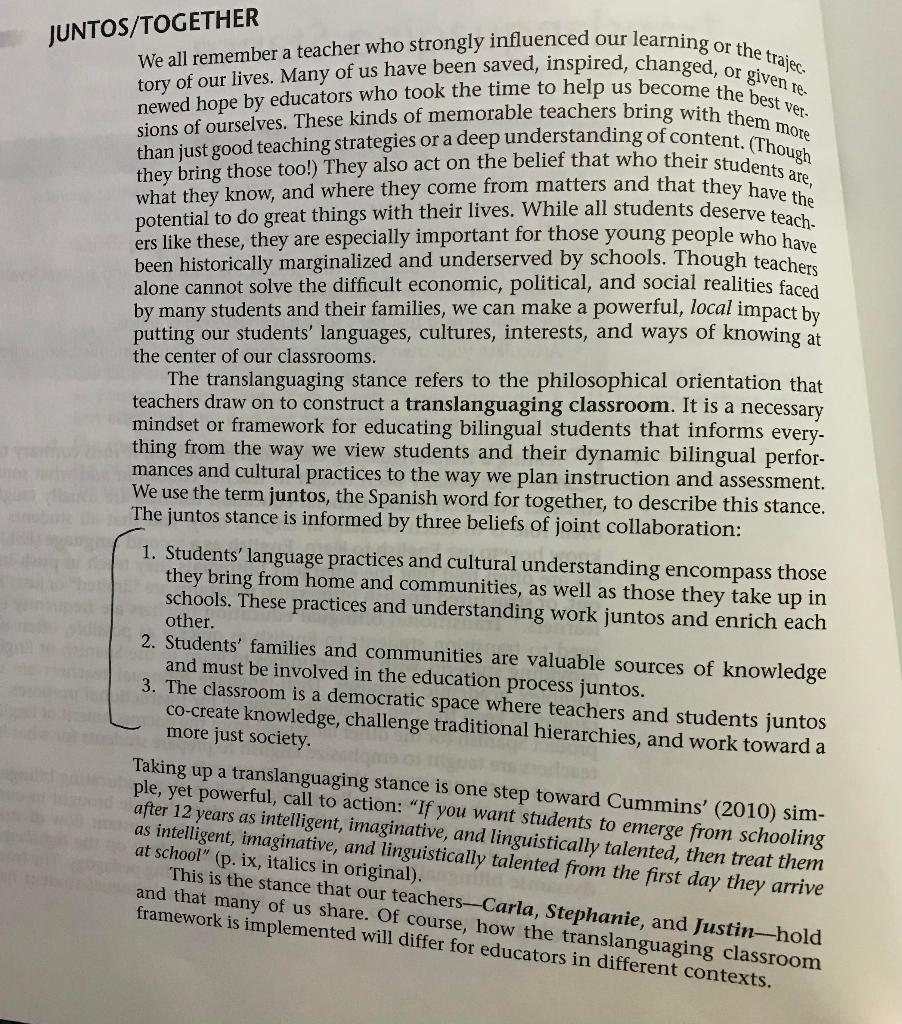
JUNTOS/TOGETHER We all remember a teacher who strongly influenced our learning or the trajec. newed hope by educators who took the time to help us become the best ver- tory of our lives. Many of us have been saved, inspired, changed, or given te sions of ourselves. These kinds of memorable teachers bring with them more than just good teaching strategies or a deep understanding of content. (Though they bring those too!) They also act on the belief that who their students are, what they know, and where they come from matters and that they have the potential to do great things with their lives. While all students deserve teach- ers like these, they are especially important for those young people who have been historically marginalized and underserved by schools. Though teachers alone cannot solve the difficult economic, political, and social realities faced by many students and their families, we can make a powerful, local impact by putting our students' languages, cultures, interests, and ways of knowing at the center of our classrooms. The translanguaging stance refers to the philosophical orientation that teachers draw on to construct a translanguaging classroom. It is a necessary mindset or framework for educating bilingual students that informs every- thing from the way we view students and their dynamic bilingual perfor- mances and cultural practices to the way we plan instruction and assessment. We use the term juntos, the Spanish word for together, to describe this stance. The juntos stance is informed by three beliefs of joint collaboration: 1. Students' language practices and cultural understanding encompass those they bring from home and communities, as well as those they take up in schools. These practices and understanding work juntos and enrich each other. 2. Students' families and communities are valuable sources of knowledge and must be involved in the education process juntos. 3. The classroom is a democratic space where teachers and students juntos co-create knowledge, challenge traditional hierarchies, and work toward a more just society. Taking up a translanguaging stance is one step toward Cummins' (2010) sim- ple, yet powerful, call to action: "If you want students to emerge from schooling after 12 years as intelligent, imaginative, and linguistically talented, then treat them as intelligent, imaginative, and linguistically talented from the first day they arrive at school" (p. ix, italics in original). This is the stance that our teachers-Carla, Stephanie, and Justin-hold and that many of us share. Of course, how the translanguaging classroom framework is implemented will differ for educators in different contextsStep by Step Solution
There are 3 Steps involved in it

Get step-by-step solutions from verified subject matter experts