Question: Please read the text below and answer the following questions 1.Given your own definition of global leadership competency (Kim & McLean, 2015, pp. 250 252),
Please read the text below and answer the following questions
1.Given your own definition of global leadership competency (Kim & McLean, 2015, pp. 250 252), what implications or lessons could you learn from the case scenario for you to become an effective global leader in the future?
2.Develop your own three original discussion questions in relation to the case scenario above.
1.
2.
3.
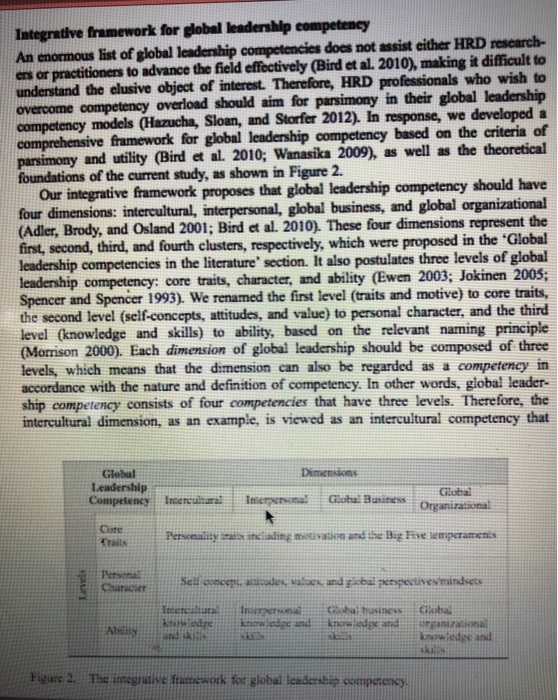
Integrative framework for global leadership competency An enormous list of global leadership competencies does not assist either HRD research- ers or practitioners to advance the field effectively (Bird et al. 2010), making it difficult to understand the elusive object of interest. Therefore, HRD professionals who wish to overcome competency overload should aim for parsimony in their global leadership competency models (Hazucha, Sloan, and Storfer 2012). In response, we developed a comprehensive framework for global leadership competency based on the criteria of parsimony and utility (Bird et al. 2010; Wanasika 2009), as well as the theoretical foundations of the current study, as shown in Figure 2. Our integrative framework proposes that global leadership competency should have four dimensions: intercultural, interpersonal, global business, and global organizational (Adler, Brody, and Osland 2001; Bird et al. 2010). These four dimensions represent the first, second, third, and fourth clusters, respectively, which were proposed in the "Global leadership competencies in the literature section. It also postulates three levels of global leadership competency: core traits, character, and ability (Ewen 2003; Jokinen 2005; Spencer and Spencer 1993). We renamed the first level (traits and motive) to core traits, the second level (self-concepts, attitudes, and value) to personal character, and the third level (knowledge and skills) to ability, based on the relevantnarning principle (Morrison 2000). Each dimension of global leadership should be composed of three levels, which means that the dimension can also be regarded as a competency in accordance with the nature and definition of competency. In other words, global leader- ship competency consists of four competencies that have three levels. Therefore, the intercultural dimension, as an example, is viewed as an intercultural competency that Dimensions Global Leadership Competency Hrnered Interpersona Gaba Susi Global Organizational Core raits Personality rails including motivation and the Bug Fixe temperaments Personal Self concept, des vales and sibul perspective mindsets Inictcatura ede kills Inser Guiness knowledge and knw lodge and Cloba organizational knowledge and Ahily Figure 2. The integrative framework for global leadership competency Human Resource Development International 251 spans three levels of core traits, personal character, and intercultural ability. Global leadership itself is also viewed as a competency consisting of four dimensions or competencies and three levels. Core traits, including motivation, are fundamental to the development of other components in the personal character level (Ewen 2003; Jokinen 2005). Personal character should consist of self-concept, attitudes, and values (Cattell 1943; Cloninger, Svrakic, and Przybeck 1993; Emmons 1995; Spencer and Spencer 1993). In addition, core traits and personal character are underlying character- istics of a global leader. That is, these two levels are applied to all dimensions of global leadership (Jokinen 2005; Spencer and Spencer 1993; Winter et al. 1998). On the contrary, each dimension requires specific knowledge and skills relevant to it. Following are the descriptions and rationales of the four dimensions and three levels of the integrative framework for global leadership competency. Three levels of global leadership competency The characteristics of global leadership at the personality (core traits and personal character) level are relatively more immutable than those at the ability level and affect all dimensions. Following are the descriptions of the components at each level of global leadership competency. Lletas A&M University Libraries at 16:34 26 October 2015 Core traits level Core traits consist of traits and motives. Traits are fundamental units of personality that consist of cognitive and affective aspects that, in tum, influence a leader's behaviours to accomplish certain goals (Twen 2003; Forgus and Shulman 1979). On the other hand, motives are regarded as a specific kind of trait (i.e. motivational trait) that explains irregular and unstable behaviours to achieve a goal (McClelland 1951; Winter et al. 1998). Personal character level As a composite of self-concept, attitudes, and values (Cattell 1943; Cloninger. Svrakic. and Przybeck 1993; Emmons 1995), personal character is the second level of the global leadership competency framework. In contrast to those inbor traits, character is used to describe acquired traits or a value judgment about personality and self (Forgus and Shulman 1979). Self-concept is defined as an individual's perceptions of her/himself that includes such terms as self-esteem, self-knowledge, self-awareness, and self-percep- tion (Shavelson, Hubner, and Stanton 1976; Wicklund and Eckert 1992). Self-concept is critical for a global leader to be effective because 'self-cognizing (Wicklund and Eckert 1992. 144) substantially increases consistency between personality and behaviour or between values and behaviour. Value is defined as a 'unifying philosophy' that gives meaning to a leader's behaviour (liwen 2003, 263). Attitudes such as 'dynamic traits (I wen 2003. 285) are more learnable than core traits and also affect a leader's behaviour Ability level The ability level is concerned with a global leader's behavioural knowledge and skills to accomplish a concrete task and produce visible outcomes (Jokinen 2005; Spencer and Spencer 1993). Abilities are influenced by core traits and personal character and more mutable than both of them (Spencer and Spencer 1993). Dimensionality of competency is 252 J. Kim and G.N. McLean applied to this level because knowledge and skills are the ability to perform a task in a specific dimension. Thus, this level of global leadership competency is more culture organization, and industry-specific. Four dimensions of global leadership competency Although the total profile of a global lesiership competency is a composite of core trait, personal character, and ability level, dimensionality is determined solely at the ability level. 06 October 2015 Intercultural dimension The Global Leadership and Organizational Behavior Effectiveness project found that culturally contingent leadership is one of the major categories of global leadership attributes (Dorfman et al. 2012). Zander. Mockaitis, and Butler (2012) also emphasized applied to this level because knowledge and skills are the ability to perform a task in a specific dimension. Thus, this level of global leadership competency more culture, organization, and industry-specific. Four dimensions of global leadership competency Although the total profile of a global leadership competency is a composite of core trait, personal character, and ability level, dimensionality is determined solely at the ability level. Intercultural dimension The Global Leadership and Organizational Behavior Effectiveness project found that culturally contingent leadership is one of the major categories of global leadership attributes (Dorfman et al. 2012). Zander, Mockaitis, and Butler (2012) also emphasized the significance of intercultural competency or dimension. The required ability in this dimension is relevant to knowledge and skills necessary to understand different perspec- tives derived from cultural differences, such as different ethical standards, languages, and perspectives on leaders (Dickson et al. 2012). Downloaded by [Texas A&M University Libraries) at 16:34 26 October 2015 Interpersonal dimension The interpersonal dimension addresses a leader's orientation towards the importance of relationships with people in general (Bird et al. 2010). Understanding individual differ- ences in aspiration, motivation, and expectation is important for all leaders, including global leaders (Sloan, Hazucha, and Van Katwyk 2003). The required ability may include building relationships across distances and managing conflicts (Hazucha, Sloan, and Storfer 2012) Global business dimension Global business ability is required because global leaders must establish and implement a coherent and aligned business strategy at all levels of the organization (dazucha, Sloan, and Storfer 2012). The required abilities in this dimension include, but are not limited to, those of international finance, marketing, and industry condition (Black, Morrison, and Gregersen 1999, Hazucha, Sloun, and Storfer 2012). Global organizational dimension Global leaders must be able to marshal their company across national boundaries (Morrison 2000). This dimension is essential for global leaders to align their companies resources, structures, processes, and systems so they can capture recognized global business opportunities. The required abilities may include bringing about organizational change (Adler, Brody, and Osland 2001) and enhancing company-specific capacity, such as the company's product lines, cost structure, and quality of human resources (Black. Morrison, and Gregersen 1999)









 Study Help