







Question: please without plagiarism!! Read case study 6 Process management and improvement at the heart of Fujitsu UK and Ireland BMS pp. 481-491 from textbook Total
please without plagiarism!! 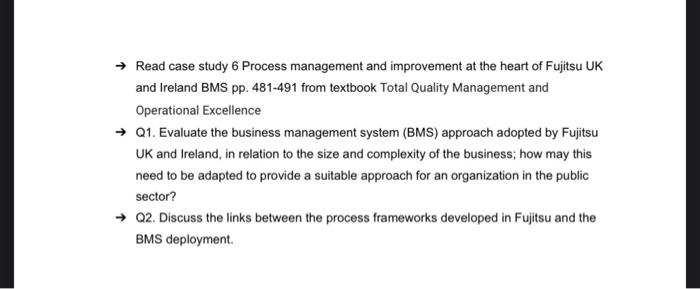
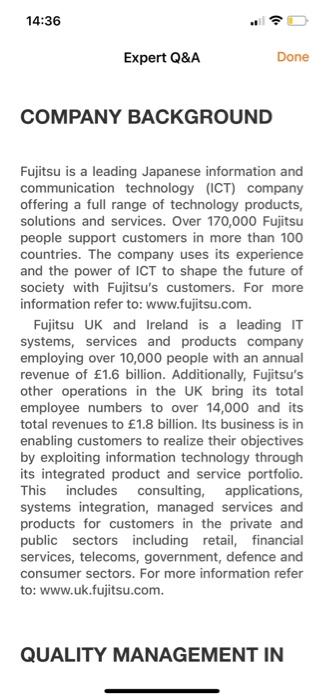
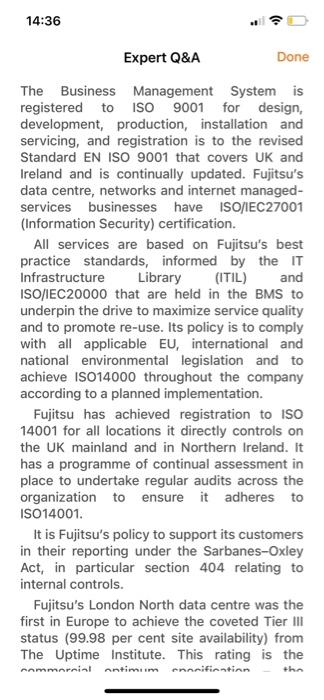
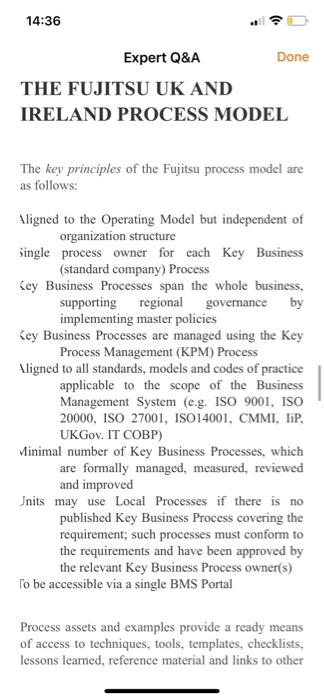
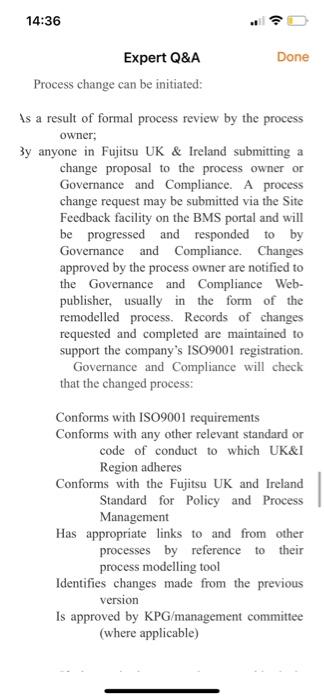
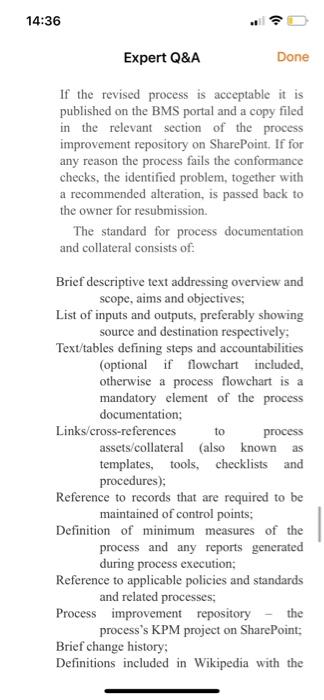
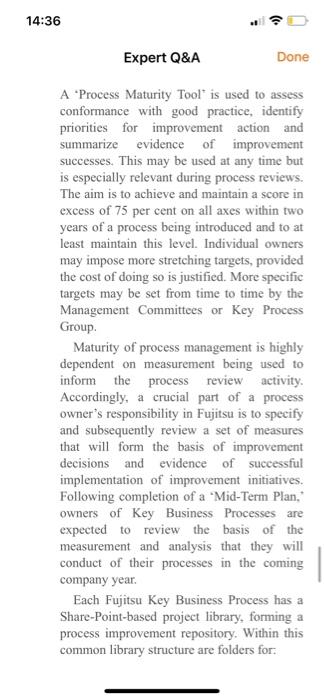
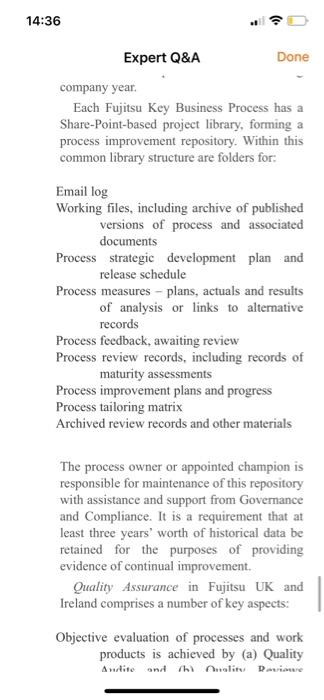
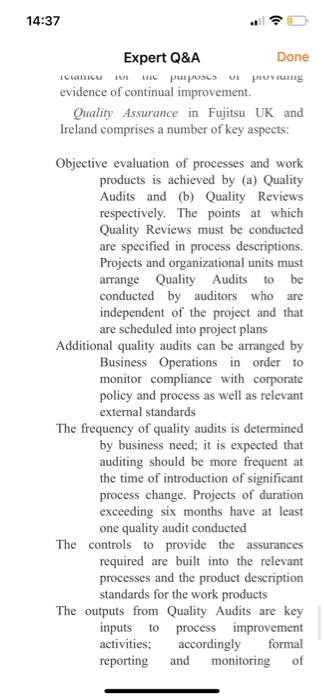
Read case study 6 Process management and improvement at the heart of Fujitsu UK and Ireland BMS pp. 481-491 from textbook Total Quality Management and Operational Excellence Q1. Evaluate the business management system (BMS) approach adopted by Fujitsu UK and Ireland, in relation to the size and complexity of the business; how may this need to be adapted to provide a suitable approach for an organization in the public sector? Q2. Discuss the links between the process frameworks developed in Fujitsu and the BMS deployment. 14:36 Expert Q&A COMPANY BACKGROUND Fujitsu is a leading Japanese information and communication technology (ICT) company offering a full range of technology products, solutions and services. Over 170,000 Fujitsu people support customers in more than 100 countries. The company uses its experience and the power of ICT to shape the future of society with Fujitsu's customers. For more information refer to: www.fujitsu.com. Fujitsu UK and Ireland is a leading IT systems, services and products company employing over 10,000 people with an annual revenue of 1.6 billion. Additionally, Fujitsu's other operations in the UK bring its total employee numbers to over 14,000 and its total revenues to 1.8 billion. Its business is in enabling customers to realize their objectives by exploiting information technology through its integrated product and service portfolio. This includes consulting, applications, systems integration, managed services and products for customers in the private and public sectors including retail, financial services, telecoms, government, defence and consumer sectors. For more information refer to: www.uk.fujitsu.com. QUALITY MANAGEMENT IN Done 14:36 Done The Business Management System is registered to ISO 9001 for design, development, production, installation and servicing, and registration is to the revised Standard EN ISO 9001 that covers UK and Ireland and is continually updated. Fujitsu's data centre, networks and internet managed- services businesses have ISO/IEC27001 (Information Security) certification. All services are based on Fujitsu's best practice standards, informed by the IT Infrastructure Library (ITIL) and ISO/IEC20000 that are held in the BMS to underpin the drive to maximize service quality and to promote re-use. Its policy is to comply with all applicable EU, international and national environmental legislation and to achieve ISO14000 throughout the company according to a planned implementation. Fujitsu has achieved registration to ISO 14001 for all locations it directly controls on the UK mainland and in Northern Ireland. It has a programme of continual assessment in place to undertake regular audits across the organization to ensure it adheres to ISO14001. It is Fujitsu's policy to support its customers in their reporting under the Sarbanes-Oxley Act, in particular section 404 relating to internal controls. Fujitsu's London North data centre was the first in Europe to achieve the coveted Tier III status (99.98 per cent site availability) from The Uptime Institute. This rating is the commercial antimum ennrification the Expert Q&A 14:36 Expert Q&A Done THE FUJITSU UK AND IRELAND PROCESS MODEL The key principles of the Fujitsu process model are as follows: Aligned to the Operating Model but independent of organization structure single process owner for each Key Business (standard company) Process Key Business Processes span the whole business, supporting regional governance by implementing master policies Key Business Processes are managed using the Key Process Management (KPM) Process Aligned to all standards, models and codes of practice applicable to the scope of the Business Management System (e.g. ISO 9001, ISO 20000, ISO 27001, ISO14001, CMMI, lip, UKGov. IT COBP) Minimal number of Key Business Processes, which are formally managed, measured, reviewed and improved Units may use Local Processes if there is no published Key Business Process covering the requirement; such processes must conform to the requirements and have been approved by the relevant Key Business Process owner(s) To be accessible via a single BMS Portal Process assets and examples provide a ready means of access to techniques, tools, templates, checklists, lessons learned, reference material and links to other 14:36 Expert Q&A Done Process change can be initiated: As a result of formal process review by the process owner; 3y anyone in Fujitsu UK & Ireland submitting a change proposal to the process owner or Governance and Compliance. A process change request may be submitted via the Site Feedback facility on the BMS portal and will be progressed and responded to by Governance and Compliance. Changes approved by the process owner are notified to the Governance and Compliance Web- publisher, usually in the form of the remodelled process. Records of changes requested and completed are maintained to support the company's ISO9001 registration. Governance and Compliance will check that the changed process: Conforms with ISO9001 requirements Conforms with any other relevant standard or code of conduct to which UK&I Region adheres Conforms with the Fujitsu UK and Ireland Standard for Policy and Process Management Has appropriate links to and from other processes by reference to their process modelling tool Identifies changes made from the previous version Is approved by KPG/management committee (where applicable) 14:36 Expert Q&A Done If the revised process is acceptable it is published on the BMS portal and a copy filed in the relevant section of the process improvement repository on SharePoint. If for any reason the process fails the conformance checks, the identified problem, together with a recommended alteration, is passed back to the owner for resubmission. The standard for process documentation and collateral consists of: Brief descriptive text addressing overview and scope, aims and objectives; List of inputs and outputs, preferably showing source and destination respectively; Text/tables defining steps and accountabilities (optional if flowchart included, otherwise a process flowchart is a mandatory element of the process documentation; Links/cross-references to process assets/collateral (also known as templates, tools, checklists and procedures); Reference to records that are required to be maintained of control points; Definition of minimum measures of the process and any reports generated during process execution; Reference to applicable policies and standards and related processes; Process improvement repository the process's KPM project on SharePoint; Brief change history; Definitions included in Wikipedia with the 14:36 Expert Q&A Done A "Process Maturity Tool is used to assess conformance with good practice, identify priorities for improvement action and summarize evidence of improvement successes. This may be used at any time but is especially relevant during process reviews. The aim is to achieve and maintain a score in excess of 75 per cent on all axes within two years of a process being introduced and to at least maintain this level. Individual owners may impose more stretching targets, provided the cost of doing so is justified. More specific targets may be set from time to time by the Management Committees or Key Process Group. Maturity of process management is highly dependent on measurement being used to inform the process review activity. Accordingly, a crucial part of a process owner's responsibility in Fujitsu is to specify and subsequently review a set of measures that will form the basis of improvement decisions and evidence of successful implementation of improvement initiatives. Following completion of a "Mid-Term Plan,* owners of Key Business Processes are expected to review the basis of the measurement and analysis that they will conduct of their processes in the coming company year. Each Fujitsu Key Business Process has a Share-Point-based project library, forming a process improvement repository. Within this common library structure are folders for. 14:36 Expert Q&A Done company year. Each Fujitsu Key Business Process has a Share-Point-based project library, forming a process improvement repository. Within this common library structure are folders for: Email log Working files, including archive of published versions of process and associated documents Process strategic development plan and release schedule Process measures - plans, actuals and results of analysis or links to alternative records Process feedback, awaiting review Process review records, including records of maturity assessments Process improvement plans and progress Process tailoring matrix Archived review records and other materials The process owner or appointed champion is responsible for maintenance of this repository with assistance and support from Governance and Compliance. It is a requirement that at least three years' worth of historical data be retained for the purposes of providing evidence of continual improvement. Quality Assurance in Fujitsu UK and Ireland comprises a number of key aspects: Objective evaluation of processes and work products is achieved by (a) Quality Andite and he Onality Paviowe 14:37 Expert Q&A Istanicu 101 une purposes providing evidence of continual improvement. Quality Assurance in Fujitsu UK and Ireland comprises a number of key aspects: Objective evaluation of processes and work products is achieved by (a) Quality Audits and (b) Quality Reviews respectively. The points at which Quality Reviews must be conducted are specified in process descriptions. Projects and organizational units must arrange Quality Audits to be conducted by auditors who are independent of the project and that are scheduled into project plans Additional quality audits can be arranged by Business Operations in order to monitor compliance with corporate policy and process as well as relevant external standards The frequency of quality audits is determined by business need; it is expected that auditing should be more frequent at the time of introduction of significant process change. Projects of duration exceeding six months have at least one quality audit conducted The controls to provide the assurances required are built into the relevant processes and the product description standards for the work products The outputs from Quality Audits are key inputs to process improvement activities; accordingly formal reporting and monitoring of Done Step by Step Solution
There are 3 Steps involved in it
1 Expert Approved Answer
Step: 1 Unlock

Question Has Been Solved by an Expert!
Get step-by-step solutions from verified subject matter experts
Step: 2 Unlock
Step: 3 Unlock
 Study Help