





Question: Problem 1 (25 points) A spherical particle of reactant B is reacted with liquid reactant A to make product C. It takes 4.85 min to
Problem 1 (25 points) A spherical particle of
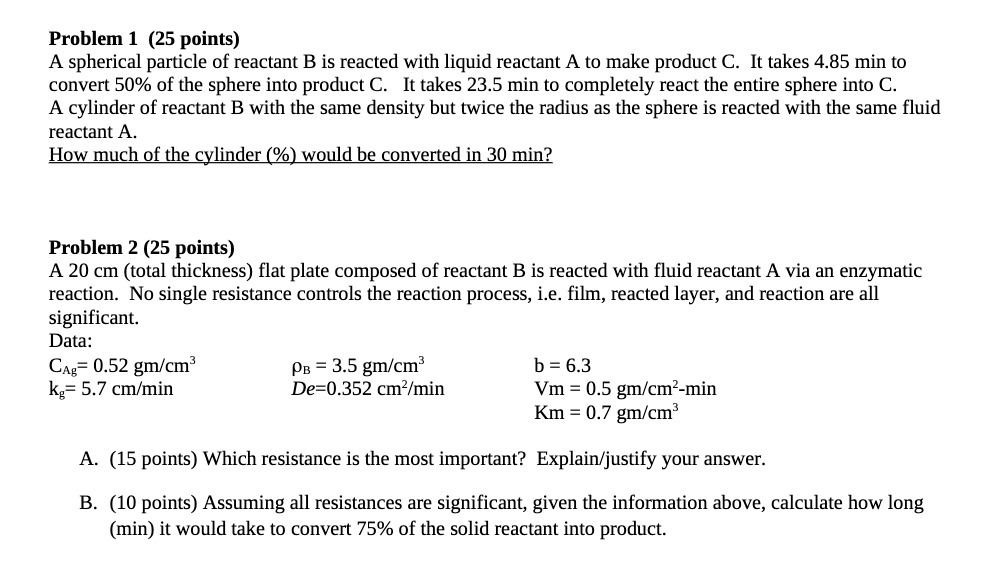
Problem 1 (25 points) A spherical particle of reactant B is reacted with liquid reactant A to make product C. It takes 4.85 min to convert 50% of the sphere into product C. It takes 23.5 min to completely react the entire sphere into C. A cylinder of reactant B with the same density but twice the radius as the sphere is reacted with the same fluid reactant A. How much of the cylinder (%) would be converted in 30 min? Problem 2 (25 points) A 20 cm (total thickness) flat plate composed of reactant B is reacted with fluid reactant A via an enzymatic reaction. No single resistance controls the reaction process, i.e. film, reacted layer, and reaction are all significant. Data: CAB= 0.52 gm/cm3 PB = 3.5 gm/cm3 b = 6.3 k = 5.7 cm/min De=0.352 cm-/min Vm = 0.5 gm/cm*-min Km = 0.7 gm/cm3 A. (15 points) Which resistance is the most important? Explain/justify your answer. B. (10 points) Assuming all resistances are significant, given the information above, calculate how long (min) it would take to convert 75% of the solid reactant into product

Step by Step Solution

There are 3 Steps involved in it

1 Expert Approved Answer
Step: 1 Unlock blur-text-image

Question Has Been Solved by an Expert!

Get step-by-step solutions from verified subject matter experts

Step: 2 Unlock
Step: 3 Unlock

Students Have Also Explored These Related Mathematics Questions!