







Question: Problem 2 - 1D heat conduction The ODE that models heat conduction across a 1D rod just like the one depicted in problem 1 is
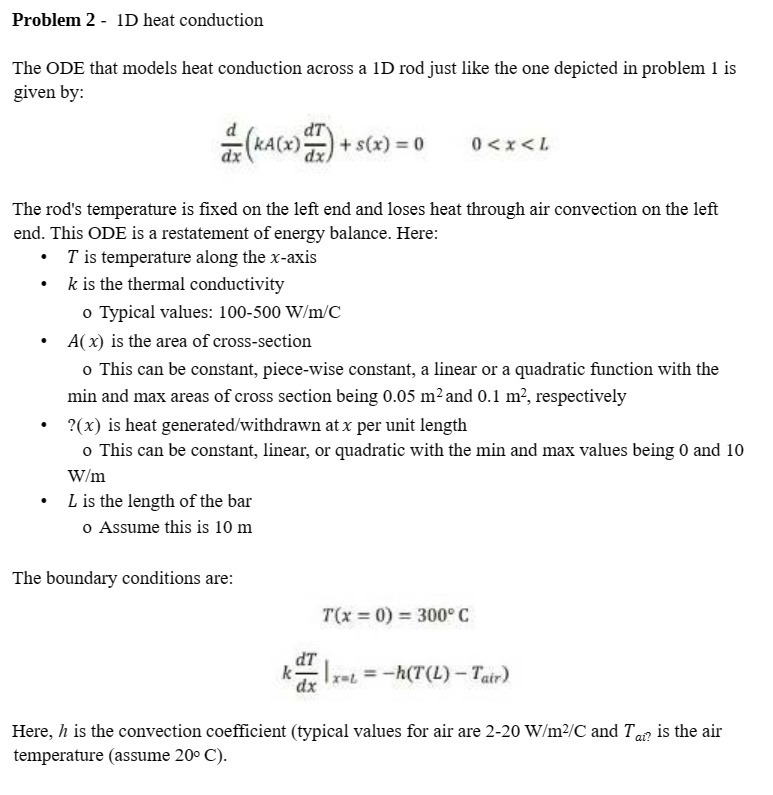
Problem 2 - 1D heat conduction The ODE that models heat conduction across a 1D rod just like the one depicted in problem 1 is given by: ( KA(X ) 27 ) + 5( x ) =0 The rod's temperature is fixed on the left end and loses heat through air convection on the left end. This ODE is a restatement of energy balance. Here: . T is temperature along the x-axis k is the thermal conductivity o Typical values: 100-500 W/m/C A( x) is the area of cross-section o This can be constant, piece-wise constant, a linear or a quadratic function with the min and max areas of cross section being 0.05 m and 0.1 m, respectively ?(x) is heat generated/withdrawn at x per unit length o This can be constant, linear, or quadratic with the min and max values being 0 and 10 W/m . L is the length of the bar o Assume this is 10 m The boundary conditions are: T(x = 0) = 300 C kay xml = -h(T(L) -Tair) Here, h is the convection coefficient (typical values for air are 2-20 W/m/C and Tan is the air temperature (assume 20. C)
Step by Step Solution
There are 3 Steps involved in it

Get step-by-step solutions from verified subject matter experts
 Study Help