







Question: Python Code plz # Given Code class AD(dict): def __init__(self, *args, **kwargs): This initializer simply passes all arguments to dict, so that we can create
Python Code plz
# Given Code
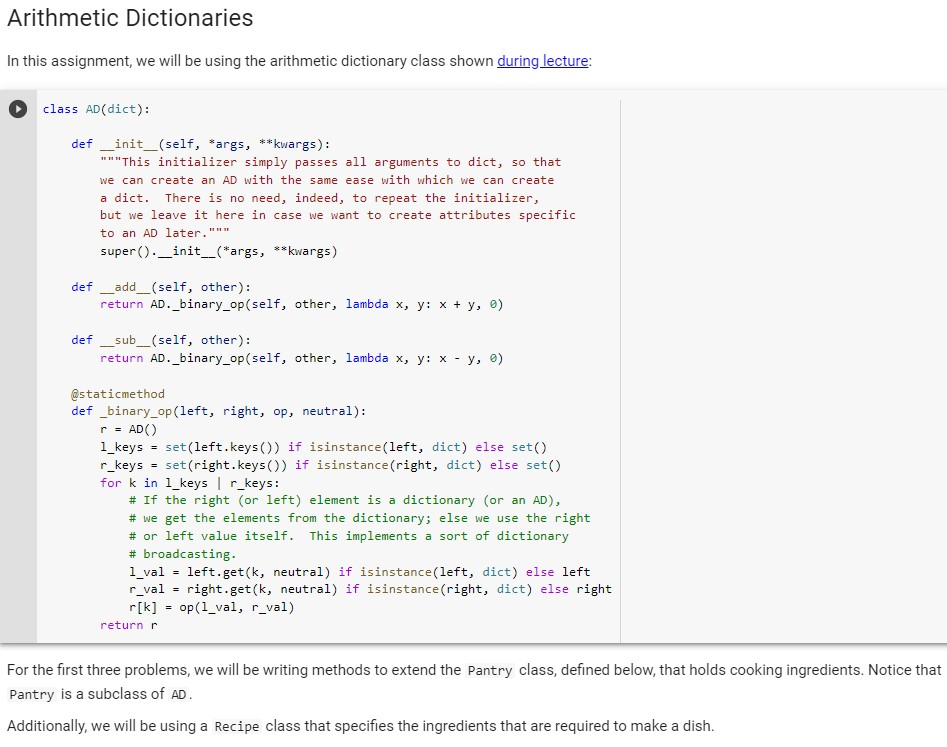
class AD(dict):
def __init__(self, *args, **kwargs):
"""This initializer simply passes all arguments to dict, so that
we can create an AD with the same ease with which we can create
a dict. There is no need, indeed, to repeat the initializer,
but we leave it here in case we want to create attributes specific
to an AD later."""
super().__init__(*args, **kwargs)
def __add__(self, other):
return AD._binary_op(self, other, lambda x, y: x + y, 0)
def __sub__(self, other):
return AD._binary_op(self, other, lambda x, y: x - y, 0)
@staticmethod
def _binary_op(left, right, op, neutral):
r = AD()
l_keys = set(left.keys()) if isinstance(left, dict) else set()
r_keys = set(right.keys()) if isinstance(right, dict) else set()
for k in l_keys | r_keys:
# If the right (or left) element is a dictionary (or an AD),
# we get the elements from the dictionary; else we use the right
# or left value itself. This implements a sort of dictionary
# broadcasting.
l_val = left.get(k, neutral) if isinstance(left, dict) else left
r_val = right.get(k, neutral) if isinstance(right, dict) else right
r[k] = op(l_val, r_val)
return r
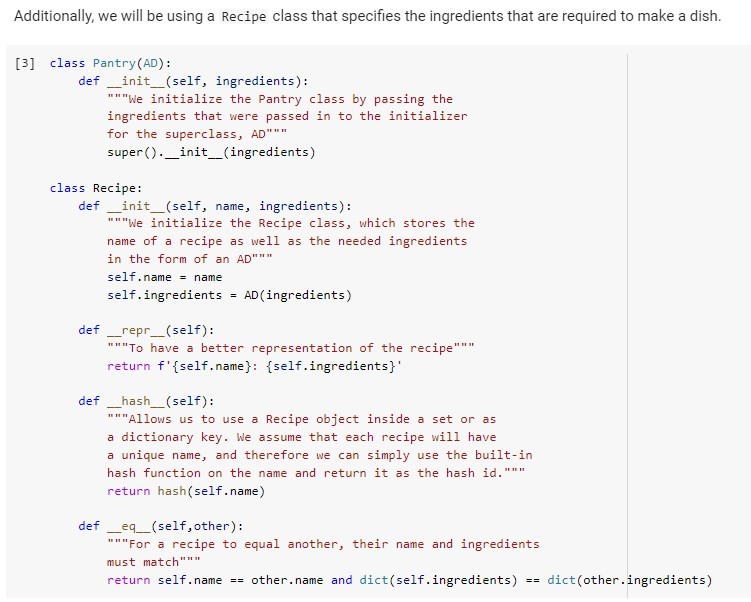
class Pantry(AD):
def __init__(self, ingredients):
"""We initialize the Pantry class by passing the
ingredients that were passed in to the initializer
for the superclass, AD"""
super().__init__(ingredients)
class Recipe:
def __init__(self, name, ingredients):
"""We initialize the Recipe class, which stores the
name of a recipe as well as the needed ingredients
in the form of an AD"""
self.name = name
self.ingredients = AD(ingredients)
def __repr__(self):
"""To have a better representation of the recipe"""
return f'{self.name}: {self.ingredients}'
def __hash__(self):
"""Allows us to use a Recipe object inside a set or as
a dictionary key. We assume that each recipe will have
a unique name, and therefore we can simply use the built-in
hash function on the name and return it as the hash id."""
return hash(self.name)
def __eq__(self,other):
"""For a recipe to equal another, their name and ingredients
must match"""
return self.name == other.name and dict(self.ingredients) == dict(other.ingredients)
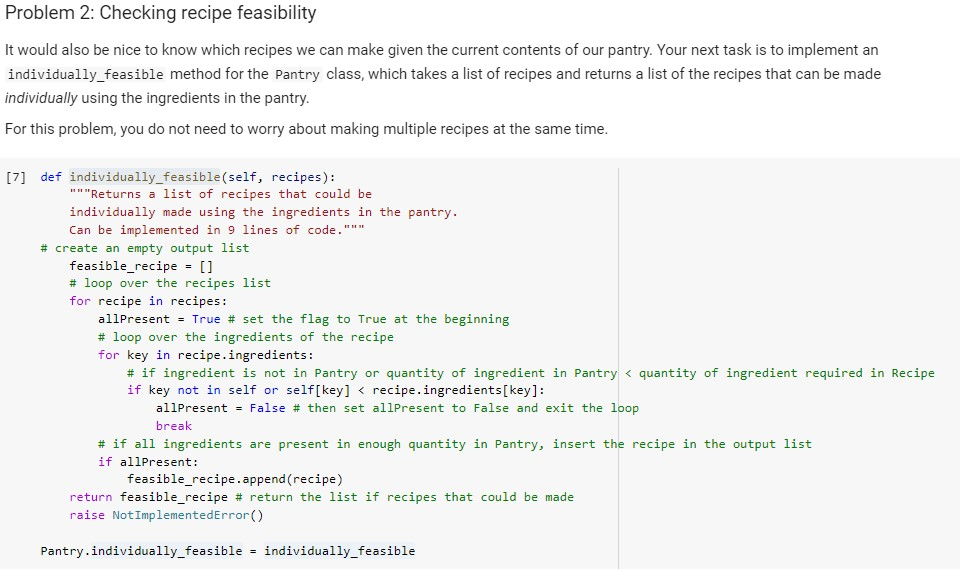
def individually_feasible(self, recipes):
"""Returns a list of recipes that could be
individually made using the ingredients in the pantry.
Can be implemented in 9 lines of code."""
# create an empty output list
feasible_recipe = []
# loop over the recipes list
for recipe in recipes:
allPresent = True # set the flag to True at the beginning
# loop over the ingredients of the recipe
for key in recipe.ingredients:
# if ingredient is not in Pantry or quantity of ingredient in Pantry
if key not in self or self[key]
allPresent = False # then set allPresent to False and exit the loop
break
# if all ingredients are present in enough quantity in Pantry, insert the recipe in the output list
if allPresent:
feasible_recipe.append(recipe)
return feasible_recipe # return the list if recipes that could be made
raise NotImplementedError()
Pantry.individually_feasible = individually_feasible
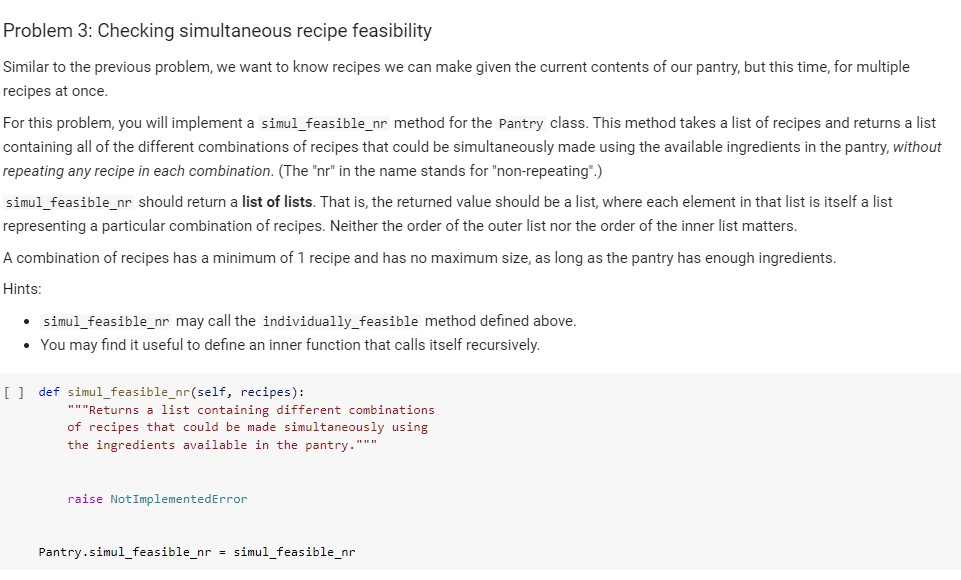
def simul_feasible_nr(self, recipes):
"""Returns a list containing different combinations
of recipes that could be made simultaneously using
the ingredients available in the pantry."""
raise NotImplementedError
Pantry.simul_feasible_nr = simul_feasible_nr
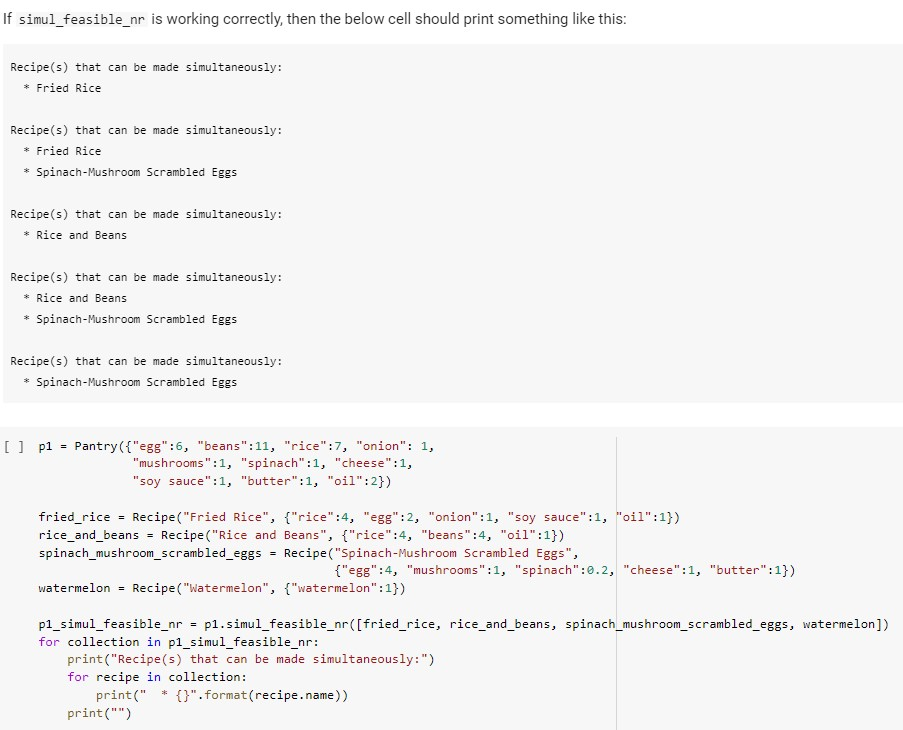
p1 = Pantry({"egg":6, "beans":11, "rice":7, "onion": 1,
"mushrooms":1, "spinach":1, "cheese":1,
"soy sauce":1, "butter":1, "oil":2})
fried_rice = Recipe("Fried Rice", {"rice":4, "egg":2, "onion":1, "soy sauce":1, "oil":1})
rice_and_beans = Recipe("Rice and Beans", {"rice":4, "beans":4, "oil":1})
spinach_mushroom_scrambled_eggs = Recipe("Spinach-Mushroom Scrambled Eggs",
{"egg":4, "mushrooms":1, "spinach":0.2, "cheese":1, "butter":1})
watermelon = Recipe("Watermelon", {"watermelon":1})
p1_simul_feasible_nr = p1.simul_feasible_nr([fried_rice, rice_and_beans, spinach_mushroom_scrambled_eggs, watermelon])
for collection in p1_simul_feasible_nr:
print("Recipe(s) that can be made simultaneously:")
for recipe in collection:
print(" * {}".format(recipe.name))
print("")
Arithmetic Dictionaries In this assignment, we will be using the arithmetic dictionary class shown during lecture: class AD(dict): def _init_(self, *args, **kwargs): """This initializer simply passes all arguments to dict, so that we can create an AD with the same ease with which we can create a dict. There is no need, indeed, to repeat the initializer, but we leave it here in case we want to create attributes specific to an AD later.""" super().__init__(*args, **kwargs) def _add_(self, other): return AD._binary_op (self, other, lambda x, y: x + y, 0) def __sub_(self, other): return AD._binary_op (self, other, lambda x, y: xy, 0) @staticmethod def _binary_op(left, right, op, neutral): r = AD() 1_keys r_keys = = set (left.keys()) if isinstance (left, dict) else set() set (right.keys()) if isinstance (right, dict) else set() for k in 1 keys | r_keys: # If the right (or left) element is a dictionary (or an AD), # we get the elements from the dictionary; else we use the right # or left value itself. This implements a sort of dictionary # broadcasting. 1_val = r_val r[k] return r = = left.get(k, neutral) if isinstance (left, dict) else left right.get(k, neutral) if isinstance (right, dict) else right op (1 val, r_val) For the first three problems, we will be writing methods to extend the Pantry class, defined below, that holds cooking ingredients. Notice that Pantry is a subclass of AD. Additionally, we will be using a Recipe class that specifies the ingredients that are required to make a dish.
Step by Step Solution
3.38 Rating (148 Votes )
There are 3 Steps involved in it
Thank you for providing the AD Arithmetic Dictionary class and introducing the Pantry class To extend the Pantry class well need to define additional ... View full answer

Get step-by-step solutions from verified subject matter experts
 Study Help