







Question: so for this lab I was able to create the matlab code for question #1 and #2 which are for #1 clear all clc L=
so for this lab I was able to create the matlab code for question #1 and #2 which are for #1
clear all
clc
L= input('what is the length of the bar');
N= input('what is the number of intervals ');
q0= input('what is this value');
E= 2.1e11;
A= 0.02;
h = L/N;
k= 1000000;
A_1= zeros(N);
for c=2:N-1
A_1(c,c)=-2;
A_1(c,c-1)=1;
A_1(c,c+1)=1;
end
A_1(N,N-1)=2;
A_1(1,1)=-2;
A_1 (1,2)= 1;
A_1(N,N)=-2-2*h*k/(A*E);
A_1;
x= h:h:L;
for i= 1:N
if x(i)
q(i)= q0*((2*x(i))^2)/L^2;
else
q(i)=q0*(2-2*x(i)/L);
end
end
A_1
q
b= zeros(N,1);
for i= 1:N
b(i)= - ((h^2)*q(i)/(E*A));
end
b
U= A_1^-1*b
For problem #2 the code is
clc
clear all
E= 2.1e11;
A= 0.02;
L= 5;
q0= 5000;
G = [2 4 8 16 4096]
for j= 1:5
N= G(j);
k= 1000000;
A_1= zeros(N);
h = L/N;
for c=2:N-1
A_1(c,c)=-2;
A_1(c,c-1)=1;
A_1(c,c+1)=1;
end
A_1(N,N-1)=2;
A_1(1,1)=-2;
A_1 (1,2)= 1;
A_1(N,N)=-2-2*h*k/(A*E);
A_1
x= h:h:L;
for i= 1:N
if x(i)
q(i)= q0*(2*x(i))^2/L^2;
else
q(i)=q0*(2-2*x(i)/L);
end
end
A_1
q
b= zeros(N,1);
for i= 1:N
b(i)= - ((h^2)*q(i)/(E*A));
end
b
U= A_1\b
plot (x,U)
hold on
end
So now I need help problem #3 and #4 the problem is continuous so you will have to use my code 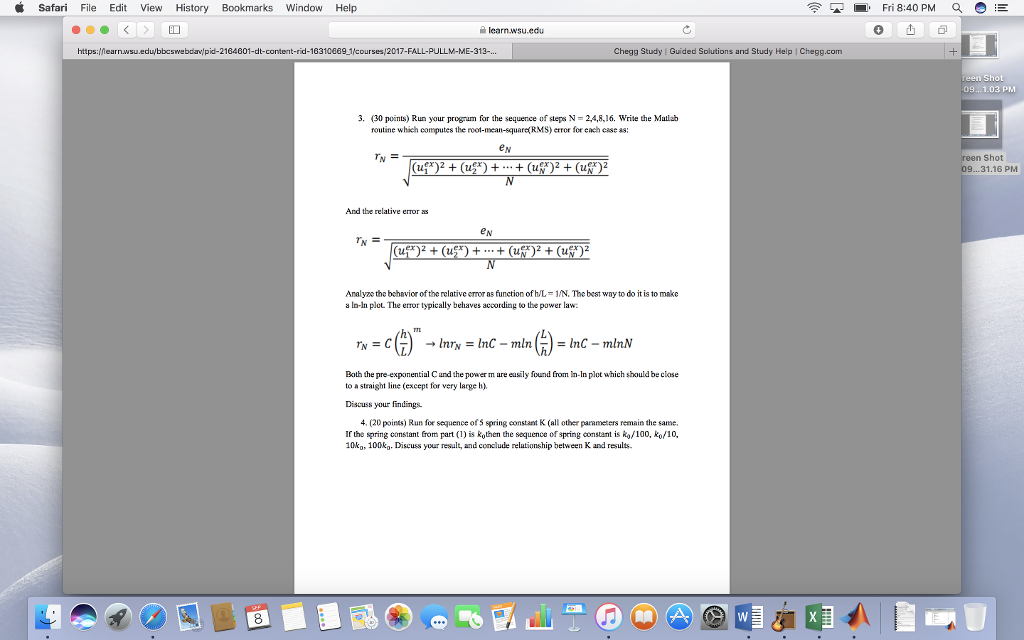 . I really need help on this one it is in Matlab this is the whole lab using my code #3 and #4 question is better understood with the whole lab together.
i Safari File Edit View History Bookmarks Window Help 11 Fri 8:40 PM 16310869 1/courses/2017-FALL-PULLM-ME-313-... Chegg Study Guided Solutions and Study Help | Chegg.com 09...1.03 PM 3. (30 points) Run your program for the sequence of steps N-2,4,8,16. Write the Matlab routine which computes the root-mean-square RMS)eor for each case as: reen Shot 09...31.16 PM And the relative error as eN Analyze the bohavior of the relative crror as function ofh/L- IN. The best wny to do it is to make a ln-In ploL The er typically behaves acording to the power law Both the pre-exponential C and the power m are eusily found from Im-In plot which should be close to a straight line (except for very large h) Discuss your findings. 4. (20 points) Run foe sequence of S spring constant K (al other parameters remain the same. If the spring constant from part (1) is kothen the sequence of spring constant is ko/100, ko/10, 10k, 100ko. Discuss your result, and conclude relationship between K and results
Step by Step Solution
There are 3 Steps involved in it

Get step-by-step solutions from verified subject matter experts
 Study Help