







Question: SUBJECT: Quality Auditing This exercise is based on an audit of a fast food restaurant. In this unit we discussed in much more detail the
SUBJECT: Quality Auditing
This exercise is based on an audit of a fast food restaurant.
In this unit we discussed in much more detail the audit plan. The exercises for this unit will center around completion of the details of the plan outline we created in unit 4.
3) As you have read it will be important to research an area and discover its status before an audit takes place. Consider as we have before the "preparation" process within your restaurant. Discuss what sources of information could be utilized in this research. Reference page below (from text) when creating this bullet point list. Add other sources that you might consider beneficial.
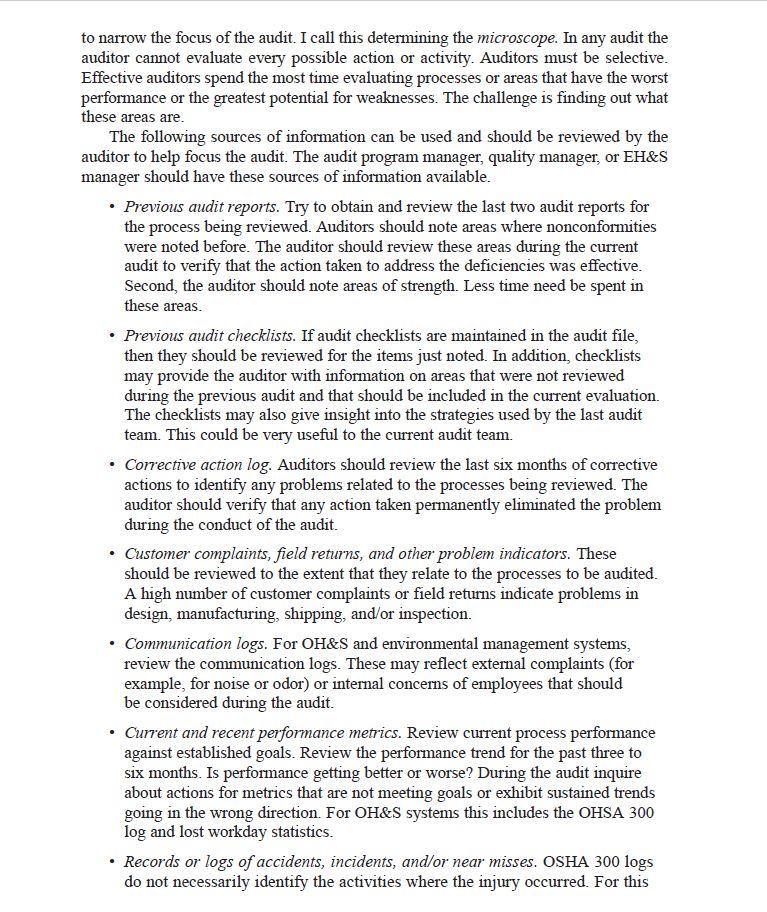
to narrow the focus of the audit. I call this determining the microscope. In any audit the auditor cannot evaluate every possible action or activity. Auditors must be selective. Effective auditors spend the most time evaluating processes or areas that have the worst performance or the greatest potential for weaknesses. The challenge is finding out what these areas are. The following sources of information can be used and should be reviewed by the auditor to help focus the audit. The audit program manager, quality manager, or EH&S manager should have these sources of information available. Previous audit reports. Try to obtain and review the last two audit reports for the process being reviewed. Auditors should note areas where nonconformities were noted before. The auditor should review these areas during the current audit to verify that the action taken to address the deficiencies was effective. Second, the auditor should note areas of strength. Less time need be spent in these areas. Previous audit checklists. If audit checklists are maintained in the audit file, then they should be reviewed for the items just noted. In addition, checklists may provide the auditor with information on areas that were not reviewed during the previous audit and that should be included in the current evaluation. The checklists may also give insight into the strategies used by the last audit team. This could be very useful to the current audit team. Corrective action log. Auditors should review the last six months of corrective actions to identify any problems related to the processes being reviewed. The auditor should verify that any action taken permanently eliminated the problem during the conduct of the audit. Customer complaints, field returns, and other problem indicators. These should be reviewed to the extent that they relate to the processes to be audited. A high number of customer complaints or field returns indicate problems in design, manufacturing, shipping, and/or inspection. Communication logs. For OH&S and environmental management systems, review the communication logs. These may reflect extemal complaints (for example, for noise or odor) or internal concems of employees that should be considered during the audit. Current and recent performance metrics. Review current process performance against established goals. Review the performance trend for the past three to six months. Is performance getting better or worse? During the audit inquire about actions for metrics that are not meeting goals or exhibit sustained trends going in the wrong direction. For OH&S systems this includes the OHSA 300 log and lost workday statistics. Records or logs of accidents, incidents, and/or near misses. OSHA 300 logs do not necessarily identify the activities where the injury occurred. For this
Step by Step Solution
There are 3 Steps involved in it
1 Expert Approved Answer
Step: 1 Unlock

Question Has Been Solved by an Expert!
Get step-by-step solutions from verified subject matter experts
Step: 2 Unlock
Step: 3 Unlock
 Study Help