







Question: This is a Calculus question. Both the question and the solution are shown below. My query relates to the solution shown below. Please explain how
This is a Calculus question.
Both the question and the solution are shown below.
My query relates to the solution shown below.
Please explain how
(x)=1+x1(1+nsx)1
is derived from
(x)
Also, explain how
x^=n+1s
is obtained.
Please show each step in as much detail as possible.
If you are using hand-written notes, then please ensure they are tidy and legible as untidy written notes are difficult to interpret. Alternatively use LaTeX.
Question
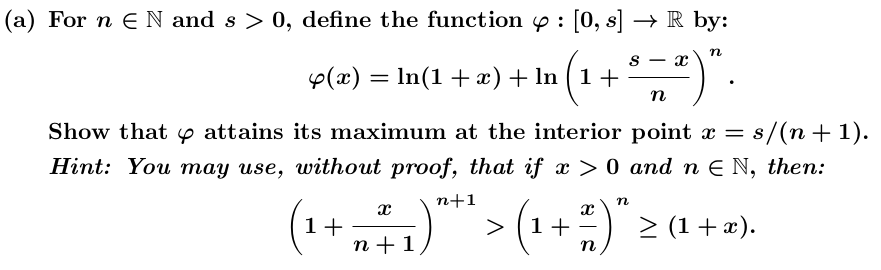
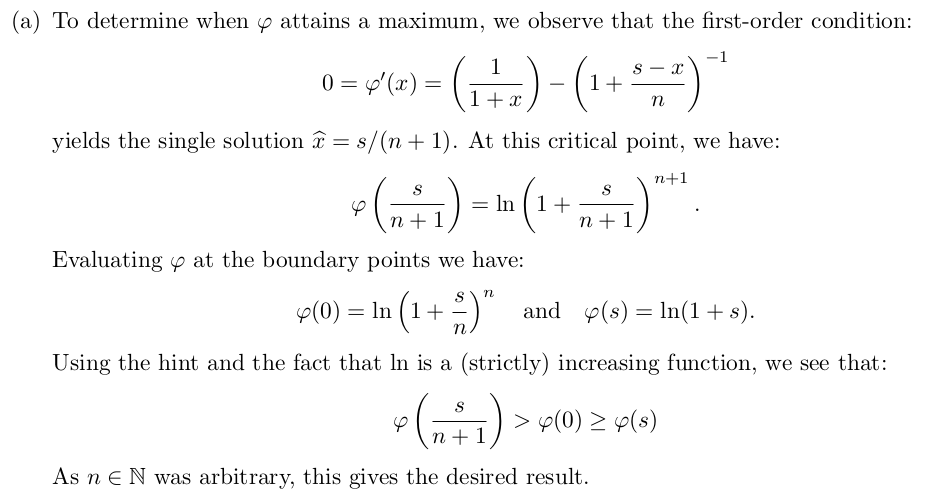
(a) For n E N and s > 0, define the function 4 : [0, s] - R by: S - D "p(a) = In(1 + ac) + In 1 + n Show that 4 attains its maximum at the interior point x = s/(n+ 1). Hint: You may use, without proof, that if x > 0 and n E N, then: n+1 n 1 + > 1 + 2 (1+x). n+1 n(a) To determine when y attains a maximum, we observe that the first-order condition: -1 S 0 = 4'(2) = 1 1 + x n yields the single solution x = s/(n + 1). At this critical point, we have: n+1 S S = In (1+ n+1 n+1 Evaluating y at the boundary points we have: n 4(0) = In (1+>) and 4(s) = In(1 + s). Using the hint and the fact that In is a (strictly) increasing function, we see that: S n+1 > 4(0) 2 4(s) As n E N was arbitrary, this gives the desired result
Step by Step Solution
There are 3 Steps involved in it

Get step-by-step solutions from verified subject matter experts
 Study Help