



Question: = This numerical example illustrates mathematically the same concept shown graphically in Figure 5.16 of Williamson's text (6th edition). The economy has a representative
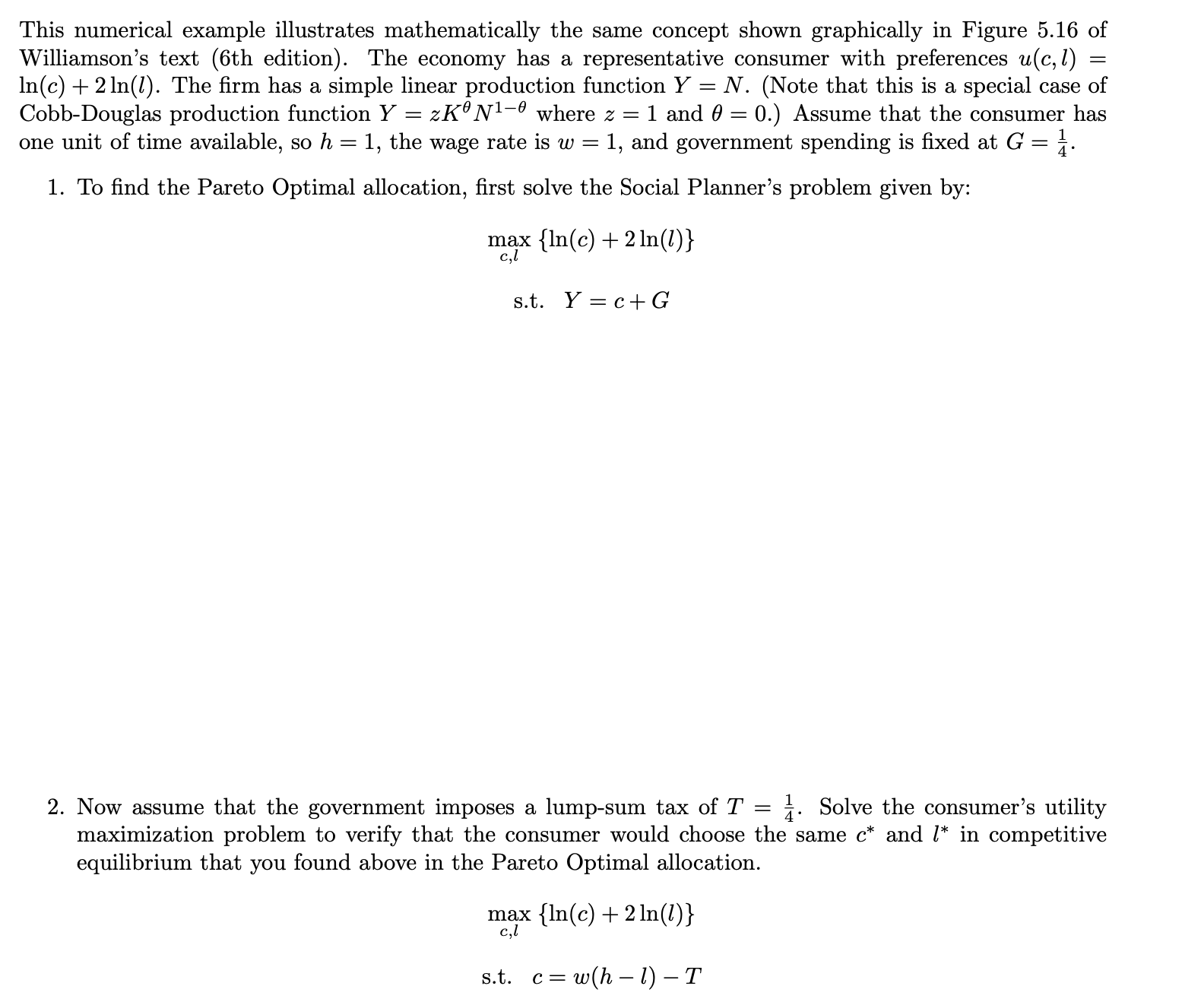
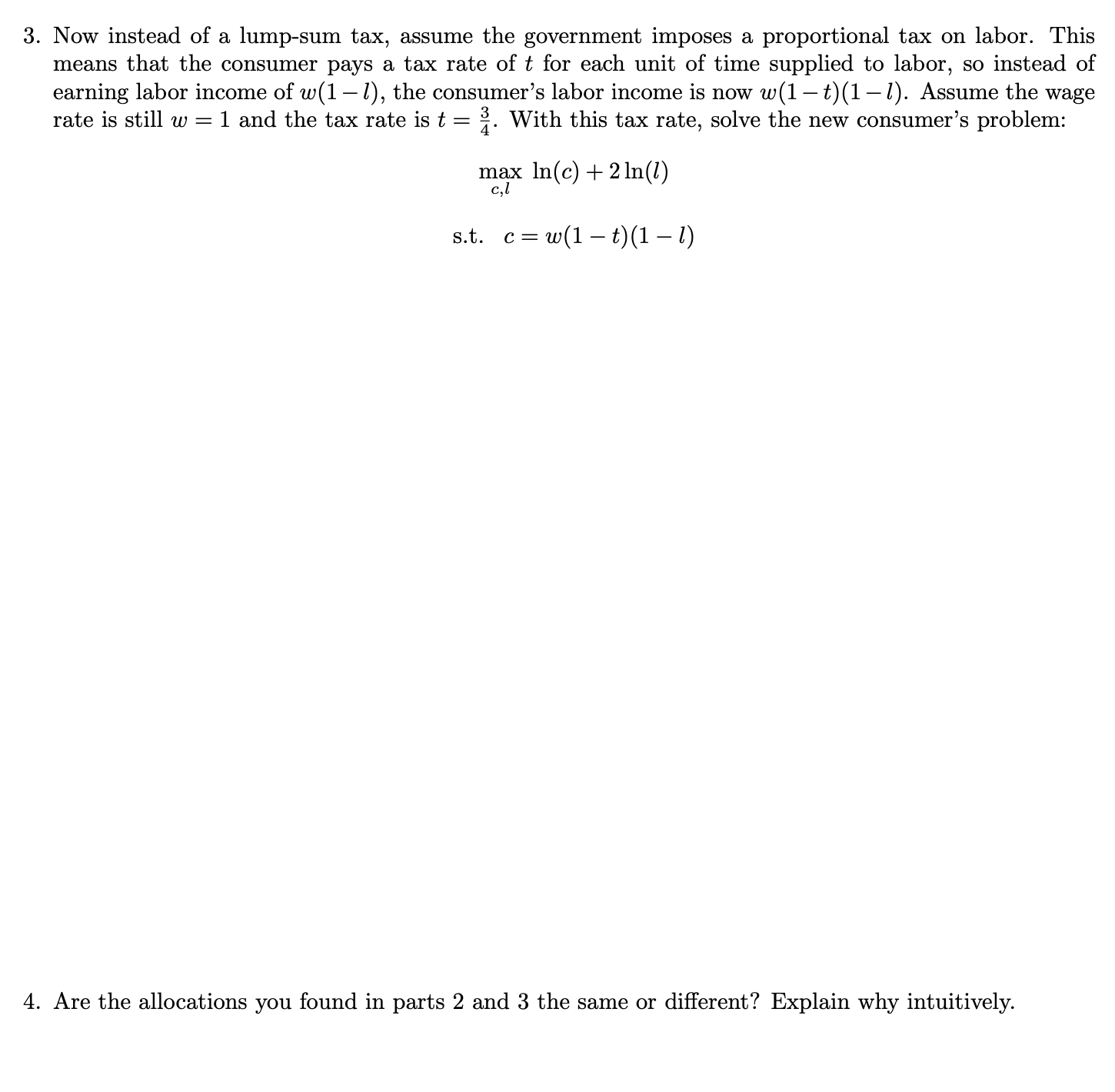
= This numerical example illustrates mathematically the same concept shown graphically in Figure 5.16 of Williamson's text (6th edition). The economy has a representative consumer with preferences u(c, l) In(c) 2ln(1). The firm has a simple linear production function Y = N. (Note that this is a special case of Cobb-Douglas production function Y = zK N-0 where z = 1 and 0 = 0.) Assume that the consumer has one unit of time available, so h = 1, the wage rate is w = 1, and government spending is fixed at G = . 1. To find the Pareto Optimal allocation, first solve the Social Planner's problem given by: max {ln(c) +2 ln(1)} c,l s.t. Y=c+ G 1. Solve the consumer's utility 2. Now assume that the government imposes a lump-sum tax of T maximization problem to verify that the consumer would choose the same c* and 1* in competitive equilibrium that you found above in the Pareto Optimal allocation. max {ln(c) +2ln(1)} c,l s.t. c = w(h-1) T 3. Now instead of a lump-sum tax, assume the government imposes a proportional tax on labor. This means that the consumer pays a tax rate of t for each unit of time supplied to labor, so instead of earning labor income of w(1-1), the consumer's labor income is now w(1 t)(1 1). Assume the wage rate is still w = 1 and the tax rate is t = 14. With this tax rate, solve the new consumer's problem: max ln(c) +2 ln(1) c,l s.t. c = w(t)(1 1) 4. Are the allocations you found in parts 2 and 3 the same or different? Explain why intuitively.
Step by Step Solution
There are 3 Steps involved in it
To solve the Social Planners problem we need to maximize the utility ... View full answer

Get step-by-step solutions from verified subject matter experts