







Question: This problem concerns the Polynomial-Time Hierarchy (PH). We say that a set of binary strings, S, is an element of ?, iff there is a
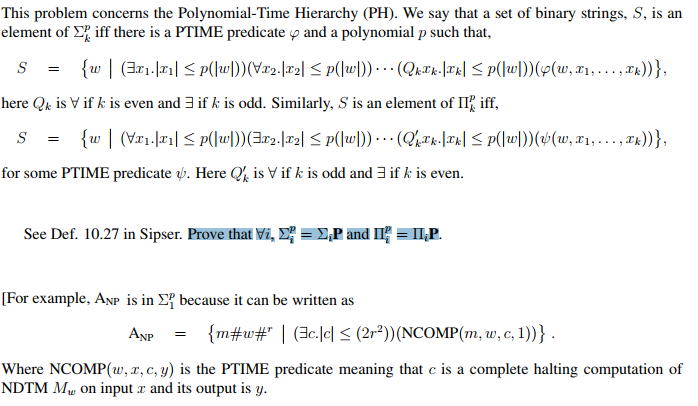
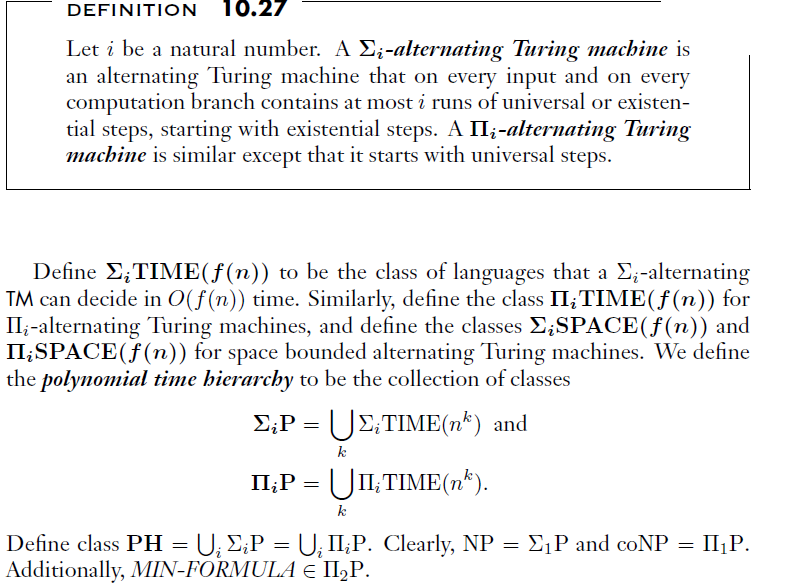
This problem concerns the Polynomial-Time Hierarchy (PH). We say that a set of binary strings, S, is an element of ?, iff there is a PTIME predicate yo and a polynomial p such that, here Qk is V if k is even and if k is odd. Similarly, S is an element orne iff. for some PTIME predicate v. Here Q. is V if k is odd and if k is even. See Def. 10.27 in Sipser. Prove that Vi, ? ?,P and I?-IP. For example, ANP s in ?' because it can be written as ANP- (m#w#r l (3c.ld (2r*))(NCOMP(rn, tv, c, l))). Where NCOMP(u z,c,y) is the PTIME predicate meaning that c s a complete halting computation of NDTM Mw on input r and its output is y. This problem concerns the Polynomial-Time Hierarchy (PH). We say that a set of binary strings, S, is an element of ?, iff there is a PTIME predicate yo and a polynomial p such that, here Qk is V if k is even and if k is odd. Similarly, S is an element orne iff. for some PTIME predicate v. Here Q. is V if k is odd and if k is even. See Def. 10.27 in Sipser. Prove that Vi, ? ?,P and I?-IP. For example, ANP s in ?' because it can be written as ANP- (m#w#r l (3c.ld (2r*))(NCOMP(rn, tv, c, l))). Where NCOMP(u z,c,y) is the PTIME predicate meaning that c s a complete halting computation of NDTM Mw on input r and its output is y
Step by Step Solution
There are 3 Steps involved in it

Get step-by-step solutions from verified subject matter experts
 Study Help