







Question: Time (in clock cycles) CC 1 CC 2 CC 3 CC4 CC5 CC6 CC7 CC 8 CC9 CC 10 Program execution order (in instructions) lw
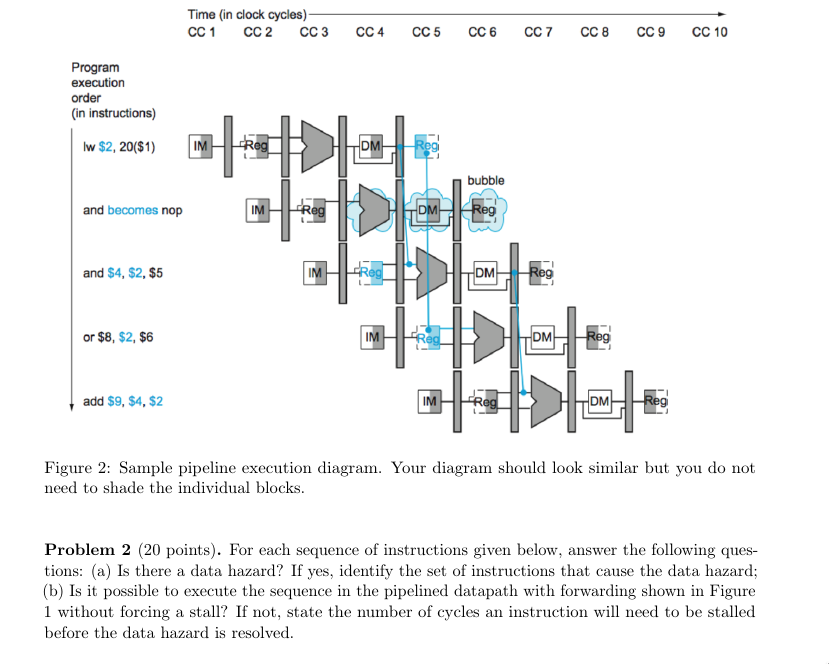
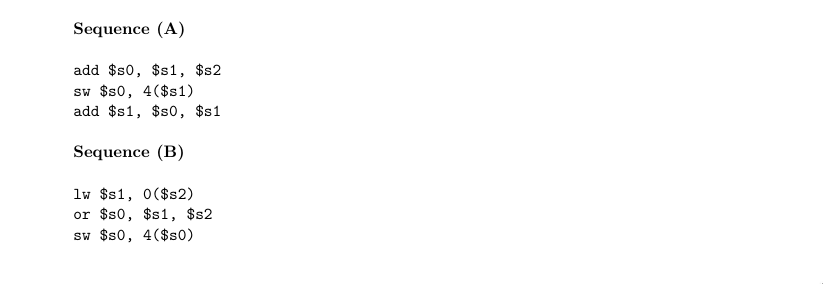
Time (in clock cycles) CC 1 CC 2 CC 3 CC4 CC5 CC6 CC7 CC 8 CC9 CC 10 Program execution order (in instructions) lw $2, 20($1) IM DM bubble and becomes nop IM and $4, $2, $5 IM DM or $8, $2, $6 IM DM add $9, $4, $2 IM DM Figure 2: Sample pipeline execution diagram. Your diagram should look similar but you do not need to shade the individual blocks Problem 2 (20 points). For each sequence of instructions given below, answer the following ques- tions: (a) Is there a data hazard? If yes, identify the set of instructions that cause the data hazard; (b) Is it possible to execute the sequence in the pipelined datapath with forwarding shown in Figure 1 without forcing a stall? If not, state the number of cycles an instruction wll need to be stalled before the data hazard is resolved. Time (in clock cycles) CC 1 CC 2 CC 3 CC4 CC5 CC6 CC7 CC 8 CC9 CC 10 Program execution order (in instructions) lw $2, 20($1) IM DM bubble and becomes nop IM and $4, $2, $5 IM DM or $8, $2, $6 IM DM add $9, $4, $2 IM DM Figure 2: Sample pipeline execution diagram. Your diagram should look similar but you do not need to shade the individual blocks Problem 2 (20 points). For each sequence of instructions given below, answer the following ques- tions: (a) Is there a data hazard? If yes, identify the set of instructions that cause the data hazard; (b) Is it possible to execute the sequence in the pipelined datapath with forwarding shown in Figure 1 without forcing a stall? If not, state the number of cycles an instruction wll need to be stalled before the data hazard is resolved
Step by Step Solution
There are 3 Steps involved in it

Get step-by-step solutions from verified subject matter experts
 Study Help