





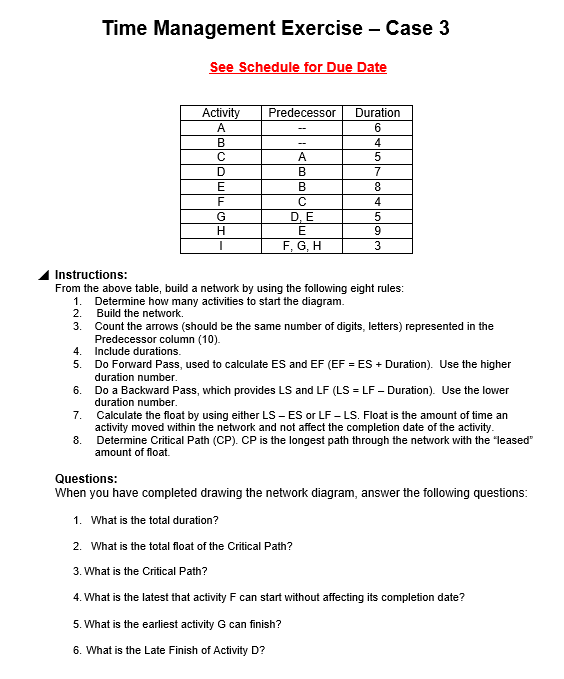
Question: Time Management Exercise - Case 3 See Schedule for Due Date Activity Predecessor Duration 6 B 4 A 5 D B 7 E B 8
Time Management Exercise - Case 3 See Schedule

Time Management Exercise - Case 3 See Schedule for Due Date Activity Predecessor Duration 6 B 4 A 5 D B 7 E B 8 F 4 G DE 5 H E 9 F,G,H 3 Instructions: From the above table, build a network by using the following eight rules: 1. Determine how many activities to start the diagram. 2. Build the network. 3. Count the arrows (should be the same number of digits, letters) represented in the Predecessor column (10) 4. Include durations. 5. Do Forward Pass, used to calculate ES and EF (EF = ES + Duration). Use the higher duration number. 6. Do a Backward Pass, which provides LS and LF (LS = LF - Duration). Use the lower duration number. 7. Calculate the float by using either LS-ES or LF-LS. Float is the amount of time an activity moved within the network and not affect the completion date of the activity 8. Determine Critical Path (CP). CP is the longest path through the network with the leased" amount of float. Questions: When you have completed drawing the network diagram, answer the following questions: 1. What is the total duration? 2. What is the total float of the Critical Path? 3. What is the Critical Path? 4. What is the latest that activity F can start without affecting its completion date? 5. What is the earliest activity G can finish? 6. What is the Late Finish of Activity D

Step by Step Solution

There are 3 Steps involved in it

1 Expert Approved Answer
Step: 1 Unlock blur-text-image

Question Has Been Solved by an Expert!

Get step-by-step solutions from verified subject matter experts

Step: 2 Unlock
Step: 3 Unlock

Students Have Also Explored These Related General Management Questions!