







Question: use the pages below to answer this question thoroughly 1. Why must managers be aware of a firm's external environment? nd the ce of ng
use the pages below to answer this question thoroughly 
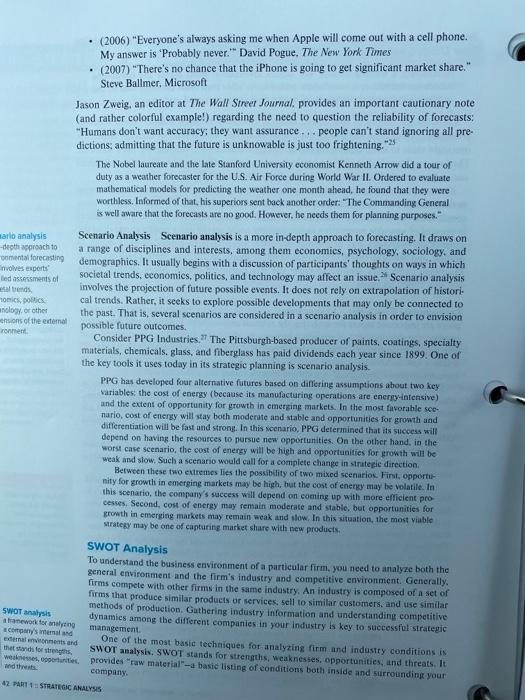
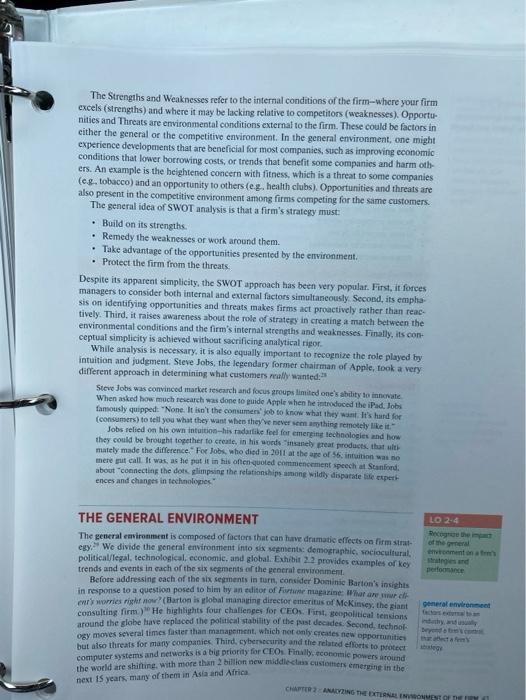
1. Why must managers be aware of a firm's external environment? nd the ce of ng forecasts of ess ment. al acuity to sense what before the fog . ENHANCING AWARENESS OF THE EXTERNAL ENVIRONMENT So how do managers become environmentally aware? Ram Charan, an adviser to many Fortune 500 CEOs, provides some useful insights with his concept of perceptual acuity. He defines it as the ability to sense what is coming before the fog clears." He draws on Ted Turner as an example: Turner saw the potential of 24-hour news before anyone else did. All the ingredients were there, but no others connected them until he created CNN. Like Turner, the best CEOs are compulsively tuned to the external environment and seem to have a sixth sense that picks up anomalies and detects early warning signals that may represent key threats or opportunities. How can perceptual acuity be improved? Although many CEOs may complain that the top job is a lonely one, they can't do it effectively by sitting alone in their office. Instead, high-performing CEOs are constantly meeting with people and searching out information. Charan provides three examples: One CEO gets together with his critical people for half a day every eight weeks to discuss what's new and what's going on in the world. The setting is informal, and outsiders often attend. The participants look beyond the lens of their industry because some trends that affect one industry may impact others later on. Another CEO meets four times a year with about four other CEOs of large, but non- competing, diverse global companies. Examining the world from multiple perspec- tives, they share their thinking about how different trends may develop. The CEO then goes back to his own weekly management meeting and throws out "a bunch of hand grenades to shake up people's thinking." Two companies ask outsiders to critique strategy during their board's strategy ses- sions. Such input typically leads to spirited discussions that provide valued input on the hinge assumptions and options that are under consideration. Once, the focus was on pinpointing the risk inherent in a certain strategy. Now, discussions have led to finding that the company was missing a valuable opportunity. We will now address three important processes-scanning, monitoring, and gathering competitive intelligence-used to develop forecasts. Exhibit 2.1 illustrates relationships among these important activities. We also discuss the importance of scenario planning in anticipating major future changes in the external environment and the role of SWOT analysis. 1 STRATEGIC ANALYSIS The Role of Scanning, Monitoring, Competitive Intelligence, and Forecasting Environmental Scanning Environmental scanning involves surveillance of a firm's external envi- ronment to predict environmental changes and detect changes already underway. This alerts the organization to critical trends and events before changes develop a discernible pattern and before competitors recognize them. Otherwise, the firm may be forced into a reactive mode." Experts agree that spotting key trends requires a combination of knowing your business and your customer as well as keeping an eye on what's happening around you. Such a big- picture/small-picture view enables you to better identify the emerging trends that will affect your business. Leading firms in an industry can also be a key indicator of emerging trends. For exam- ple, with its wide range of household goods, Procter & Gamble is a barometer for consumer spending. Any sign that it can sell more of its premium products without cutting prices sharply indicates that shoppers may finally be becoming less price-sensitive with everyday purchases. In particular, investors will examine the performance of beauty products like Olay moisturizers and CoverGirl cosmetics for evidence that spending on small, discretion- ary pick-me-ups is improving. LO 2-2 Explain why environmen environment monitoring, collecting cor intelligence a inputs to forec environments scanning surveillance of a external environ predict environm changes and dete changes already environmental monitoring a firm's analysis of the external environment tracks the evolution environmental trends sequences of events. streams of activities Environmental Monitoring Environmental monitoring tracks the evolution of environmen- tal trends, sequences of events, or streams of activities. They may be trends that the firm came across by accident or ones that were brought to its attention from outside the organi- zation. Monitoring enables firms to evaluate how dramatically environmental trends are changing the competitive landscape. One of the authors of this text has conducted on-site interviews with executives from several industries to identify indicators that firms monitor as inputs to their strategy pro- cess. Examples of such indicators included: A Motel 6 executive. The number of rooms in the budget segment of the industry in the United States and the difference between the average daily room rate and the consumer price index (CPI). A Pier 1 Imports executive. Net disposable income (NDI), consumer confidence index, and housing starts. A Johnson & Johnson medical products executive. Percentage of gross domestic prod- uct (GDP) spent on health care, number of active hospital beds, and the size and power of purchasing agents (indicates the concentration of buyers). Such indices are critical for managers in determining a firm's strategic direction and resource allocation. CHAPTER 2 - ANALYZING THE EXTERNAL ENVIRONMENT OF THE FIRM 19 tive Competitive Intelligence Competitive intelligence (CT) helps firms define and understand ence their industry and identify rivals' strengths and weaknesses. This includes the intelligence tivities of and interpreting gathering associated with collecting data on competitors and interpreting such data. Done competitors. properly, competitive intelligence helps a company avoid surprises by anticipating competi- and understanding tors' moves and decreasing response time! stry, and identifying Examples of competitive analysis are evident in daily newspapers and periodicals such as tors' strengths and The Wall Street Journal, Bloomberg Businessweek, and Fortune. For example, banks continu- sses ally track home loan, auto loan, and certificate of deposit (CD) interest rates charged by rivals. Major airlines change hundreds of fares daily in response to competitors' tactics. Car manufacturers are keenly aware of announced cuts or increases in rivals' production vol- ume, sales, and sales incentives (e.g., rebates and low interest rates on financing). This information is used in their marketing, pricing, and production strategies. Keeping track of competitors has become easier today with the amount of information that is available on the Internet. The following are examples of some websites that compa- nies routinely use for competitive intelligence gathering. 16 . Slideshare. A website for publicly sharing PowerPoint presentations. Marketing teams have embraced the platform and often post detail-rich presentations about their firms and products. Quora. A question-and-answer site popular among industry insiders who embrace the free flow of information about technical questions. iSpionage. A site that reveals the ad words that companies are buying, which can often shed light on new campaigns being launched YouTube. Great for finding interviews with executives at trade shows. At times, a firm's aggressive efforts to gather competitive intelligence may lead to uneth- ical or illegal behaviors. Strategy Spotlight 2.1 provides an example of a company, United Technologies, that has set clear guidelines to help prevent unethical behavior. A word of caution: Executives must be careful to avoid spending so much time and effort tracking the actions of traditional competitors that they ignore new competitors. Further. PART 1 STRATEGIC ANALYSIS broad environmental changes and events may have a dramatic impact on a firm's viability Peter Drucker, wrote: Increasingly, a winning strategy will require information about events and conditions outside the institution: noncustomers, technologies other than those currently used by the company and its present competitors, markets not currently served, and so on." Consider the failure of specialized medical lab Sleep Health Centers. Until recently. patients suffering from sleep disorders, such as apnea, were forced to undergo expensive overnight visits to sleep clinics, including Sleep Health Centers, to diagnose their ailments, The firm was launched in 1997 and quickly expanded to over two dozen locations. Revenue scared from nearly 510 million in 1997 to $30 million in 2010. However, the rapid improvements in the price and performance of wearable monitoring devices changed the busin gradually at first and then suddenly. For one thing, the more comfortable home setting produced more effective measurements. And the quick declines in the cost of wearable monitoring meant patients could get the same results at one-third the price of an overnight stay at a clinic. By 2011, Sleep Health Centers' revenue began to decline, and the firm closed 20 percent or its locations. In 2012, its death knells sounded: Insurance companies decided to cover the less expensive option. Sleep Health Centers abruptly closed its doors Environmental Forecasting Environmental scanning, monitoring, and competitive intelli- gence are important inputs for analyzing the external environment. Environmental forecasting environmental involves the development of plausible projections about the direction, scope, speed, and forecasting the development of intensity of environmental change. Its purpose is to predict change." It asks: How long will plauble projections about it take a new technology to reach the marketplace? Will the present social concern about an the directionscape issue result in new legislation are current lifestyle trends likely to continue? Speed, and intensity of Some forecasting issues are much more specific to a particular firm and the industry in anal charge which it competes. Consider how important it is for Motel 6 to predict future indicators, such as the number of rooms, in the budget segment of the industry. If its predictions are too optimistic, it will build too many units, creating a surplus of room capacity that would drive down room rates A danger of forecasting is that managers may view uncertainty as black and white and Ignore important gray areas. The problem is that underestimating uncertainty can lead to strategies that neither defend against threats or take advantage of opportunities In 1977 one of the colossal underestimations in business history occurred when Kenneth H LO 23 Olsen, president of Digital Equipment Corp. announced. There is no reason for individuals to have a computer in their home. The explosion in the personal computer market was not easy Expewny to detect in 1977, but it was clearly within the range of possibilities at the time. And, historically. panga technique forms there have been underestimates of the growth potential of new telecommunication services competing in its The electric telegraph was derided by Ralph Waldo Emerson, and the telephone had its skep- wered by ties. More recently, an infamous" McKinsey study in the early 1980s predicted fewer than up and 1 million cellular users in the United States by 2000. Actually, there were nearly 100 million chanje Obviously poor predictions about technology change never go out of vogue. Consider some other pema-predicted by very knowledgeable people . (1981) Cellular phones will absolutely not replace local wire systems. Inventor Marty Cooper . (1995) "1 predict the Internet will soon po spectacularly supernova and in 1996 catastrophically collapse Robert Metcalfe, founder of Com (1997) Apple is already dead." Former Microsoft CTO Nathan Myhrvold . (2005) "There's just not that many videos. I want to watch Steve Chen, CTO and co-founder YouTube, expressing concerns about the firm's long-term viability CHAPTER 2 ANALYZING THE EXTENNAL ENVIRONMENT OF THE . (2006) "Everyone's always asking me when Apple will come out with a cell phone. My answer is 'Probably never." David Pogue, The New York Times (2007) "There's no chance that the iPhone is going to get significant market share." Steve Ballmer, Microsoft Jason Zweig, an editor at The Wall Street Journal, provides an important cautionary note (and rather colorful example!) regarding the need to question the reliability of forecasts: "Humans don't want accuracy, they want assurance ... people can't stand ignoring all pre- dictions admitting that the future is unknowable is just too frightening." The Nobel laureate and the late Stanford University economist Kenneth Arrow did a tour of duty as a weather forecaster for the U.S. Air Force during World War II. Ordered to evaluate mathematical models for predicting the weather one month ahead, he found that they were worthless. Informed of that his superiors sent back another order: "The Commanding General is well aware that the forecasts are no good. However, he needs them for planning purposes." arlo analysis --depthroach to mental forecasting volves experts Bed assessments of albends cs, politics inology, or other ons of the external ronment Scenario Analysis Scenario analysis is a more in-depth approach to forecasting. It draws on a range of disciplines and interests, among them economics, psychology, sociology, and demographics. It usually begins with a discussion of participants' thoughts on ways in which societal trends, economics, politics, and technology may affect an issue. Scenario analysis involves the projection of future possible events. It does not rely on extrapolation of histori cal trends. Rather, it seeks to explore possible developments that may only be connected to the past. That is, several scenarios are considered in a scenario analysis in order to envision possible future outcomes Consider PPG Industries. The Pittsburgh-based producer of paints, coatings, specialty materials, chemicals, glass, and fiberglass has paid dividends each year since 1899. One of the key tools it uses today in its strategic planning is scenario analysis PPG has developed four alternative futures based on differing assumptions about two key variables the cost of energy (because its manufacturing operations are energy intensive) and the extent of opportunity for growth in emerging markets. In the most favorable sce- nario, cost of energy will stay both moderate and stable and opportunities for growth and differentiation will be fast and strong. In this scenario, PPG determined that its success will depend on having the resources to pursue new opportunities. On the other hand, in the worst case scenario, the cost of energy will be high and opportunities for growth will be weak and slow. Such a scenario would call for a complete change in strategie direction Between these two extremes lies the possibility of two mixed scenarios. First, opportu- nity for growth in emerging markets may be high, but the cost of energy may be volatile. In this scenario, the company's success will depend on coming up with more efficient pro cesses. Second, cost of energy may remain moderate and stable, but opportunities for growth in emerging markets may remain weak and slow. In this situation, the most viable strategy may be one of capturing market share with new products SWOT Analysis To understand the business environment of a particular firm, you need to analyze both the general environment and the firm's industry and competitive environment. Generally. firms compete with other firms in the same industry. An industry is composed of a set of firms that produce similar products or services, sell to similar customers, and use similar methods of production. Gathering industry information and understanding competitive SWOT analysis dynamics among the different companies in your industry is key to successful strategic work for lang management Can's maand aments and One of the most basic techniques for analyzing firm and industry conditions is that stands for SWOT analysis. SWOT stands for strengths, weaknesses, opportunities, and threats. It provides raw material- basic listing of conditions both inside and surrounding your and that company 42 PARTE STRATEGIC ANALYSS . The Strengths and weaknesses refer to the internal conditions of the firm-where your firm excels (strengths) and where it may be lacking relative to competitors (weaknesses). Opportu- nities and Threats are environmental conditions external to the firm. These could be factors in cither the general of the competitive environment. In the general environment, one might experience developments that are beneficial for most companies, such as improving economic conditions that lower borrowing costs, or trends that benefit some companies and harm oth ers. An example is the heightened concern with fitness, which is a threat to some companies (c.g. tobacco) and an opportunity to others (eg, health clubs). Opportunities and threats are also present in the competitive environment among firms competing for the same customers. The general idea of SWOT analysis is that a firm's strategy must: Build on its strengths. Remedy the weaknesses or work around them. Take advantage of the opportunities presented by the environment. Protect the firm from the threats. Despite its apparent simplicity, the SWOT approach has been very popular. First, it forces managers to consider both internal and external factors simultaneously Second, its empha sis on identifying opportunities and threats makes firms act proactively rather than reac- tively. Third, it raise awareness about the role of strategy in creating a match between the environmental conditions and the firm's internal strengths and weaknesses. Finally, its con- ceptual simplicity is achieved without sacrificing analytical rigor While analysis is necessary, it is also equally important to recognize the role played by intuition and judgment. Steve Jobs, the legendary former chairman of Apple, took a very different approach in determining what customers really wanted Steve Jobs was convinced market research and focus groups limited one's ability to innovate When asked how much research was done to guide Apple when he introduced the iPad. Jobs famously quipped: "None. It isn't the consumers job to know what they want. It's hard for (consumers) to tell you what they want when they ve never seen anything remotely like it." Jobs relied on his own intuition-histadartike feel for emerging technologies and how they could be brought together to create, in his words insanely great products that ult mately made the difference. For Jobs who died in 2011 at the ape of 56. intuition was no mere put call. It was as he put it in his often quoted commencement speech at Stanford about connecting the dots glimpsing the relationships among wildly disparate le expert ences and changes in technologies LO 2-4 ermenton ranges and performance THE GENERAL ENVIRONMENT The general environment is composed of factors that can have dramatic effects on firm stru egy. We divide the general environment into segments: demographic, sociocultural political/legal, technological, economie, and global Exhibit 2.2 provides examples of key trends and events in each of the six segments of the general environment Before addressing each of the six segments in turn, consider Dominic Barton's insights in response to a question posed to him by an editor of Fortune magazine: War are well car's worries right now?(Barton ismlobal managing director emeritus of McKinsey, the giant consulting firm.)"He highlights four challenges for CEOs. First soopolitical tensions around the globe have replaced the political stability of the past decades. Second, technol ogy moves several times faster than management, which not only creates new opportunities but also threats for many companies Third, cybersecurity and the related efforts to protect the world are shifting with more than 2 billion now middle-clan customers emerging in the general environment computer systems and networks is a big priority for CEOs Finally, economie polers round next 15 years, many of them in Asia and Africa CHAPTER 2 ANTING THE ONLINE Step by Step Solution
There are 3 Steps involved in it
1 Expert Approved Answer
Step: 1 Unlock

Question Has Been Solved by an Expert!
Get step-by-step solutions from verified subject matter experts
Step: 2 Unlock
Step: 3 Unlock
 Study Help