Question: Using A Battle Emerging in Mobile Payments case study (Schilling, 2017, p67), discuss the forces that are likely to encourage one of the mobile payment
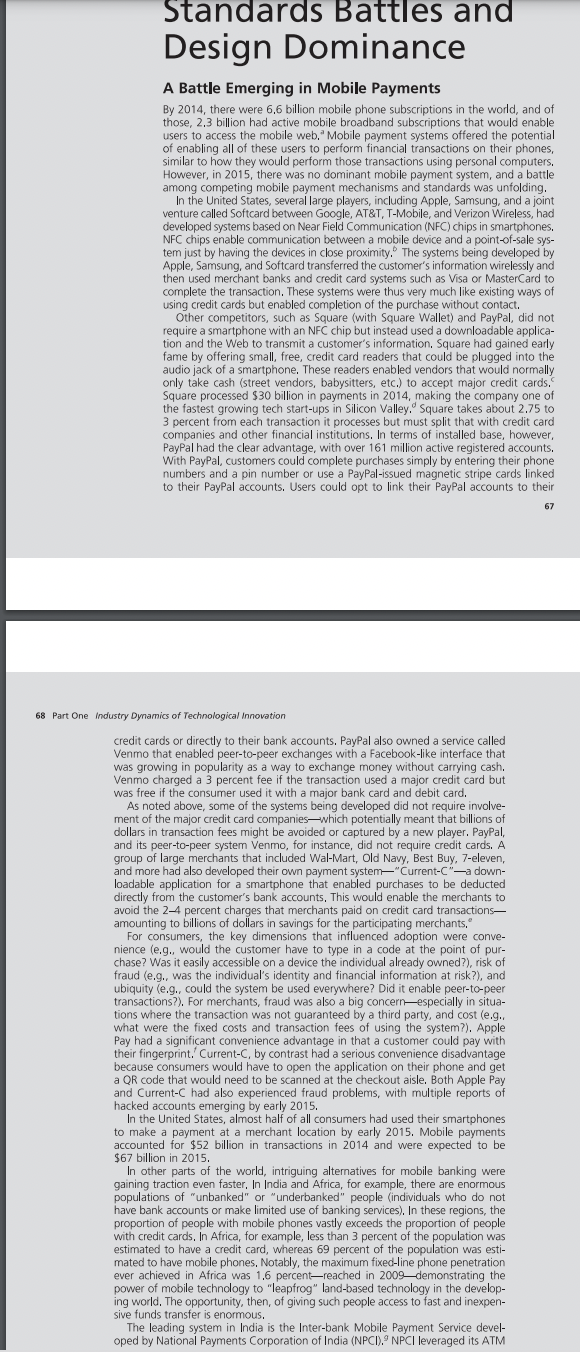 Using A Battle Emerging in Mobile Payments case study (Schilling, 2017, p67), discuss the forces that are likely to encourage one of the mobile payment systems to emerge as dominant and how Absorptive capacity and Network Externalities are linked together
Standards Battles and Design Dominance A Battle Emerging in Mobile Payments By 2014, there were 6.6 billion mobile phone subscriptions in the world, and of those, 2.3 billion had active mobile broadband subscriptions that would enable users to access the mobile web," Mobile payment systems offered the potential of enabling all of these users to perform financial transactions on their phones, similar to how they would perform those transactions using personal computers. However, in 2015, there was no dominant mobile payment system, and a battle among competing mobile payment mechanisms and standards was unfolding. In the United States, several large players, including Apple, Samsung, and a joint venture called Softcard between Google, AT&T, T-Mobile, and Verizon Wireless, had developed systems based on Near Field Communication (NFC) chips in smartphones, NFC chips enable communication between a mobile device and a point-of-sale sys- tem just by having the devices in close proximity. The systems being developed by Apple, Samsung, and Softcard transferred the customer's information wirelessly and then used merchant banks and credit card systems such as Visa or MasterCard to complete the transaction. These systems were thus very much like existing ways of using credit cards but enabled completion of the purchase without contact. Other competitors, such as Square (with Square Wallet) and PayPal, did not require a smartphone with an NFC chip but instead used a downloadable applica- tion and the Web to transmit a customer's information. Square had gained early fame by offering small, free, credit card readers that could be plugged into the audio jack of a smartphone. These readers enabled vendors that would normally only take cash (street vendors, babysitters, etc.) to accept major credit cards. Square processed $30 billion in payments in 2014, making the company one of the fastest growing tech start-ups in Silicon Valley." Square takes about 2.75 to 3 percent from each transaction it processes but must split that with credit card companies and other financial institutions. In terms of installed base, however, PayPal had the clear advantage, with over 161 million active registered accounts. With PayPal, customers could complete purchases simply by entering their phone numbers and a pin number or use a PayPal-issued magnetic stripe cards linked to their PayPal accounts. Users could opt to link their PayPal accounts to their 67 68 Part One Industry Dynamics of Technological Innovation credit cards or directly to their bank accounts. PayPal also owned a service called Venmo that enabled peer-to-peer exchanges with a Facebook-like interface that was growing in popularity as a way to exchange money without carrying cash. Venmo charged a 3 percent fee if the transaction used a major credit card but was free if the consumer used it with a major bank card and debit card. As noted above, some of the systems being developed did not require involve- ment of the major credit card companieswhich potentially meant that billions of dollars in transaction fees might be avoided or captured by a new player. PayPal, and its peer-to-peer system Venmo, for instance, did not require credit cards. A group of large merchants that included Wal-Mart, Old Navy, Best Buy, 7-eleven, and more had also developed their own payment system-"Current-C"a down- loadable application for a smartphone that enabled purchases to be deducted directly from the customer's bank accounts. This would enable the merchants to avoid the 2-4 percent charges that merchants paid on credit card transactions, amounting to billions of dollars in savings for the participating merchants. For consumers, the key dimensions that influenced adoption were conve- nience (e.g., would the customer have to type in a code at the point of pur- chase? Was it easily accessible on a device the individual already owned?), risk of fraud (e.g., was the individual's identity and financial information at risk?), and ubiquity (e.g., could the system be used everywhere? Did it enable peer-to-peer transactions?). For merchants, fraud was also a big concernespecially in situa- tions where the transaction was not guaranteed by a third party, and cost (e.g. what were the fixed costs and transaction fees of using the system?). Apple Pay had a significant convenience advantage in that a customer could pay with their fingerprint.' Current-C, by contrast had a serious convenience disadvantage because consumers would have to open the application on their phone and get a QR code that would need to be scanned at the checkout aisle. Both Apple Pay and Current-C had also experienced fraud problems, with multiple reports of hacked accounts emerging by early 2015, In the United States, almost half of all consumers had used their smartphones to make a payment at a merchant location by early 2015. Mobile payments accounted for $52 billion in transactions in 2014 and were expected to be $67 billion in 2015. In other parts of the world, intriguing alternatives for mobile banking were gaining traction even faster, In India and Africa, for example, there are enormous populations of "unbanked" or "underbanked" people (individuals who do not have bank accounts or make limited use of banking services). In these regions, the proportion of people with mobile phones vastly exceeds the proportion of people with credit cards. In Africa, for example, less than 3 percent of the population was estimated to have a credit card, whereas 69 percent of the population was esti- mated to have mobile phones, Notably, the maximum fixed-line phone penetration ever achieved in Africa was 1.6 percent-reached in 2009demonstrating the power of mobile technology to "leapfrog land-based technology in the develop- ing world. The opportunity, then, of giving such people access to fast and inexpen- sive funds transfer is enormous. The leading system in India is the Inter-bank Mobile Payment Service devel- oped by National Payments Corporation of India (NPCI)." NPCI leveraged its ATM









 Study Help