Question: What do you mean by reading these four points? explain Dec Forma Formal ethics programmes According to Trevio et al. (1999), there are four main
What do you mean by reading these four points? explain
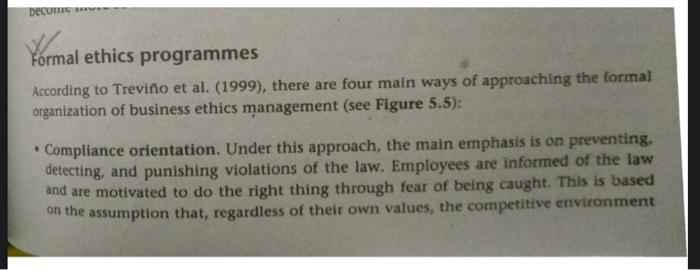
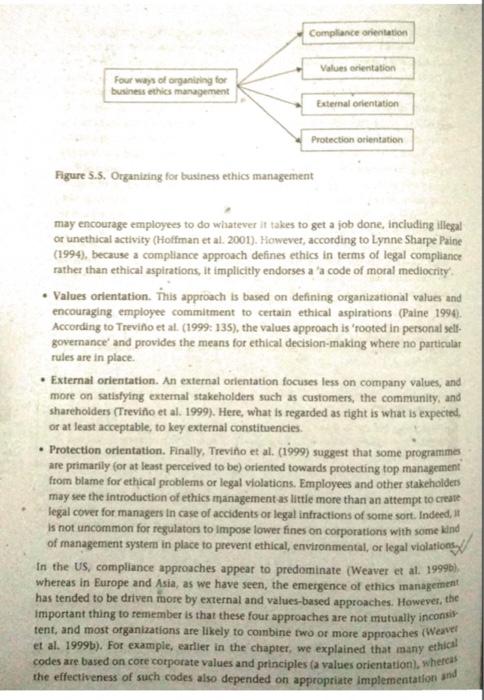
Dec Forma Formal ethics programmes According to Trevio et al. (1999), there are four main ways of approaching the formal organization of business ethics management (see Figure 5.5): Compliance orientation. Under this approach, the main emphasis is on preventing, detecting, and punishing violations of the law. Employees are informed of the law and are motivated to do the right thing through fear of being caught. This is based on the assumption that, regardless of their own values, the competitive environment Compliance orientation Values orientation Four ways of organising for business ethics management External orientation Protection orientation Figure 5.5. Organizing for business ethics management may encourage employees to do whatever it takes to get a job done, including illegal or unethical activity (Hoffman et al. 2001). However, according to Lynne Sharpe Paine (1994), because a compliance approach defines ethics in terms of legal compliance rather than ethical aspirations, it implicitly endorses a 'a code of motal mediocrity Values orientation. This approach is based on defining organizational values and encouraging employee commitment to certain ethical aspirations (Paine 1994). According to Trevino et al. (1999: 135), the values approach is 'rooted in personal self- governance and provides the means for ethical decision-making where no particular rules are in place External orientation. An external orientation focuses less on company values, and more on satisfying external stakeholders such as customers, the community, and shareholders (Trevio et al. 1999). Here, what is regarded as right is what is expected or at least acceptable, to key external constituencies. Protection orientation. Finally, Trevio et al. (1999) suggest that some programmes are primarily for at least perceived to be) oriented towards protecting top management from blame for ethical problems or legal violations. Employees and other stakeholders may see the introduction of ethics management as little more than an attempt to create legal cover for managers in case of accidents or legal infractions of some sort. Indeed, is not uncommon for regulators to impose lower fines on corporations with some kind of management system in place to prevent ethical, environmental, or legal violations, In the US, compliance approaches appear to predominate (Weaver et al. 1999), whereas in Europe and Asia, as we have seen, the emergence of ethics management has tended to be driven more by external and values-based approaches. However, the Important thing to remember is that these four approaches are not mutually inconsi tent, and most organizations are likely to combine two or more approaches (Weaver et al. 1999b). For example, earlier in the chapter, we explained that many ethical codes are based on core corporate values and principles (a values orientation), whereas the effectiveness of such codes also depended on appropriate implementation and









 Study Help