







Question: The disk in Figure = has a mass of 10-kg and a radius of gyration of KG 0.02 m about its center of mass
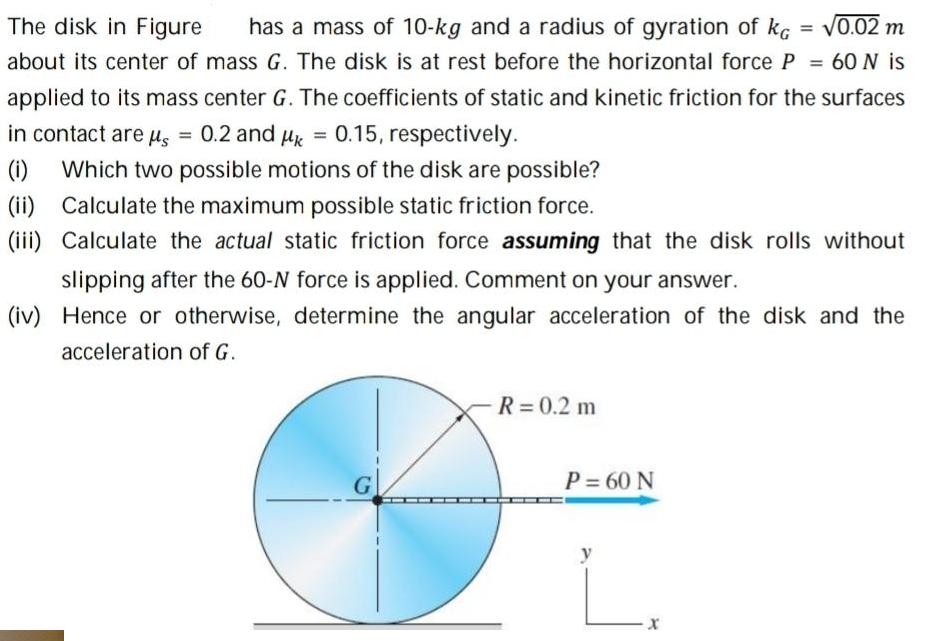
The disk in Figure = has a mass of 10-kg and a radius of gyration of KG 0.02 m about its center of mass G. The disk is at rest before the horizontal force P = 60 N is applied to its mass center G. The coefficients of static and kinetic friction for the surfaces in contact are s = 0.2 and k = 0.15, respectively. (i) Which two possible motions of the disk are possible? (ii) Calculate the maximum possible static friction force. (iii) Calculate the actual static friction force assuming that the disk rolls without slipping after the 60-N force is applied. Comment on your answer. (iv) Hence or otherwise, determine the angular acceleration of the disk and the acceleration of G. G R = 0.2 m P = 60 N x
Step by Step Solution
3.43 Rating (159 Votes )
There are 3 Steps involved in it

Get step-by-step solutions from verified subject matter experts
 Study Help