why did sony choose sir howard stringer to be the CEO ? and would you take the same decisions as him ?
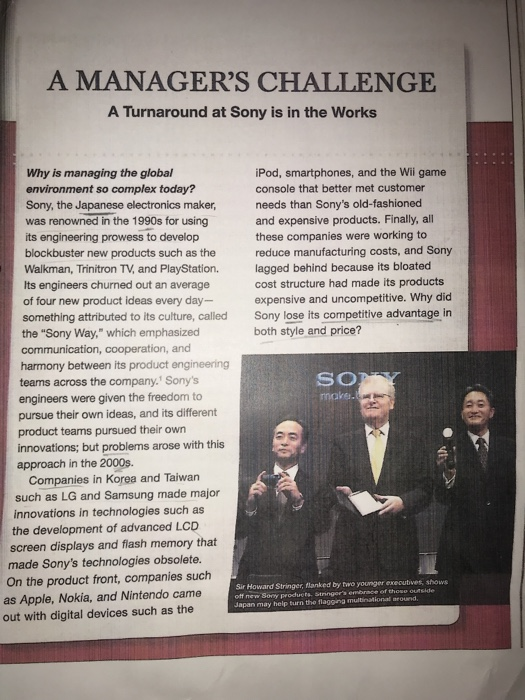
A MANAGER'S CHALLENGE A Turnaround at Sony is in the Works Why is managing the global iPod, smartphones, and the Wii game environment so complex today? console that better met customer Sony, the Japanese electronics maker, needs than Sony's old-fashioned was renowned in the 1990s for using and expensive products. Finally, all its engineering prowess to develop these companies were working to blockbuster new products such as the reduce manufacturing costs, and Sony Walkman, Trinitron TV, and PlayStation. lagged behind because its bloated Its engineers churned out an average cost structure had made its products of four new product ideas every day- expensive and uncompetitive. Why did something attributed to its culture, called Sony lose its competitive advantage in the "Sony Way," which emphasized both style and price? communication, cooperation, and harmony between its product engineering teams across the company.' Sony's SOM engineers were given the freedom to more pursue their own ideas, and its different product teams pursued their own innovations; but problems arose with this approach in the 2000s. Companies in Korea and Taiwan such as LG and Samsung made major innovations in technologies such as the development of advanced LCD screen displays and flash memory that made Sony's technologies obsolete. On the product front, companies such as Apple, Nokia, and Nintendo came of newSony products, Stringer's embrace of those outside out with digital devices such as the Sir Howard Stringer, flanked by two younger executives, shows Japan may help turn the flagging multinational round. One reason was that Sony's culture no longer worked in its favor. The top managers of its most successful divisions worked to protect their own divisions' interests-not Sony's -- and they had been slow to recognize the major changes taking place in the technological and global environment. As Sony's performance fell, competition between managers increased, slowing strategic decision making, making it harder for the company to take advantage of its extensive pipeline of new product innovations, and increasing operating costs because each division fought to obtain the funding necessary to develop and promote new products. By 2005 Sony was in big trouble; and at this crucial point in their company's history, Sony's Japanese top managers turned to a gajin, or non-Japanese, executive to lead their company. Their choice was Sir Howard Stringer, a Welshman, the previous head of Sony's North American operations who had been instrumental in cutting costs and increasing the profits of Sony's US division. Once he became CEO in 2005, Stringer faced the immediate problem of reducing Sony's operating costs, which were double those of its competitors even as it was losing its technological leadership. Stringer had to make many radical strategic decisions. Japan is a country where large companies traditionally had a policy of lifetime employment, but Stringer made it clear that layoffs were inevitable. Within five years he cut Sony's Japanese workforce by over 25,000 employees and closed 12 factories to reduce costs. Stringer also recognized how the extensive power struggles among the top managers of Sony's different product divisions were hurting the company, and he made it clear that these problems had to stop. Many top divisional managers, including the manager of Sony's successful PlayStation division, ignored Stringer, they were replaced, and he worked steadily to downsize Sony's bloated corporate headquarters staff and to change its culture. In Stringer's own words, the culture or "business of Sony has been management, not making products." In 2009 Stringer announced he would take charge of the Japanese company's struggling core electronics group and would add the title of president to his existing roles as chairman and CEO as he reorganized Sony's divisions. He also replaced four more top executives with young managers who had held positions outside Japan and were "familiar with the digital world." in the future, according to Stringer, managers must prioritize new products and invest in only those with the greatest chance of success so Sony could reduce its out-of-control R&D costs. Stringer worked hard to bring the realities of global competition to the forefront at Sony-along with the need to deal with them quickly. Beyond his internal problems, he also pushed for major changes in how Sony picked its suppliers. Stringer's goal was to reduce the number of Sony's parts suppliers from 2,500 to 1,200 to cut zurchasing costs by over $5 billion or 20%. This would require cooperation between divisions because in the past each division made its own purchasing decisions. In the future Sony will centralize purchasing to negotiate cheaper prices by increasing the amount of business it does with its remaining Suppliers. By 2010 Sony's financial results suggested that Stringer's initiatives were finally paying off; he had stemmed Sony's ge losses, and its products were deling better. For example, PlayStation 3 sales jumped more than 40% after a 25% price cut and continued to cutperform Nintendo's Wii. Although Sony still expected to lose money in 2010, Stringer expected it to become profitable by 2011. To help ensure this Stringer also took charge of a newly created networked products and service: group that included its Vaio computers, Walkman media players, Sony's PlayStation gaming console, and the software and online services to support these products. Stringer's goal was for Sony to regain its global leadership in making the premium, differentiated digital products that command high prices and result in good profit margins. In 2010 Sony announced a major initiative to push into new technologies such as 3D LCD TVs, tablet computers, digital viewers, and action gaming and introduced a new motion controller for its PlayStation. But competitors such as Apple, Samsung, and Panasonic were also competing in these markets, so global rivalry was likely to remain intense