



Question: You can determine the net charge on an object if you know how many excess protons or electrons it has. To calculate the net charge,
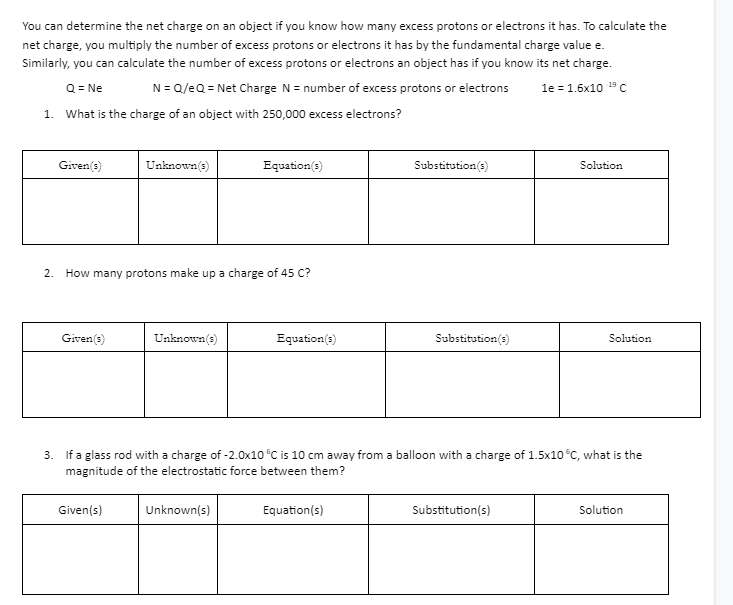
You can determine the net charge on an object if you know how many excess protons or electrons it has. To calculate the net charge, you multiply the number of excess protons or electrons it has by the fundamental charge value e. Similarly, you can calculate the number of excess protons or electrons an object has if you know its net charge. Q = Ne N = Q/eQ = Net Charge N = number of excess protons or electrons le = 1.6x10 19 C 1. What is the charge of an object with 250,000 excess electrons? Given () Unknown(3) Equation(=) Substitution(s) Solution 2. How many protons make up a charge of 45 C? Given (9) Unknown () Equation(s) Substitution(s) Solution 3. If a glass rod with a charge of -2.0x10 *C is 10 cm away from a balloon with a charge of 1.5x10 C, what is the magnitude of the electrostatic force between them? Given(s) Unknown(s) Equation(s) Substitution(s) Solution
Step by Step Solution
There are 3 Steps involved in it

Get step-by-step solutions from verified subject matter experts