New Semester
Started
Get
50% OFF
Study Help!
--h --m --s
Claim Now
Question Answers
Textbooks
Find textbooks, questions and answers
Oops, something went wrong!
Change your search query and then try again
S
Books
FREE
Study Help
Expert Questions
Accounting
General Management
Mathematics
Finance
Organizational Behaviour
Law
Physics
Operating System
Management Leadership
Sociology
Programming
Marketing
Database
Computer Network
Economics
Textbooks Solutions
Accounting
Managerial Accounting
Management Leadership
Cost Accounting
Statistics
Business Law
Corporate Finance
Finance
Economics
Auditing
Tutors
Online Tutors
Find a Tutor
Hire a Tutor
Become a Tutor
AI Tutor
AI Study Planner
NEW
Sell Books
Search
Search
Sign In
Register
study help
sciences
introduction to modern climate change
Introduction To Modern Climate Change 3rd Edition Andrew E. Dessler - Solutions
Imagine a planet with a solar constant of 1,500 W/m2 and an albedo of 0.6. Which would cause that planet’s climate to warm more, a 1 percent increase in solar constant or a 0.01 decrease in albedo?
Imagine a planet with a solar constant of 3,500 W/m2 and an albedo of 0.8. The planet has no atmosphere.(a) What is the planet’s climate sensitivity in K per W/m2?(b) If the Sun gets 10 percent dimmer, how does the temperature change?
Aerosols have a short lifetime, so once we stop emitting them, their atmospheric abundance will go to zero in a few months. This is a very important goal – aerosols are one of the primary components of air pollution, which kills millions of people around the world every year. However, these
(a) List all of the physical processes that can alter the climate.(b) For all processes in part (a) except greenhouse gases, explain why they are unlikely to be the cause of the warming over the past few decades.(c) List the evidence that greenhouse gases are responsible for the recent warming.
In this chapter, we reached three different conclusions about the attribution of recent warming to humans. The three different statements had different levels of uncertainty. What are the statements, and how certain is each one?
Why are feedbacks (e.g., increases in water vapor) not discussed as potential causes of climate change?
Explain the physical mechanism for the occurrence of ice ages. Make sure you explain the role of carbon dioxide and its timing with respect to the temperature change.
Critique this statement: “It is clear that it was warmer around 1000 AD, during the Medieval Warm Period, than it is today. Therefore, humans cannot be causing today’s warming.” Assume that the claim that the Medieval Warm Period was warmer than today is correct (it probably isn’t). Is the
What are the three ways that the Earth’s orbit varies? How does each variation affect the climate?
Explain how the Paleocene–Eocene Thermal Maximum provides support for the claim that today’s warming is caused by humans.
How does plate tectonics affect our climate?
(a) Someone asks you about how much the climate will warm over the next 100 years. How do you answer?(b) What determines whether we are at the bottom end of the range or the top end of the predicted range?
(a) Define each term in the IPAT identity.(b) What are the units of each term? Show how the units cancel so that the I term has units of emissions of greenhouse gases.
What is the single most important thing the world needs to do to address climate change? Why?
A friend argues, “We must be certain climate change is a problem before we take action.” Another friend argues, “We must take action if the slightest chance exists that climate change could be catastrophic.” How do you determine which one is right? Which one (if either) do you judge to be
Imagine that your hometown is always at risk of being destroyed by some natural disaster (tornado, hurricane, earthquake). How much would you pay each year to eliminate the chance that the disaster would occur in that year? What are some ways you could determine this value?
(a) Explain conceptually the role that discounting plays in determining climate change policy.(b) If you change the discount rate from 0 percent to 4 percent, how will this change your policy?
Juries in criminal trials are given a standard of evidence that must be crossed in order to find a defendant guilty. What is it? What would the standard be if our society decided that the worse error is to acquit a guilty person?
For climate impacts happening in 50 years, how much effort do you think we should make to eliminate those? What about impacts happening in 500 years?
How does irreversibility of the choices affect policy decisions?
Economic analyses struggle to assign a monetary value to a small chance of a truly terrible outcome. To see this, imagine that some otherwise unavoidable activity carries with it a one-in-a-thousand chance of killing you. How much money would you spend to avoid that activity? What if the risk of
Ein is the energy being absorbed by an object, and Eout is the energy being radiated.(a) If the temperature of an object is not changing, what does this tell us about Ein and Eout?(b) If the temperature of an object is increasing, what does this tell us about Ein and Eout?
The temperature of an object increases by 1 K. How much did it increase in degrees Fahrenheit and how much in degrees Celsius?
A sphere with a radius of 1m has a temperature of 100°C. How much power is it radiating?
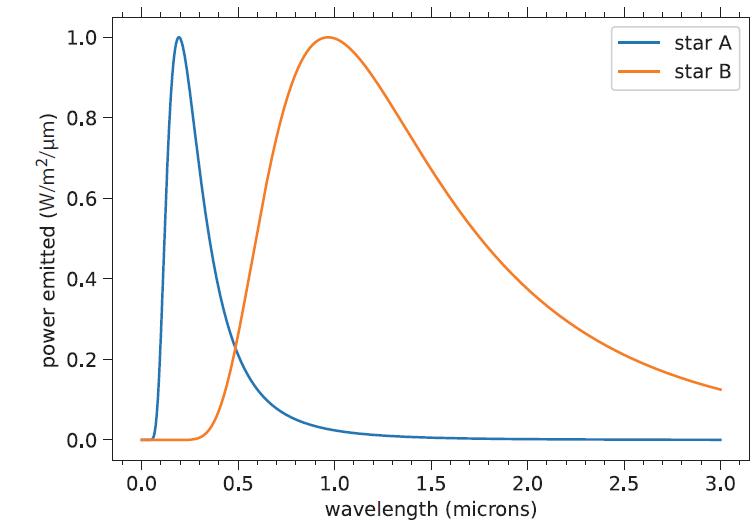
Consider two stars that have the spectra shown in Figure 3.7. Based just on the information provided in this plot, what are the colors and radiating temperatures of the stars?Figure 3.7 power emitted (W/m²/μm) 1.0 0.8 0.6 0.4 0.2 0.0 0.0 0.5 1.0 1.5 2.0 wavelength (microns) 2.5 star A star B 3.0
As a room-temperature object increases in temperature, it begins to glow. Describe the progression in colors as the object heats up. Ultimately, what happens to the glow if the warming continues to nearly infinite temperatures?
How much total energy (in watts) is the Sun radiating? It is a 6,000-K blackbody with a radius of 700,000km.
You can dim an incandescent bulb by decreasing the temperature of the filament. What do you think happens to the color of the bulb as it dims? Find a dimmer and test your hypothesis.
If you run a 60-W light bulb for one week, how many joules of energy have been consumed?
Why are incandescent light bulbs being phased out in many countries (including the United States)?
The Sun as a blackbody:(a) The Sun is a 6,000-K blackbody. At what characteristic wavelength does it radiate?(b) How much power per unit surface area is the Sun radiating?(c) Imagine that the Sun had a radius twice as large as it does at present, but the Sun emitted the same total amount of
Your bank account has the same balance on April 1 as it did on March 1. Your friend suggests that this means that you did not deposit or withdraw any money for the entire month. Is that correct? Explain why or why not.
Heat capacity is the amount of energy you need to add to an object to warm it up by 1K. The heat capacity of water is 4.18 J/g/K; in other words, if you add 4.18 J to 1 g of water, the water will warm by 1K. Imagine you have a cup containing 200 g of water that is absorbing 150W of power. Check
Microwave ovens are able to deliver more energy to food during cooking than conventional ovens, so microwave ovens can cook food faster. For the following, imagine you are cooking a turkey in a conventional oven at 325°F.(a) What would you have to do in order to increase the amount of power being
Refrigerators are essentially reverse ovens – they cool things by maintaining the walls at low temperatures. Imagine you put a turkey with a temperature of 80°C into a refrigerator with walls of 3°C.(a) How fast is the turkey losing energy? The answer should be in watts. Assume the turkey has
Determine the latitude and longitude of the White House, the Kremlin, the Pyramids of Giza, and the point on the opposite side of the Earth to where you were born. Use an online tool (e.g., Google Earth) or an atlas (which you can find in any library).
(a) Convert the following temperatures from degrees Fahrenheit to degrees Celsius: 300, 212, 70, 50, 32, and 0°F.(b) Convert the following temperatures from degrees Celsius to degrees Fahrenheit: 150, 100, 70, 50, 0, and –10°C.
(a) The temperature increases by 1°C. How much does it increase in degrees Fahrenheit?(b) The temperature increases by 1°F. How much does it increase in degrees Celsius?(c) This is true: I told a reporter that the Earth has warmed by 0.8°C over the last century. When it appeared in print, the
What temperature has a numerical value that is the same in degrees Celsius as it is in degrees Fahrenheit?
Find a two-digit temperature in degrees Fahrenheit for which, if you reverse the digits, you get that same temperature in degrees Celsius (e.g., find a temperature, such as 32°F, for which the Celsius equivalent would be 23°C; this example, of course, does not work).
Why do you believe that smoking causes cancer? (If you do not believe this, then why do you believe that smoking does not cause cancer?) What would be required to get you to adopt the opposing view?
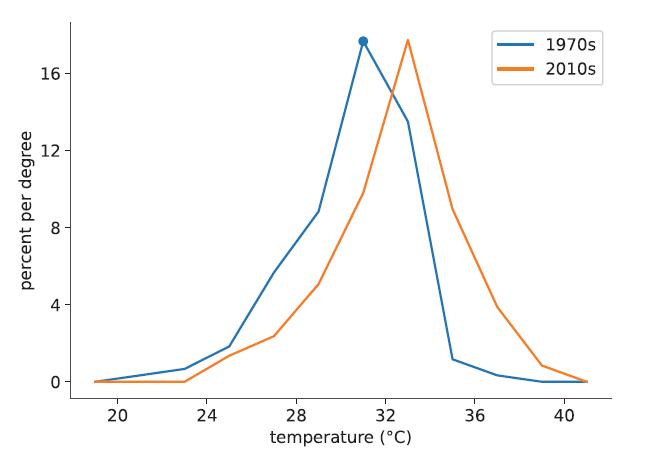
Practice reading a graph. These questions all refer to Figure 1.1.(a) What fraction of days have a daily high temperature of 28°C during the 1970s and the 2010s?(b) For the 1970s and 2010s, what is the most likely temperature? How much did it increase over this period?(c) What temperature(s)
Find two friends who have strong but opposing views of climate change.(a) Ask both of them why they believe what they do and what would be required for them to adopt the opposing view. It is important to understand where their views come from; if they argue, say, that glaciers are retreating or
Give examples of situations when weather affected your or your family’s life. Then do the same for climate.
Those opposed to the IPCC’s scientific conclusions have set up their own summary of the science of climate change, which they call the NIPCC. Do some online research and then compare and contrast the credibility of the two reports.
In the climate debate, few institutions are attacked as frequently as the IPCC. Using web searches, identify some arguments made by those arguing that the IPCC cannot be trusted.
You are the President of the United States. A novel virus has appeared, and two trusted advisors are giving you contradictory claims about how bad it is. One says it’s no worse than the flu, the other says it’s far worse. They can’t both be right. What questions would you ask them in order to
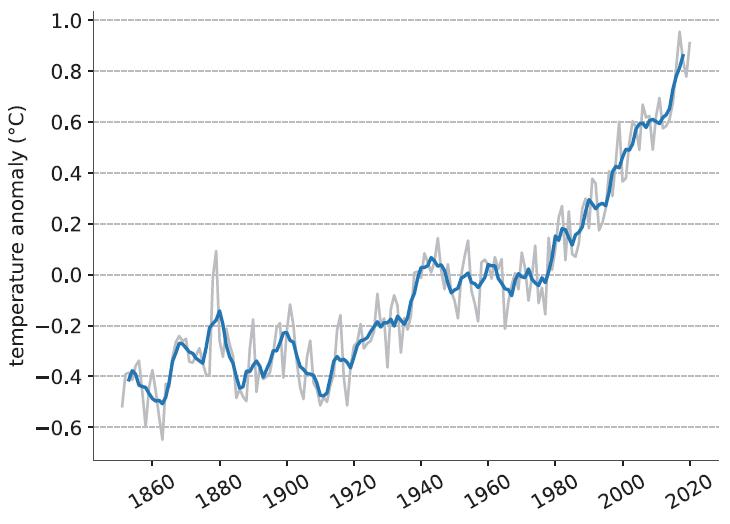
From Figure 2.2, how much did the Earth warm between(a) 1880 and 2020 and(b) 1970 and 2020? Provide answers in both degrees Celsius and degrees Fahrenheit.Figure 2.2 anomaly (°C) temperature 1.0 0.8 0.6 0.4 0.2 0.0 -0.2 -0.4 -0.6 MM 1860 1880 1900 1920 1940 1960 1980 Boun 2000 2020
Donald Trump says that the wildfires in California in 2020 were caused by forest management while Joe Biden says it’s due to climate change. Whose statement do you believe and why? Do you think your views are supported by science?
Every year, you measure the height of a child relative to a coat hook on the wall. In the first year, he was 2″ below the hook, the next year he was 1.5″ below the hook, the next year he was 0.75″ below the hook, the next year he was even with the hook, the next year he was 0.5″ above the
If you found out that the satellite data were unreliable because of a previously unknown error, would that change your opinion about whether the Earth is currently warming? Why or why not?
A reporter asks you to explain why scientists are so confident that the Earth has undergone a general warming over the past century. Knowing that reporters hate long answers, construct an answer that takes 60 seconds or less to deliver (that corresponds to less than 100 words).
Download the annual and global average temperature data from Berkeley Earth (link to data located at www.andrewdessler.com/data) and reproduce Figure 2.2. Calculate the trend for the past 30 years and for the past 100 years.Figure 2.2 anomaly
List the evidence that supports the contention that the Earth is currently warming. Is there any evidence that goes against this conclusion?
What is a temperature anomaly? Why are temperature anomalies typically used in global temperature calculations?
Download the monthly and global average temperature data from Berkeley Earth (located at www.andrewdessler.com/data). Calculate trends over various lengths of time (ranging from a few years to several decades). If you look at the period after 1970, can you find any periods with negative trends?
Go to the station page on Berkeley Earth (link to data located at www.andrewdessler .com/data) and find a station near your hometown or city you live in today that covers a century or so (they’re normally in the bigger cities). How does the final time series (the “breakpoint adjusted”
The stations that make up the surface thermometer data set must be individually adjusted to account for known issues in the data set (e.g., station moves). Some skeptics claim that the warming in the record (e.g., Figure 2.2) is due to these adjustments. We can check this. Berkeley Earth provides a
Why do we turn to paleoproxy measurements to infer the temperature of millions of years ago?
A global warming advocate tells you that the Earth is now warmer than it has ever been.Is that correct?
Showing 100 - 200
of 160
1
2
Step by Step Answers

 Get 50% OFF
Claim Now
Get 50% OFF
Claim Now