New Semester
Started
Get
50% OFF
Study Help!
--h --m --s
Claim Now
Question Answers
Textbooks
Find textbooks, questions and answers
Oops, something went wrong!
Change your search query and then try again
S
Books
FREE
Study Help
Expert Questions
Accounting
General Management
Mathematics
Finance
Organizational Behaviour
Law
Physics
Operating System
Management Leadership
Sociology
Programming
Marketing
Database
Computer Network
Economics
Textbooks Solutions
Accounting
Managerial Accounting
Management Leadership
Cost Accounting
Statistics
Business Law
Corporate Finance
Finance
Economics
Auditing
Tutors
Online Tutors
Find a Tutor
Hire a Tutor
Become a Tutor
AI Tutor
AI Study Planner
NEW
Sell Books
Search
Search
Sign In
Register
study help
sciences
modern physics
Symmetry Broken Symmetry And Topology In Modern Physics A First Course 1st Edition Mike Guidry, Yang Sun - Solutions
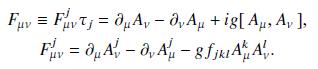
The electromagnetic field tensor \(F^{\mu v}\) given in Eq. (14.14) is Lorentz covariant since it is a rank-2 Lorentz tensor. Show that it is also invariant under the local gauge transformation given by Eq. (16.40).Data from Eq. 14.14Data from Eq. 16.40 FHV-FVH="A" - "A",
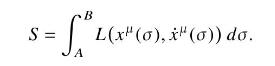
Consider spacetime paths between fixed endpoints \(A\) and \(B\). For a Lagrangian function \(L\left(x^{\mu}(\sigma), \dot{x}^{\mu}(\sigma)\right)\), where \(\sigma\) parameterizes the position on the path and \(\dot{x}^{\mu} \equiv d x^{\mu} / d \sigma\), define an integral over a pathShow that
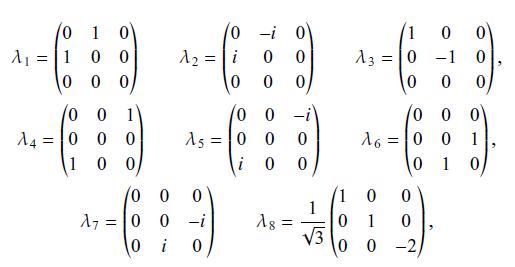
Construct the matrix generator \(A_{\mu}(x)=\tau_{i} A_{\mu}^{i}(x)\) of Eq. (16.49) for an SU(3) YangMills field assuming the representation (8.2).Data from Eq. 16.49 AH (o, A) (A,A) = = j" = (p, j) - = 00,
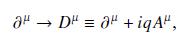
Evaluate the commutator \(\left[D_{\mu}, D_{v}\right]\), where \(D_{\mu}\) is the covariant derivative defined in Eq. (16.36). Show that for the U(1) electromagnetic field\[(i q)^{-1}\left[D_{\mu}, D_{v}\right]=\partial_{\mu} \partial_{v}-\partial_{v} \partial_{\mu}=F_{\mu v}\]where \(q\) is the
Prove that Eq. (16.52) follows from Eq. (16.51). Take \(A_{\mu}(x)=\tau_{j} A_{\mu}^{j}(x)\) and\[U(\boldsymbol{\theta}) \simeq 1-i \tau_{k} \theta^{k} \quad\left[\tau_{i}, \tau_{j}\right]=i f_{i j k} \tau_{k} \quad \operatorname{Tr}\left(\tau_{i}, \tau_{j}\right)=2 \delta_{i j}\]for the gauge
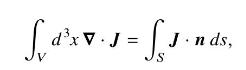
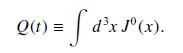
Show that if Eq. (16.24) is true, the charge \(Q\) of Eq. (16.21) is conserved.where \(\boldsymbol{n}\) is an outward normal to \(S\) and \(d s\) is a surface differential element.Data from Eq. 16.21Data from Eq. 16.24 S dx v s = S s J J.nds,
Prove that if a symmetry is broken spontaneously, at least one generator of the symmetry group gives a non-zero value when applied to the vacuum state.
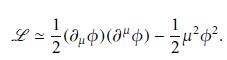
Use Eq. (17.1) to find the minima of Fig. 17.2 . Confirm Eq. (17.5) for \(\mu^{2})^{1 / 2}=\) \(\left(-2 \mu^{2}\right)^{1 / 2}\) after the symmetry is broken spontaneously.Data from Eq. 17.1Data from Eq. 17.2Data from Eq. 17.5 *** = 0,4 (x)= =
Show that the expansion (18.7) substituted into Eq. (18.1) gives a Lagrangian density for which there appear to be five degrees of freedom: one from a massive scalar \(\eta\), one from a massive scalar \(\xi\), and three from a massive photon \(A_{\mu}\). Argue that this is unphysical because the
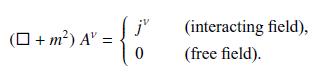
Prove that taking the 4-divergence of both sides of Eq. (18.11) leads to the constraint \(\partial_{\mu} A^{\mu}=0\), so that Eq. (18.11) reduces to Eq. (18.12).Data from Eq. 18.11Data from Eq. 18.12 (+m) A-a (AH) = jv,
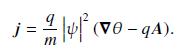
Show that the current \(\boldsymbol{j}\) in Eq. (18.17) is invariant under the gauge transformation \(\boldsymbol{A} \rightarrow \boldsymbol{A}+\boldsymbol{abla} \chi \equiv \boldsymbol{A}^{\prime}\) and \(\theta \rightarrow \theta+q \chi \equiv \theta^{\prime}\), where \(\chi=\chi(x)\) is an
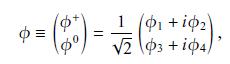
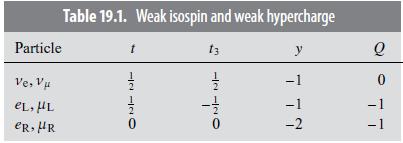
Verify the weak isospin and weak hypercharge quantum number assignments in Table 19.1 , given the charges \(Q\) in the last column. Verify the weak isospin and weak hypercharge assignments for the complex scalar doublet in Eq. (19.9).Data from Eq. 19.9Data from Table 19.1 III Q = + 1 ( + 2\03 +104)
Demonstrate that an explicit Dirac mass term in the electroweak Lagrangian of the form \(m \bar{\psi} \psi\) as in Eq. (16.10) would violate gauge symmetry. Show that a mass introduced by breaking the gauge symmetry spontaneously using Eq. (19.13) with \(\mu^{2}Data from Eq. 19.13Data from Eq.
Show that the Weinberg angle \(\theta_{\mathrm{W}}\) is related to the coupling strengths \(g\) and \(g^{\prime}\) by\[\sqrt{g^{2}+g^{\prime 2}}=\frac{g}{\cos \theta_{\mathrm{W}}}=\frac{g^{\prime}}{\sin \theta_{\mathrm{W}}}\]for the electroweak model, and that Eq. (19.23) is equivalent to Eq.
Prove that the generators \(\left(\tau_{1}, \tau_{2}, K\right)\) of Eq. (19.17) for the local \(\mathrm{SU}(2)_{\mathrm{w}} \times \mathrm{U}(1)_{y}\) standard electroweak symmetry annihilate the vacuum state but that the charge generator \(Q\) does not.Data from Eq. 19.17 K 0 91 = (1 1) 12 = ( ; 0
One possible exotic QCD hadronic structure is \(q q \bar{q} \bar{q}\). Assuming the quarks and antiquarks to transform according to the fundamental and conjugate representations of an \(\mathrm{SU}(3)\) color symmetry, respectively, find the color \(\mathrm{SU}(3)\) irreps corresponding to \(q q
Assume the basis vectors of the fundamental representation for color \(\mathrm{SU}(3)\) to correspond to the "colors" \(r, g\), and \(b\). Write the properly symmetrized wavefunction corresponding to a singlet color \(\mathrm{SU}(3)\) state. Show that if a gluon \(G\) transforms as the adjoint
Demonstrate that for colors \(r, g\), and \(b\), color \(\mathrm{SU}(3)\) two-quark states are of the form \(q q=\mathbf{3} \otimes \mathbf{3}=\mathbf{6} \oplus \overline{\mathbf{3}}\), withShow that this implies that the non-color part of any two-quark wavefunction in a baryon must be symmetric. 3
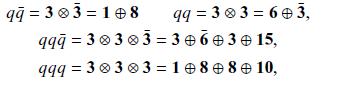
Verify the color SU(3) representations for combinations of three or fewer quarks and antiquarks given in Eq. (19.28).Data from Eq. 19.28 qq=303=108 qq 3 3 603, 999 3 3 3 = 36315, qqq 3 3 3 1088 10,
Prove that Eq. (19.34) gives the simplest multi-gluon and gluon-quark states that contain an \(\mathrm{SU}(3)\) color singlet in the decomposition.Data from Eq. 19.34 (GG)1: (88)1 (Gqq) : [8 (383)8] (GGG)1 (888)1 (Gqqq) : [8 (3383)8],
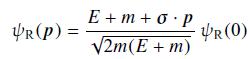
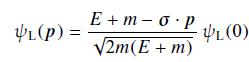
Prove that the boosted right-handed spinor \(\psi_{\mathrm{R}}(\boldsymbol{p})\) is related to the corresponding rest spinor by Eq. (14.21).
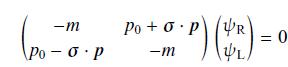
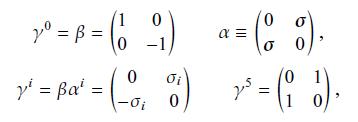
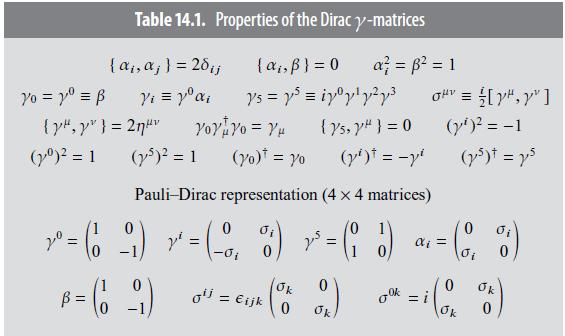
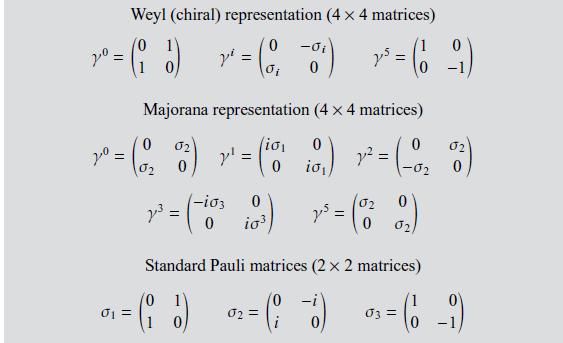
Use the \(\gamma\)-matrices in the Weyl representation to show that the Dirac equation (14.31) is equivalent to Eq. (14.25).Data from Eq. 14.31Data from Eq. 14.25 (y"Pu-m)(p) = (iy" - m)(p) = 0
Prove the identity \((\sigma \cdot \boldsymbol{p})^{2}=\mathrm{I}^{(2)} p^{2}\), where \(\sigma=\left(\sigma_{1}, \sigma_{2}, \sigma_{3}\right)\) are the Pauli matrices, \(\boldsymbol{p}\) is the 3-momentum, \(\boldsymbol{p}=|\boldsymbol{p}|\), and \(\mathrm{I}^{(2)}\) is the unit \(2 \times 2\)
Show that the relations (14.23) follow from Eqs. (14.21) and (14.22).Data from Eq. 14.21Data from Eq. 14.22Data from Eq. 14.23 VR (P) = E+m+o.p VR (0) 2m(E+m)
Verify that the Pauli-Dirac representation (14.43) satisfies Eq. (14.27).Data from Eq. 14.27Data from Eq. 14.43 {,} = + = 2
Verify the projection characteristics implied by equations (14.51).Data from Eq.14.51 2 In = (s + I) Da 1- 24(1-y's) = UR
Verify the results of Eq. (14.48) for the properties of the chiral projection operators.Data from Eq. 14.48 P = P+ P+ + P = 1 P_P+ P+P = 0 Py" = y P
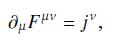
Starting from Eq. (14.17), show that the equation for the 4-vector potential \(A^{\mu}\) takes the covariant form \(\square A^{\mu}=j^{\mu}\) of Eq. (14.13) in Lorenz gauge.Data from Eq. 14.13Data from Eq. 14.17 = j = 0,
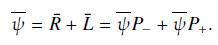
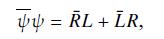
Beginning with Eq. (14.50), prove Eq. (14.52), and derive the chiral decompositions given for \(\bar{\psi} \psi, \bar{\psi} \gamma^{\mu} \psi\), and \(\bar{\psi} \gamma^{\mu} \gamma^{5} \psi\) interactions in Eqs. (14.53) and (14.54).Data from Eq. 14.50Data from Eq. 14.52Data from Eq. 14.53Data
Using the Dirac Hamiltonian \(H=-i \gamma_{0} \gamma^{i} p_{i}+\gamma_{0} m\) given in (14.45), show that the chirality operator \(\gamma_{5}\) commutes with this Hamiltonian only if the mass \(m \rightarrow 0\).Data from Eq. 14.45 H= (a p+m) = -ia' p; + m = -iyoy'Pi + yom.
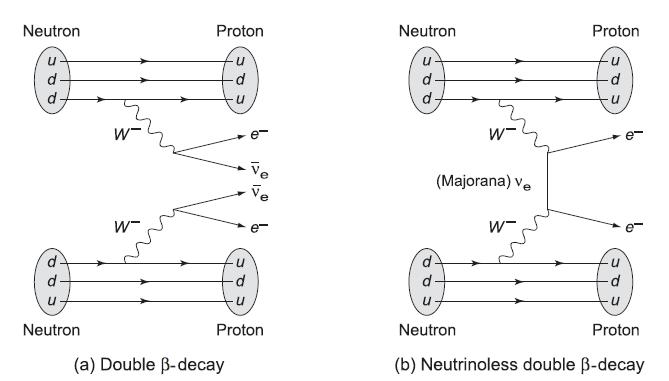
Show that in Fig. 14.2 , normal double \(\beta\)-decay conserves lepton number but neutrinoless double \(\beta\)-decay does not. Define a lepton number by \(L \equiv n_{\ell}-n_{\bar{\ell}}\), where \(n_{\ell}\) is the total number of leptons and \(n_{\bar{\ell}}\) is the total number of
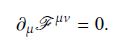
Show that a gauge transformation of the 4-vector potential \(A^{\mu}\) leaves the Maxwell field tensor \(F^{\mu v}\) invariant.
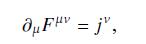
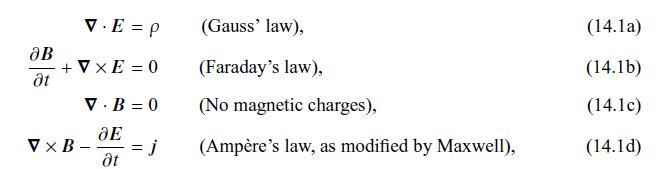
Show that the Maxwell equations written in the manifestly covariant form (14.17) and (14.18) are equivalent to the standard form given by Eqs. (14.1a)-(14.1d).Data from 14.17Data from 14.18Data from Eqs. (14.1a)-(14.1d) FH 8FV = j",
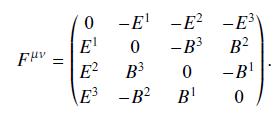
Prove that Eq. (14.3) implies the Maxwell field tensor of Eqs. (14.14) and (14.15).Data from Eq. (14.3)Data from Eq. (14.14)Data from Eq. (14.15) B = V XA E = -VO- at
It is common to use the normalization \(u^{(\alpha) \dagger}(\boldsymbol{p}) u^{(\beta)}(\boldsymbol{p})=(E / m) \delta_{\alpha \beta}\) for a massive free Dirac spinor \(u^{(\alpha)}\), where \(E\) is energy, \(m\) is restmass, and \(\alpha\) and \(\beta\) are spinor indices. Show that this spinor
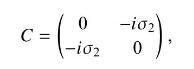
In the Pauli-Dirac representation of Table 14.1, a suitable charge conjugation operator is \(C=i \gamma^{2} \gamma^{0}\). Show that \(C\) is given explicitly by the matrixin this representation. Verify by matrix multiplication the matrices for \(\gamma^{5}\) shown in Table 14.1 for the Pauli-Dirac
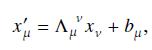
By applying two successive Poincaré transformations (15.1), show that the Poincaré multiplication rule is given by Eq. (15.2). Data from 15.1Data from 15.2 "q+^x "V= "H =
Prove that the infinitesimal rank-2 tensor \(\epsilon_{\mu u}\) introduced in Eq. (15.7) is antisymmetric in its indices, \(\epsilon_{\mu v}=-\epsilon_{v \mu}\), by requiring that Eq. (15.7) be consistent with Eq. (13.24) to first order in \(\epsilon_{\mu u}\).Data from Eq. 15.7Data from Eq. 13.24
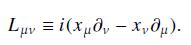
Prove the result in Eq. (15.9) that the \(L_{\mu v}\) defined in Eq. (15.8) are generators of proper Lorentz transformations. Utilize \(\partial^{\alpha} x_{ho}=\eta_{ho}^{\alpha}=\delta_{ho}^{\alpha}\) and the antisymmetry of \(\epsilon_{\mu v}\) under exchange of indices. Data from Eq. 15.8Data
Prove the result in Eq. (15.13) that the \(P_{\mu}\) defined in Eq. (15.12) are generators of translations. Remember that \(\partial^{\alpha} x_{ho}=\eta_{ho}^{\alpha}=\delta_{ho}^{\alpha}\).Data from Eq. 15.12Data from Eq. 15.13 Pu = i- = i(8%, 81,02,3) P = id=i(0,-8',-82,-8),
Verify \(\left[P^{2}, P_{\mu}\right]=0\) [Eq. (15.16)] and \(\left[P_{\mu}, L_{ho \sigma}\right]=i\left(\eta_{\mu ho} P_{\sigma}-\eta_{\mu \sigma} P_{ho}\right)\) [Eq. (15.14)].Data from Eq 15.14Data from Eq 15.16 [P, P] = 0 [Pus Lpa]=i(nup Po - oPp), - [Luv, Lpo ]=i(nupLvo us Lop + nvolup -
Use Eq. (15.10) to prove that \(J_{1}=L_{23}, J_{2}=L_{31}\), and \(J_{3}=L_{12}\).Data from Eq. 15.10 1 Ji J = - Eijk Ljk K = Loi,
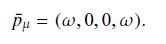
Prove Eq. (15.28) for lightlike particles. Use Eq. (15.26) for the standard vector and take note of the Minkowski metric, so \(p_{\mu}=\eta_{\mu u} p^{v}\) and \(L^{\mu u}=\eta^{\mu \lambda} L_{\lambda \sigma} \eta^{\sigma v}\). You also will need Eq. (15.27) and results of Problem 15.8 .Data from
Prove Eq. (15.30) for massless Poincaré particles.Data from Eq. 15.30 W2 == W = WW=-w (P + P).
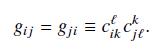
\(\mathrm{SO}(2,1)\) is the analog in two spatial dimensions of the Lorentz group \(\mathrm{SO}(3,1)\). Its generators \(\left(X_{1}, X_{2}, X_{3}\right)\) obey the Lie algebra \(\left[X_{i}, X_{j}\right]=\) \(c_{i j}^{k} X_{k}\) withUse the metric tensor computed from Eq. (7.19) to show that
Show that the Lorentz group commutation relations (13.20) are satisfied by the choices \(K_{i}= \pm \frac{i}{2} \sigma_{i}\) and \(J_{i}=\frac{1}{2} \sigma_{i}\), where the \(\sigma_{i}\) are Pauli matrices.Data from 13.20 [Ji, Jj] = iijk Jk [Ji, Kj] = iijk Kk [Ki, K; ]=-iijk Jk,
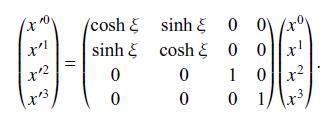
Verify that the Lorentz transformation (13.16) leaves invariant the squared Minkowski line element (13.5).Data from 13.5Data from 13.16 T = F iF U = F6 iF7 V = F4 iF5.
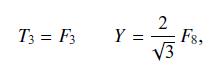
Find the relationship of the eight SU(3) operators \(T_{ \pm}, V_{ \pm}, U_{ \pm}, T_{3}\), and \(Y\) defined in Eqs. (8.2) and (8.7)-(8.8), and the nine oscillator operators \(\left(A_{i}^{j}\right)_{k l} \equiv \delta_{i k} \delta_{j l}-\frac{1}{3} \delta_{k l}\), with a constraint
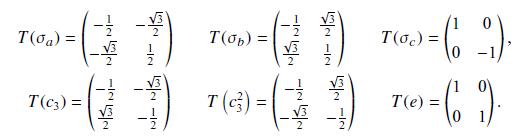
Verify that the set of matrices (5.14) is closed under ordinary matrix multiplication.Data from Eq. 5.14 T(oc)= = 629 > - (+19) TOO) = (721) TO) = ( ). T(oa)= T(b) TO) -(11) T(4-(11) TO=(9) T(C3)= =
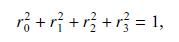
(a) Show that the most general \(2 \times 2\) unitary matrix with unit determinant can be parameterized as in Eqs. (6.76) and (6.77). (b) Take the group identity element \(U(1,0,0,0)\) to correspond to \(r_{1}=r_{2}=r_{3}=0\) and expand around the identity to show that \(U \simeq 1-i d r_{i}
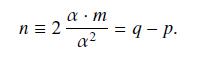
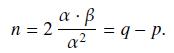
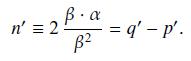
Use Eqs. (7.27)-(7.31) to verify the entries in Table 7.1.Data from Eq. 7.27Data from Eq. 7.28Data from Eq. 7.29Data from Eq. 7.30Data from Eq. 7.31Data from Table 7.1 n = 2 a.m = q- p.
Use the definition of the adjoint representation matrices (3.8), to compute the action of a generator \(X_{a}\) on a state \(\left|X_{b}\rightangle\) given in Eq. (7.3).Data from Eq. 3.8Data from Eq. 7.3 = (Ta)be (Xb Ta |Xc) = -ifabes
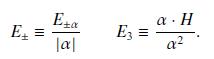
Show that the operators given in Eq. (7.20) have the SU(2) commutators (7.21).Data from Eq. (7.20)Data from Eq. (7.21) Eta a. H E = E3 E = |a| a
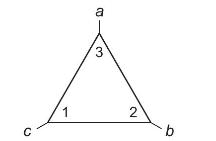
The group \(\mathrm{D}_{3}\) in Schoenflies notation (32 in international notation, which is read "three-two"; see Table 5.1 ) consists of the proper (those not reflections or inversions) covering operations on an equilateral triangle. Label the vertices of a triangle asand show that there are six
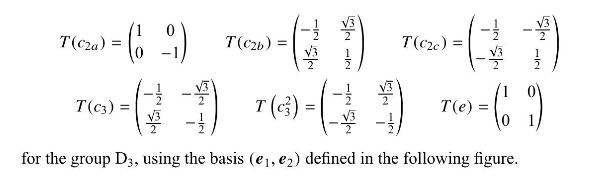
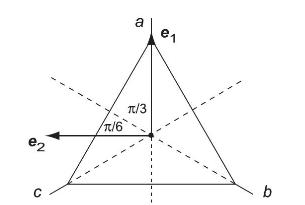
Derive the two-dimensional matrix representation Tic)=(2) Tin)=(3) Tex)=(37) (69) T(c2b)= 1 TO)-(71) 10-(11) TO=(9) = for the group D3, using the basis (e1, e2) defined in the following figure.
Prove that the matrix representation of \(\mathrm{D}_{3}\) worked out in Problem 5.6 is irreducible.Data from Problem 5.6Derive the two-dimensional matrix representation Tic)=(2) Tin)=(3) Tex)=(37) (69) T(c2b)= 1 TO)-(71) 10-(11) TO=(9) = for the group D3, using the basis (e1, e2) defined in the
Show that the group \(D_{3}\) has two 1D irreps in addition to the 2D irrep found in Problem 5.6 , and construct the character table.Derive the two-dimensional matrix representationData from Problem 5.6Derive the two-dimensional matrix representation Tic)=(2) Tin)=(3) Tex)=(37) (69) T(c2b)= 1
The matrix representation of \(\mathrm{C}_{3 \mathrm{v}}\) given in Eq. (5.14) was constructed with respect to the particular coordinate system defined by the unit vectors \(\boldsymbol{e}_{1}\) and \(\boldsymbol{e}_{2}\) in Fig. 5.10 . Show that a corresponding matrix representation for basis
Show that the groups \(C_{3 v}\) and \(D_{3}\) have equivalent characters, but the basis functions corresponding to their irreps are different.
Prove that the action of the symmetry operations \(\sigma_{b}\) and \(\sigma_{c}\) on the basis vectors \(\boldsymbol{e}_{1}\) and \(\boldsymbol{e}_{2}\) in Fig. 5.10 are given by the matrix equations (5.11) and (5.12).
If cyclic boundary conditions are imposed on a periodic 1D lattice by identifying the two ends with \(N\) cycles between the boundaries, the translation group becomes a cyclic group of order \(N\). Show that the irreps of this group are of the form\[\Gamma^{(p)}(C)=e^{2 \pi i p / N}(p=1,2,3,
As shown in Problem 5.14 , the symmetry group for a finite 1D periodic lattice having cyclic boundary conditions with \(N\) periods between boundaries is the cyclic group of order \(N\), with irreps of the form\[\Gamma^{(p)}=e^{2 \pi i p / N}(p=1,2,3, \ldots, N) .\]Show that if the total length of
Show that an arbitrary \(2 \times 2\) matrix with real entries that is orthogonal and has unit determinant can always be parameterized as in Eq. (6.3). Thus any \(\mathrm{SO}(2)\) matrix can be interpreted as a rotation in some plane.
Use Eq. (6.20) to show that Eq. (6.21) defines the SO(2) integration measure.
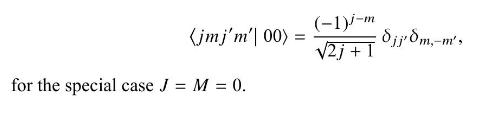
Show that the \(\mathrm{SO}(3)\) Clebsch-Gordan coefficients \(\left\langle j_{1} m_{1} j_{2} m_{2} \mid J M\right\rangle\) evaluate to (-1)j-m jmj'm'| 00): = 2j+1 djj' dm,-m'> for the special case J = M = 0.
Use the method of Section 6.3 .9 with stepping operators to find the Clebsch-Gordan coefficients for coupling \(j=1\) and \(j^{\prime}=\frac{1}{2}\) to good total angular momentum \(J\).
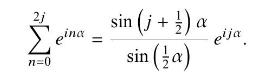
Prove Eqs. (6.42) and (6.43), thus showing that the dimension of the \(\mathrm{SO}(3)\) irrep labeled by \(j\) is the character \(2 j+1\) of the identity. Rearrange the sum and useThen take the limit \(\alpha \rightarrow 0\) to define the identity element. 2j eina n=0 sin (j+) a sin (a) eija
Derive Eqs. (6.55) and (6.57) for the commutators of tensor operators, beginning from the tensor transformation law given in Eq. (6.52).
(a) Prove that the position coordinate \(r\) transforms as a vector under 3D rotations; that is, show that it is an \(\mathrm{SO}(3)\) tensor of rank one. Hint: Begin by noting that the orbital angular momentum may be written in the form \(L_{a}=\epsilon_{a b c} r_{b} p_{c}\), where \(\epsilon_{a b
Derive the forms for the spherical tensor components given in Eq. (6.68).
Prove the spherical harmonic addition theorem(where \(\theta_{12} \equiv \theta_{1}-\theta_{2}\) ), by coupling two spherical harmonics to an \(\operatorname{SO}(3)\) scalar and invoking the invariance of that scalar under rotations. 21+1 (-1) (0,01)-(02, 2) = P(cos 012) m
Use tensor methods to evaluate the reduced matrix element of the spherical harmonic \(Y_{L M}(\theta, \phi)\) between states of good angular momentum \(|J Mangle .
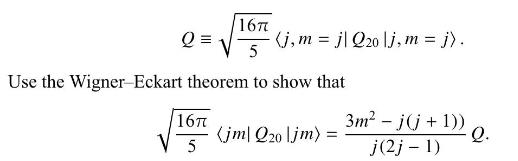
Define a quadrupole operator \(Q_{20}=r^{2} Y_{20}(\theta, \phi)\). The quadrupole moment \(Q\) for a state of good angular momentum \(|j mangle\) is conventionally defined as the expectation value of this operator in the substate \(|j, m=jangle\), multiplied by a factor \(\sqrt{16 \pi / 5}\), 16 Q
Prove that the operator \(a_{j m}^{\dagger}\) that acts on the vacuum as \(a_{j m}^{\dagger}|0angle=|j mangle\) to create a fermion with angular momentum \(j\) and magnetic quantum number \(m\) transforms as a spherical tensor of rank \(j\). The second-quantized form of the angular momentum
Demonstrate the relationship between the groups \(\mathrm{SO}(3)\) and \(\mathrm{SU}(2)\) as follows.(a) Associate each 3D euclidean coordinate \(\boldsymbol{x}=\left(x_{1}, x_{2}, x_{3}\right)\) with a \(2 \times 2\), traceless, hermitian matrix \(X\) through the map \(X=\sigma_{i} x_{i}\), where
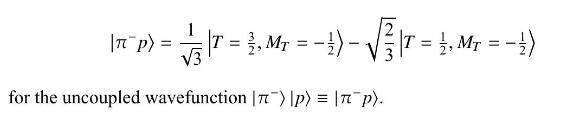
Consider collisions of pions with nucleons. View the pions as a \(T=1\) isospin triplet \(\pi=\left(\pi^{+}, \pi^{0}, \pi^{-}\right)\), and the nucleon as a \(T=\frac{1}{2}\) isospin doublet, \(N=(p, n)\). The combined system may be coupled to a total isospin \(T=\frac{3}{2}\) or \(\frac{1}{2}\).
Derive the Clebsch-Gordan coefficients for the \(\mathrm{SU}(2)\) direct product \(\mathbf{2} \otimes \mathbf{2}\).
The 2D rotation matrix \(R(\phi)\) defined in Eq. (6.3) is a reducible representation of \(\mathrm{SO}(2)\). Diagonalize \(R(\phi)\) to give the eigenvalues \(\lambda_{ \pm}=e^{ \pm i \phi}\) and Eq. (6.11). Show that the basis vectors in the new basis after diagonalization are given by Eq. (6.12).
Construct the rotation matrix \(d_{m m^{\prime}}^{l}\) for \(l=1\). Check your results against the entries in Table C. 1 of Appendix C. Hint: You can save time by considering the product \(d^{1 / 2} \otimes d^{1 / 2}\) and using the expression for \(d^{1 / 2}\) already constructed in Eq. (6.33).
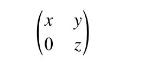
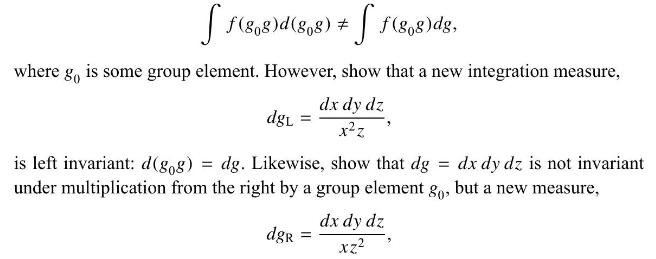
Show that if \(x\) and \(z\) are positive real numbers and \(y\) is an arbitrary real number, the matricesform a group under matrix multiplication but the naive group integration measure \(d g=d x d y d z\) is not invariant under left multiplication of the group elements; that is, if \(f(g)\) is a
Starting from Eq. (6.27) and similar expressions for rotations around the \(x\) and \(y\) axes, show that the generators of 3D rotations are given by Eq. (6.28). Hint: Assume group elements to be parameterized as in Eq. (3.2) with generators \(J_{a}=X_{a}\), expand expressions like Eq. (6.27) in a
Use \(\mathrm{SO}(3)\) group characters to show that in Eq. (6.44) the coefficients \(c_{J}\) are all zero or one [so \(\mathrm{SO}(3)\) is simply reducible], which leads to the \(\mathrm{SO}(3)\) Clebsch-Gordan series (6.45). Use the results of Section 6.3 .4, and that the \(\mathrm{SO}(3)\)
Find the simple roots for the rank-2 Lie algebras \(\mathrm{G}_{2}\) and \(\mathrm{SO}(5)\).
Show that the angular momentum Lie algebra \(\left[J_{i}, J_{j}\right]=i \epsilon_{i j k} J_{k}\) can be put in the form\[\left[X_{1}, X_{2}\right]=X_{3} \quad\left[X_{2}, X_{3}\right]=X_{1} \quad\left[X_{3}, X_{1}\right]=X_{2},\]by substituting \(J_{i} \rightarrow i X_{i}\), which is the form
Beginning from the Dynkin diagram for the \(\mathrm{SU}(3)\) algebra, construct the complete root diagram.
For the group \(\mathrm{SO}(3)\), find the metric tensor (7.19) and show that \(\mathrm{SO}(3)\) is compact and semisimple. Use the metric tensor to construct the Casimir operator. Hint: The SO(3) algebra has been put in the form (7.18) in Problem 7.4 .
Prove the result of Eq. (7.13) that the \(E_{ \pm \alpha}\) act as raising and lowering operators within the weight space.
Use the Dynkin diagramto construct the simple roots, and from those all roots, for the algebra \(\mathrm{G}_{2} .
From Problem 7.11 , suitably normalized simple roots for the algebra \(\mathrm{G}_{2}\) are \(\alpha_{1}=\) \((0, \sqrt{3})\) and \(\alpha_{2}=\left(\frac{1}{2},-\frac{\sqrt{3}}{2}\right)\). What is the corresponding Cartan matrix?
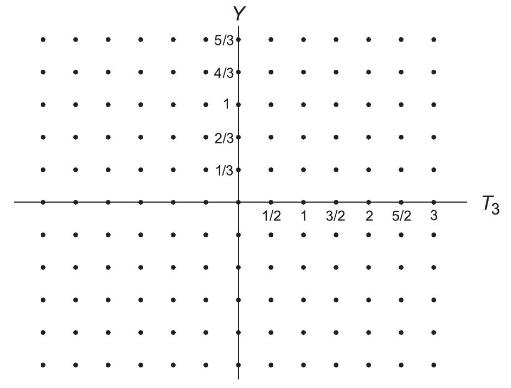
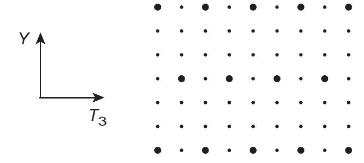
Use the \(\mathrm{SU}(3)\) algebra to prove that \(T_{ \pm}, V_{ \pm}\), and \(U_{ \pm}\)have the raising and lowering properties in the \(\left(T_{3}, Y\right)\) plane that we have ascribed to them. Prove that the allowed values of \(Y\) and \(T_{3}\) are indicated by the dots shown in the
Prove that for \(\mathrm{SU}(2)\) symmetry \(\mathbf{2} \otimes \mathbf{2} \otimes \mathbf{2}=\mathbf{4} \oplus \mathbf{2} \oplus \mathbf{2}\), while for \(\mathrm{SU}(3)\) symmetryWhat is the irrep content of \(\mathbf{8} \otimes \mathbf{8} \otimes \mathbf{8}\) in \(\mathrm{SU}(3)\) ? = 33 3 10 8
Determine the \(\mathrm{SU}(3)\) irreps appearing in the direct product \((2,1) \otimes(3,0)\). Label them by their \((\lambda, \mu)\) quantum numbers and dimensionality.
Use the method of Young diagrams to find the irrep content of \(\mathbf{6} \otimes \mathbf{1 0}\) for \(\mathrm{SU}(3)\).
Show that the \(\mathrm{SU}(3)\) quadratic Casimir operator (8.9) can be written aswhere the integers \(p\) and \(q\) labeling representations are defined in Section 8.3 .2. (F) = (p + pq + q ) + p + q
A representation is said to be complex if it is equivalent to its complex conjugate representation. Show that the \(\mathbf{2}\) and \(\overline{\mathbf{2}}\) representations are equivalent for \(\mathrm{SU}(2)\) but \(\mathbf{3} eq \overline{\mathbf{3}}\) for SU(3). Look at the weight space.
Use the graphical method described in Section 8.11 to find the direct product \(\mathbf{3} \otimes \overline{\mathbf{3}}\) for \(\mathrm{SU}(3)\).
Use the fundamental quark triplet and Young diagrams to construct the quark content of the \(\Delta\) decuplet illustrated in Fig. 9.4 .
Use the Young diagram method to deduce the SU(2) isospin content of the SU(3) flavor representations \(\mathbf{6}\) and \(\mathbf{2 7}\).
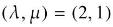
Use Young diagrams to deduce the \(\mathrm{SU}(2)\) isospin irrep content of the flavor \(\mathrm{SU}(3)\) irrep . (A, ) = (2,1)
Use Young diagrams to find the \(\mathrm{SU}(2)\) isospin content of the flavor \(\mathrm{SU}(3)\) irreducible representation \((1,2)\).
Showing 100 - 200
of 267
1
2
3
Step by Step Answers

 Get 50% OFF
Claim Now
Get 50% OFF
Claim Now